The New Voice of Women in Academia
Ana-Maria Cononovici, 20.10.2026, 13:18
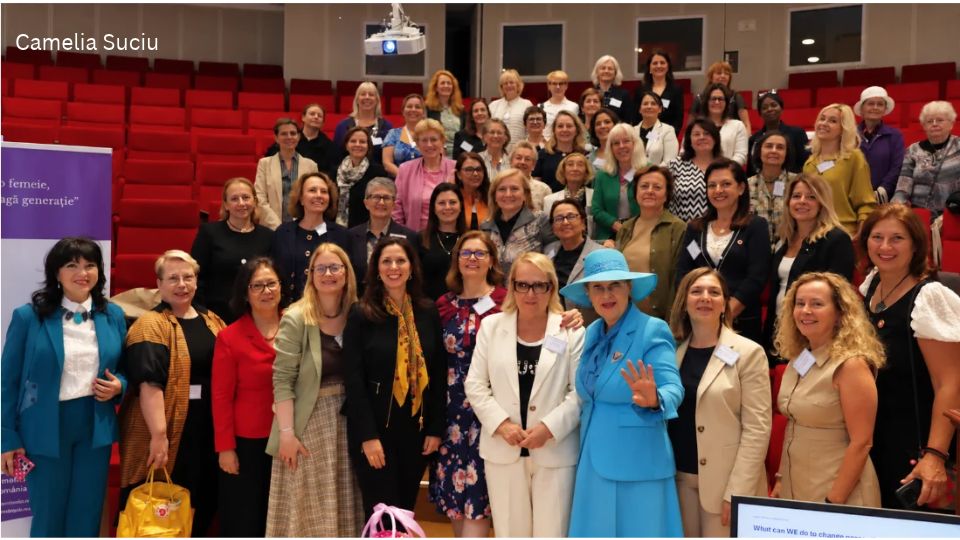
In early October, the Romanian University Women Association (AFU Romania) hosted the 2026 University Women of Europe (UWE) Conference in Bucharest, a European event focusing on women’s leadership, education, collaboration, and the role of women in building a more equitable and inclusive society. Roxana Elena Petrescu, the president of AFU Romania, highlighted the importance of the event.
Roxana Elena Petrescu: “A European event devoted to women’s leadership, education, collaboration, and the role of women in building a more equitable and inclusive society. The conference brought together representatives of University Women of Europe (UWE), as well as leaders, experts, and professionals from Romania and other European countries. The chosen theme focused on the transformations shaping contemporary leadership and the need to move beyond traditional models in favor of leadership styles based on collaboration, inclusion, diversity, responsibility, and adaptability to societal changes. The event was particularly important as it marked the 45th anniversary of University Women of Europe, an organisation with which we are affiliated and which is part of the parent organisation, Graduate Women International, founded after World War I. It has a history built on education, solidarity, European cooperation, and support for women’s engagement in society. A highlight of the program was the presentation of the 2026 UWE Award to Ms. Dina Loghin, head of the European Women’s Lobby and founder of the Romanian Women’s Lobby, in recognition of her contributions to promoting women’s rights, gender equality, and women’s leadership, both in Romania and at European level.”
The conference brought together experts in entrepreneurship, human rights, gender equality, civil society, democratic governance, and international cooperation. The speakers offered diverse perspectives on the challenges and opportunities facing women who take on leadership roles and shape the future.
Dina Loghin, the head of the European Women’s Lobby and this year’s award recipient, voiced confidence in the power of women’s voices: “I believe this is proof of recognition of our work, the work of all of us who uphold women’s rights and interests. We are often marginalised, and lately there has been a movement against human rights in general and women’s rights in particular: budgets are being cut for organisations that defend women’s rights or work on labour and health rights. It is important to see that we are being heard and that our work is appreciated. After all, we all need encouragement. We will not give up, we move forward!”
As for young women today, Dina Loghin said: “They grew up differently, looking at laptops and mobile phones rather than reading books, as we did, sometimes with compulsory reading lists. They did not seek refuge in art, literature, theatre or music during their childhood and youth. They grew up in very different times and are much more focused on having than on being. I am optimistic because there are examples of genuine leadership: women who truly practice what they preach. There is a group of young people who want real democracy, and if they want real democracy, they will also address women’s rights as human rights.”
Aurora Martin, an AFU member with extensive experience in institutions dedicated to tackling discrimination and promoting equal opportunities, spoke during the panel on women’s leadership: “I would like every girl listening to us today to know that she matters. That she, too, can lead, that her ideas can change a decision and that her ambitions deserve to be taken seriously. Leadership means seeing who is missing, who is not being heard and whose path you can help open up to new opportunities. Solidarity between women is demonstrated when we support another woman’s work, put her forward for a position of responsibility and stand by her when she speaks. But what happens after a woman finds the courage to speak out? Who listens to her, and what changes? When we tell her, ‘Be brave, speak up’, we must also ask ourselves who will protect her and who will take action on her behalf. Through my work at the National Council for Combating Discrimination and the National Agency for Equal Opportunities, and through my research into harassment in the workplace and at universities, I have come to understand just how much this response matters. Because, yes, a woman’s courage needs institutions that will not leave her to face things alone. For me, this is what leadership means: using the authority you have earned to make room for others, too. And I would like today’s girls to inherit everything we have built before them, but not the silence we had to overcome.”
The first UWE conference in Bucharest had taken place in 2014. This earlier event inspired the organisers to celebrate 45 years of UWE in Bucharest, confident that beyond the official proceedings, what endures is the people, the ideas shared, the new connections and the friendships. (AMP/EE)