Fine Artist Miliţa Petraşcu and adaptation to communism
The most outstanding Romanian woman sculptor of the 20th century, and also a prominent painter, Miliţa Petrascu was born in 1892 in Chishinau (on the territory of today's Republic of Moldova).
România Internațional, 25.11.2017, 13:56
The most outstanding Romanian woman sculptor of the
20th century, and also a prominent painter, Miliţa Petrascu was born
in 1892 in Chishinau (on the territory of today’s Republic of Moldova).
Attracted to fine arts since early childhood, Milita Petrascu later studied in
Tsarist Russia and shortly after WWI she left for Paris, where she furthered
her studies under the guidance of Constantin Brancusi.
Her professional route
will take her close to the European avant-garde, although she truly embraced
those movements only when she settled in Bucharest, in 1925. Here, she joined
the group affiliated to Contimporanul magazine, which, just like most
avant-garde movements, promoted left-leaning political ideas. In Milita
Petrascu’s case, these ideas became apparent as early as 1925, when Ana Pauker,
the future foreign minister of the country in the first three years after the
instatement of communism, was photographed in the artist’s studio.
So in 1948,
when the communists seized power in Romania, Milita Petrascu should have been a
privileged artist in the circles of the new political power. But reality was
different. Her career after the war had many ups and downs, as she was either flooded
with honours and orders, or criticised by the communist party for the slips in
her aesthetic doctrine.
Historian Cristian Vasile tells us more about the
cultural and political context in which Milita Petrascu continued her career
after the war: The official rhetoric after
1948, reinforced by the newly set up Fine Artists Union, insisted on the idea
that there no longer were such things as a system that exploited artists or a
distorted arts market controlled by oppressive financiers. On the contrary,
there was a socialist state in place, which fostered and guaranteed gender
equality, which made rational investment in art, which made no discrimination
in terms of orders and the purchase of art objects. There was a period of
adjustment with the system, and this period started with prestigious painters
and sculptors from the old generations of artists being lured into accepting the
new artistic and ideological order. This involved, among other things, public
honors, orders, housing and material benefits.
One of these artists was, in a first stage, Milita
Petrascu, an artist already established and well promoted in the inter-war
years. But paradoxically enough, as early as the 1950s her career was shadowed
by her close ties with Ana Pauker, a communist leader ousted by her own party
fellows, in the good Stalinist tradition. This was not the only stain in Milita
Petrascu’s file, as Cristian Vasile tells us: There have been some controversial
works by Milita Petrascu, which hardly brought her professional glory. An
interesting fact, for instance, is that the monographs on Milita Petrascu’s
works published during those times did not include the half-nude bust of
actress Elvira Godeanu, which fuelled the rumours regarding the actress’s
affair with the communist leader Gheorghe Gheorghiu-Dej. Another cause of
Petrascu’s fall from grace was also, apparently, a portrait of the collector
Constantin Doncea. Doncea had become some sort of Nemesis, the arch-enemy of
the then head of state Gheorghe Gheorghiu-Dej. Why was that? Because Doncea,
just like Gheorghiu Dej, was also very attached to the Grivita railway works
and the 1933 riots of the Grivita workers, which was an iconic moment for Dej,
for his rise as a leader of the proletariat. In 1958, the Institute of the
Romanian Communist Party History invited inter-war communist party members to
record testimonials related to the 1933 Grivita strike. Doncea also made a
statement, but in June 1958 Gheorghiu-Dej launched a crackdown on him and other
communist leaders who, he thought, had defied him. Milita Petrascu, who had
painted Doncea’s portrait, was caught in the middle of this political row. In
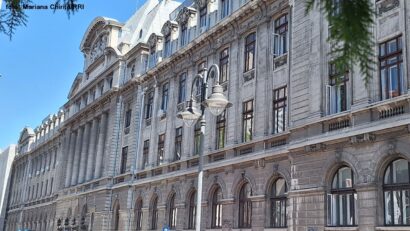
April 1959 she was the target of a showdown at the Aula Magna of the Bucharest Law
School, where workers and secret police agents had been brought in to expose
the artists who departed from the party line. But even after the 1959 incident,
in the following decades Milita Petrascu would nevertheless retain her nonconformist
spirit, to the point of defining herself as a materialist person, imbued with
mysticism.
Miliţa Petraşcu died in 1976. Her best-known work remains the mosaic on
the Miorita Fountain, placed at the northern exit of Bucharest, and created in
the mid-1930s.