Gherla, a Baroque town in central Romania
Located in central Romania, some 50 km from the city of Cluj-Napoca, Gherla is considered the first modern town in Transylvania.
Christine Leșcu, 04.03.2017, 17:50
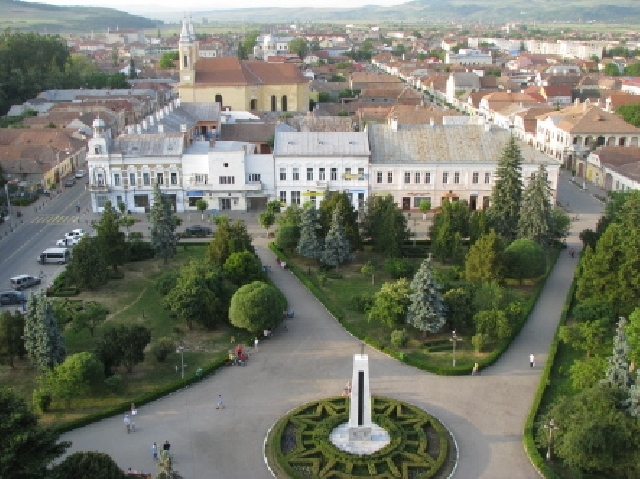
Located in central Romania, some 50 km from the city of Cluj-Napoca, Gherla is considered the first modern town in Transylvania. But its uniqueness resides not only in its modernity. The modern town of Gherla was conceived in the Baroque style, and its urban history is linked with the Armenian community in Transylvania. In fact, for over two centuries, Gherla was better known as Armenopolis, the town of the Armenian. Armenians came to this town, documented as early as the ancient times, in early 17th century, coming in particular from Moldavia, where they had developed rich trade and crafts communities.
Lucian Nastasa-Kovacs, the Director of the Cluj Napoca Art Museum, told us more about the beginnings of that migration: “The then Prince of Transylvania, Apafi, was very much interested in attracting to Transylvania what would be active economic factors. And those factors were the Armenians. In a first stage, in late 17th century, they settled in Bistrita. But Bistrita was a predominantly Saxon city, where people dealt in small crafts and petty trade. That is why in 1712, when the plague struck, it was used as a pretext to drive Armenians away from the place. Those were the Armenians who subsequently settled in Gherla, a town that in fact belonged to the Armenian community as proven by deeds issued by the imperial court in Vienna. Ever since they settled in there, the town started developing in keeping with the urban principles that were very much in fashion in the 17th century. It was divided in plots and surrounded by walls, access being secured by gates.”
It didn’t take long for the Armenian community to become even stronger in Gherla, acquiring a special status and without being subordinated to the court in Vienna. According to Lucian Nastasa-Kovacs, the wealth of the community was generated by trade and multi-craft enterprises: “That brought them a lot of wealth and prosperity, so much that, in time they ended up loaning money to the Court in Vienna. Although the Court, when supposed to return the loans, would suddenly become short of money and reluctant to pay back. Eventually, an Armenian delegation from Gherla, arriving in Vienna exactly when a big cathedral was being erected in the town, came with an answer to the question: ‘what can the Emperor offer you in exchange for the loaned money?’. This story explains why an impressive panting by Rubens, titled ‘Descent from the Cross’, became property of the Armenian community. The painting is still hosted by the cathedral in Gherla. The paining was rather small and it did not fit the size of the cathedral, so it could not be displayed behind the altar. However, it was placed in a chapel of its own, and nowadays it’s probably the only painting by Rubens that can be admired free of charge. “
The Armenian — Catholic cathedral was built in the 18th century, during the building of the baroque town. Another church erected in the same period, and still standing, is the Solomon Church, the first church of the Armenians in Gherla. The new town had four straight and parallel streets, crossing perpendicularly, all opening towards the Somes River and the central square. The Elisabeta Park, also known as “the Little Schonbrun”, was built in 1864 as an immense English garden. Of the non-Baroque buildings, built before the Armenian settlement, still standing is also the Gherla Fortress or the Martinuzzi Fortress, erected in mid 16th century and turned into a penitentiary during the Communist regime.
However, the town looks predominantly Baroque, in the typical sober and simple Austrian style. Here is Lucian Nastasa — Kovacs once more: “Representative for this style is, for instance, the Karacsony House, which today is home to the History Museum in Gherla. Actually, the entire main street, where this building stands too, is full of such houses. During the period when the Armenians settled in Transylvania, the place was under the authority of the Austrian Empire. So, things were not done randomly, not even from an urban point of view. They used town planning and architectural designs that were extremely well conceived and also extremely practical.”
Armenopolis started to decay after the WWI, along with the fast pace of industrialization and the Armenians’ migration towards Cluj. Today, there are just a few Armenian families left in Gherla.