The Casino in Constanța
The Casino in Constanța been the emblem of the Romanian Black Sea Coast
Christine Leșcu, 15.08.2020, 14:00
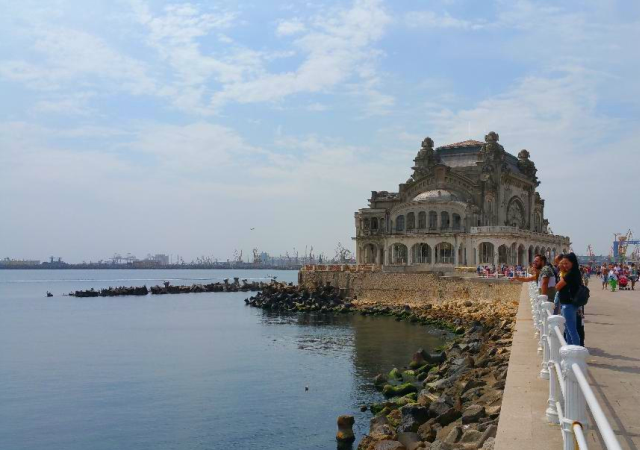
After having been left in dereliction for many years, the Casino in Constanța is now undergoing restoration works. Standing high on the waterfront, with its huge, seashell-shaped windows, the Casino has, for a long time, been the emblem of the Romanian Black Sea Coast, of a world of elegance and refined relaxation. The history of the Casino overlaps the history and evolution of the city of Constanța that became a tourist and spa treatment destination especially after the union of Dobrogea with Romania in 1878. After 1880, more and more inhabitants of the Kingdom of Romania started going to Constanța to bask in the sun or undergo spa treatments, so the city officials had to find new ways to accommodate tourists in comfortable facilities and make their stay more pleasant.
Doina Păuleanu is the director general of the Art Museum of Constanța and she will tell us more about the history of the Casino in Constanța: “Back in 1880, a first spa-treatment facility was built high on the steep waterfront boulevard which was called then as it is now, the Elisabeta boulevard. The facility was made of wood and was open only during the summer season, boasting a dancing room and a terrace from where people could admire the sea. This first casino was very successful, because in a spa resort, a treatment facility was a must, where people could read the newspapers, talk, dance and socialize. A powerful storm destroyed this wooden casino, so in 1892 the Constanța city hall decided to erect another building, from more resilient materials. This second building was constructed somewhere opposite the location of today’s casino, high on the waterfront, because the present promenade did not exist back then. A construction team was set up within the Constanța Prefect’s Office led by construction engineer Scarlat Vârnav, who suggested expanding the city by building a promenade. This promenade, which has stood the test of time, has a platform which goes into the sea, and which is the place where the present day Casino was erected.”
A first blueprint of the casino dates back to 1903 and was made by engineer Scarlat Vârnav’s team that had their own architect: Daniel Renard, a young man born in Moldavia to a Romanian mother and a Swiss father.
In 1903 the project was assumed and promoted by the Liberal leadership of the then local administration of Constanța. Subsequently, the Liberals were replaced by the Conservatives who brought their own architect Petre Antonescu, a fan of the neo-Romanian or national style. Antonescu designed another building for the Casino in the neo Romanian style. The previous plan had been designed by Daniel Renard in the Art Nouveau style, which had just been launched in Europe and could seem too cutting-edge.
Next Doina Păuleanu will tell us more about the trials and tribulations of the Casino blueprints: “In 1906 Petre Antonescu made a new blueprint. I had the chance to find the drawing of this plan, which I have recently published. It was a beautiful building designed to be a casino that could stay open also in winter. Of course, for that new plan, a second groundwork was made. The Conservative local administration was again replaced by a Liberal administration, which returned to Daniel Renard’s Art Nouveau design. The architect realized that the two sets of groundwork had actually harmed the structure of his project, so he made a third groundwork. Consequently, the Casino boasts an indestructible foundation on which the building proper was erected starting in 1906-1907. The costs exceeded the initial estimates and the Casino looked different from what it is today. The upper floor had been first designed by Daniel Renard as a performance room with a big seashell-shaped window facing the promenade and the sea. Following later works, the part of that window facing the sea was walled up and the casino building was extended on the terrace. Thus constructors made a very large room for baccarat. The modification was made against Daniel Renard’s will, but he had to accept it upon the request of the Casino owners who wanted the place to be profitable. The building had actually been leased to private entrepreneurs. So Daniel Renard led the team that, between 1912-1913, walled up the window facing the sea and extended the casino.”
During the day people would go at the casino to have tea or coffee, read the newspapers or attend a performance, while gambling games would be the stars of the evening. A new casino was built in Mamaia, an old neighborhood of the city of Constanța that was transformed into a seaside resort, so the building designed by Daniel Renard lost its fame and profitability. Gradually, gambling games lost ground to the cultural activities organized in the building in the interwar period. However, the situation changed again during the Communist period.
Here is the director of the Art Museum of Constanța Doina Păuleanu with more: “When the Communists took over the building, they started refurbishing it with the help of political detainees in the 1950s. Recently a sack of cement has been discovered on the premises, which bears the names of the detainees who worked there in 1950. The Casino had been heavily bombarded during the two world wars, and during the Communist regime, the building served several purposes. At one time, it was closed to the public at large, then it became the most elegant and expensive restaurant of that respective epoch. The casino also hosted a night club for the foreign sailors who arrived in the port of Constanța.”
After the fall of Communism, the building of the Casino was the subject of many controversies and lawsuits related to its ownership. Eventually, the Casino became the property of the Constanța city hall, since it had been built exclusively from public funds. At present, large-scale restoration works are under way at the Casino, with the team of architects and construction engineers trying to render the Casino its former Art Nouveau grandeur. (translation by Lacramioara Simion)