The First Romanian Translation of the Old Testament
In 1648, in Alba, the first translation of the New Testament in Romanian was printed, the so-called “Balgrad Bible.
Christine Leșcu, 22.07.2017, 12:34
The 17th century was a watershed moment for Wallachia and Moldavia in terms of cultural development, and not only. That far, Old Church Slavonic and Greek were used for official and administrative documents, and in church, for mass and for religious texts. Starting in 1600, but especially in the second half of the 17th century, significant progress was made in respect of adopting the language of the people, Romanian.
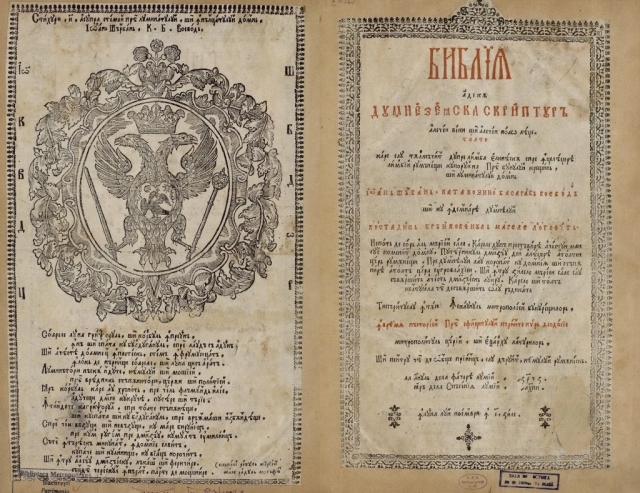
The first step, obviously, was in religious texts. In fact, Romanians were the first Christian Orthodox people to translate the Bible in a secular language. In 1648, in Alba, the first translation of the New Testament in Romanian was printed, the so-called “Balgrad Bible”. In 1688, the first translation of the whole Bible, the Bucharest Bible, was printed in Bucharest, financed by the ruler of Wallachia, Serban Cantacuzino. Between the two, another print, this time a translation of the Old Testament, was issued by Nicolae Milescu, which took from 1661 to 1668 to be completed.
Milescu made the first translation of the entire text of the Old Testament based on the Greek text of the Septuagint Bible published in Frankfurt in 1597. Nicolae Milescu, who lived between 1636 and 1708, was a major figure in culture and politics at the time. A high-ranking official at the rulers court holding the post of Spatharios, he was one of the Romanian scholars who, next to Dimitrie Cantemir, managed to make a name for himself in his lifetime beyond the boundaries of his native Moldavia.
Eugen Munteanu, from the Alexandru Ioan Cuza University of Iasi, tells us more about his life and work: “He is generally known for heading a large delegation sent by the Tsar of Russia to China, a trip that resulted in his writing several major texts, travel diaries that popularised that vast empire of the East in Europe. Few people know that Nicolae Milescu has left behind a substantial body of writings, most of which are not in print, written in Romanian, Slavonic, Latin, and partially Greek.”
Around the age of 25, Nicolae Milescu started translating the Greek version of the Old Testament, the Septuagint Bible, into Romanian. Recently, the Alexandru Ioan Cuza University Press has published the annotated version of this manuscript, which is kept in the Cluj branch of the Romanian Academy library under the name Manuscript 45.
The coordinator of this publication, Eugen Munteanu, explains the importance of the first Romanian translation of the Septuagint Bible: “The first version of the Old Testament in a language other than Hebrew was the Greek version. This text is known as the Septuagint, and it is the primary Bible of Christianity. As a literary and religious text, the Septuagint is very interesting to philologists. The first European to translate the Biblical text from its Greek version, rather than its Judaic or Latin version, is Nicolae Milescu. What could have possibly motivated this 25 year-old scholar to do that? We have no direct clues to help us answer this question. However, we may suppose that Milescu was at the centre of a debate among scholars of his time in this regard. He had been educated at the Patriarchal School in Constantinople, the most important higher education institution of the day. In addition, Nicolae Milescu had also been exposed to the ideas of Italian humanism, because a lot of his teachers in Constantinople were from Padua. As a result, he was part of an elite that were very much aware of their duty in respect of their mother tongue.”
Manuscript 45, which can be found in the Cluj branch of the Romanian Academy Library, is in itself a work of art, according to professor Eugen Munteanu: “The text has been preserved in a beautiful, elegant manuscript, a masterpiece in its own right, written in artfully drawn black and white ink. This manuscript is a very carefully made copy dating from the late 17th century produced by a copyist called Dumitru of Campulung, who was assigned this work by the Metropolitan of Wallachia himself. As a result, no original manuscript by Milescus hand has been preserved. At the age of 25, in 1661, Nicolae Milescu was in Constantinople on a diplomatic mission, as ambassador for the ruler of Wallachia, even though he was a Moldavian. In the first four years, he worked intensely at this translation. He probably continued to work until 1668, during his travels in Europe. We assume the translation had been completed by 1668. It then made its way to Iasi and later also to Bucharest, where it became the basis of the Bible printed in 1688.”
This translation has been available to the public since 2016, when it was published in a volume entitled “The Old Testament — the Septuagint. The Version of Spatharios Nicolae Milescu.”