RRI Live!

Listen to Radio Romania International Live

The Iasi National Theatre

2016 is for the theatre world in Iasi a year full of anniversaries.
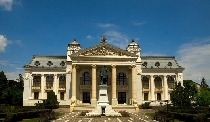
The Iasi National Theatre

, 13.02.2016, 16:56

200 years ago, in 1816, the then capital of Moldavia, saw the first performance of a play in Romanian. Later, in 1840, that is 176 years ago, the institution of the National Theatre in Iasi was founded and in 1896 the building that has since sheltered the theater of Iasi was inaugurated. Considered today one of the most impressive edifices in Romania, the Iasi National Theatre building was born as a result of a tragedy. The institution’s artistic director, Daniel Busuioc, tells us more about it.


Daniel Busuioc: “In the beginning, as we all know, the Iasi Theatre was housed in a building in the Copou Park, being called “The Big Theatre of Copou”. But the building burnt down in February 1888 and until 1894 steps were taken for the building of a new national theatre. A letter addressed to a prominent cultural personality of the time, Titu Maiorescu, the then Minister of Public Education, wrote that ‘the lack of a theatre in Iasi does not compare to any other shortage. It is as if Iasi were left in the dark, as if it were deprived of intellectual life and were plunged into a frivolous life that cannot mould characters.’ Consequently, the present building was raised according to the design of the Viennese architects Fellner and Helmer. However, a Romanian contractor built the theatre. An electric power plant, the first of the kind in Iasi, supplied the theatre with electricity. It was at that time that the first public lighting poles appeared, standing close to the theatre. The style of the building is eclectic, with Baroque, Rococo and Viennese Neo-Classical elements. The grand hall seats 750 people. The chandelier has crystal light bulbs from Vienna, the main curtain is painted by the Viennese master Lenz, it is the only extant main curtain, with the illustration of an allegory of life, with the three stages of life on the centerpiece, and on the right side we have a symbolic representation of the Union of the Principalities. The ceiling is painted by Alexander Goltz, and its theme is ‘Story’, figuratively represented by paradise allegories, with nymphs and cherubs in a Rococo stucco structure. On the ceiling, above the orchestra pit, we find the crest of the four united Romanian provinces.”


The Grand Hall was inaugurated on December 1 and 2, 1896, with Flechtenmacher’s National Overture, the vaudevilles The Burdujeni Muse by Negruzzi, and ‘Cinel-cinel’ by Vasile Alecsandri, as well as the versified comedy ‘The Romantic Poet’, by Matei Millo. The proceeds for the first evening were donated to the poor, with the artists getting paid from the proceeds of the second evening. Today, the building of the Iasi National Theater is not only a venue for live shows, but also a museum preserving objects salvaged from the hall on Copou Hill. Here is artistic director Daniel Busuioc.


Daniel Busuioc: “In the 1888 – 1889 season, Hamlet was on in Iasi. Following the fire that broke out in 1888, they managed to rescue only several costumes, and today we have the costume the great Grigore Manolescu wore in ‘Hamlet’. It is on display in the National Theatre foyer. Right now we have also inaugurated an exhibition marking all the events that are being celebrated this year, with the help we got from the Literature Museum in Iasi that made available for us costumes and items that belonged to actors, posters and show programmes. All these are on display in the theatre lobby. For instance, spectators can see a lamp stand used for stage lighting, which was also used in the Copou Theatre. Also, they can see costumes that belonged to great actresses of the past. All these mark important moments that were preserved in the affective memory of the public in Iasi. “


In the autumn of 2015, the BBC TV station listed the National Theatre in Iasi as one of the most beautiful theater buildings in the world.
Sergiu Celibidache (1912-1996)
RRI Encyclopaedia Sunday, 05 April 2026

The Micia Roman fort

Established in the 2nd century AD within the Roman province of Dacia, the fort served a vital strategic node: it controlled the road connecting...

The Micia Roman fort
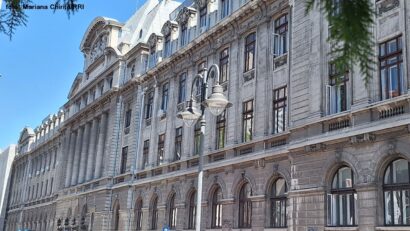
Universitatea Bucureşti (foto: Mariana Chiriţă/RRI)
RRI Encyclopaedia Sunday, 29 March 2026

The University Museum in Bucharest

The University of Bucharest was established and has operated under this name since 1864, following the founding of Romania through the union of the...

The University Museum in Bucharest
Ion Dumitrana (AI geerated image)
RRI Encyclopaedia Sunday, 22 March 2026

Engraver and illustrator Ion Dumitrana

Ion Dumitrana (1923-1976) was one of the most important Romanian stamp artists, creating hundreds of postage stamp designs in the second half of the...

Engraver and illustrator Ion Dumitrana
Lo scultore Frederic Storck
RRI Encyclopaedia Sunday, 15 March 2026

Princely and Royal Thrones

  A symbol of royal authority, thrones held a central place in the representations of power in the Romanian space. Before 1945, they were a...

Princely and Royal Thrones
RRI Encyclopaedia Sunday, 08 March 2026

The George Severeanu Museum

The George Severeanu Museum is located in Bucharest, in a house built at the beginning of the 20th century and forms part of the Bucharest...

The George Severeanu Museum
RRI Encyclopaedia Sunday, 01 March 2026

Diplomat Grigore Gafencu

Grigore Gafencu served his country without reservation and sought to promote its interests both in his official capacities and during his exile after...

Diplomat Grigore Gafencu
RRI Encyclopaedia Saturday, 21 February 2026

A Scholar of international repute – Traian Săvulescu

Traian Săvulescu used to be one of the leading figures of the Romanian science in the 20th century, a biologist, botanist, professor and president...

A Scholar of international repute – Traian Săvulescu
RRI Encyclopaedia Sunday, 15 February 2026

General Henri Cihoski (1871-1950)

The history of the Romanians was also written by foreigners, just as Romanians are present in the history of other nations. Although a numerically...

General Henri Cihoski (1871-1950)

Partners

Muzeul Național al Țăranului Român Muzeul Național al Țăranului Român
Liga Studentilor Romani din Strainatate - LSRS Liga Studentilor Romani din Strainatate - LSRS
Modernism | The Leading Romanian Art Magazine Online Modernism | The Leading Romanian Art Magazine Online
Institului European din România Institului European din România
Institutul Francez din România – Bucureşti Institutul Francez din România – Bucureşti
Muzeul Național de Artă al României Muzeul Național de Artă al României
Le petit Journal Le petit Journal
Radio Prague International Radio Prague International
Muzeul Național de Istorie a României Muzeul Național de Istorie a României
ARCUB ARCUB
Radio Canada International Radio Canada International
Muzeul Național al Satului „Dimitrie Gusti” Muzeul Național al Satului „Dimitrie Gusti”
SWI swissinfo.ch SWI swissinfo.ch
UBB Radio ONLINE UBB Radio ONLINE
Strona główna - English Section - polskieradio.pl Strona główna - English Section - polskieradio.pl
creart - Centrul de Creație Artă și Tradiție al Municipiului Bucuresti creart - Centrul de Creație Artă și Tradiție al Municipiului Bucuresti
italradio italradio
Institutul Confucius Institutul Confucius
BUCPRESS - știri din Cernăuți BUCPRESS - știri din Cernăuți

Affiliates

Euranet Plus Euranet Plus
AIB | the trade association for international broadcasters AIB | the trade association for international broadcasters
Digital Radio Mondiale Digital Radio Mondiale
News and current affairs from Germany and around the world News and current affairs from Germany and around the world
Comunità radiotelevisiva italofona Comunità radiotelevisiva italofona

Providers

RADIOCOM RADIOCOM
Zeno Media - The Everything Audio Company Zeno Media - The Everything Audio Company