The Romanian General Exhibition of 1906
120 years ago, on June 6, 1906, a major exhibition opened in the Romanian capital city
Steliu Lambru, 15.11.2026, 12:54
120 years ago, on June 6, 1906, a major exhibition opened in the Romanian capital city to mark a triple celebration: the 40-year reign of King Carol I (which began in 1866), the 25th anniversary of the proclamation of the Kingdom (1881), and 1,800 years since the conquest of Dacia by the Roman Emperor Trajan in 106 AD.
The event was a tribute to the efforts of the entire Romanian society in building a modern, European state, a “celebration of Romanian labour,” as King Carol I himself described it at the opening. The event was titled the “Romanian General Exhibition” and remained open until November 23, 1906. Written records and photographs reveal a large-scale showcase of Romanian economic and cultural achievements.
Substantial work was required in order to develop what had previously been a marshy area: over an entire year, swamps were drained, hills were levelled, a valley was filled in, and a lake was excavated. A park, a lake, and an exhibition compound were built across 41 hectares.
In addition to various Romanian institutions, organisations, and civil or trade associations, several other nations, including France, Germany, Austria, Hungary, Italy, and Switzerland were also represented.
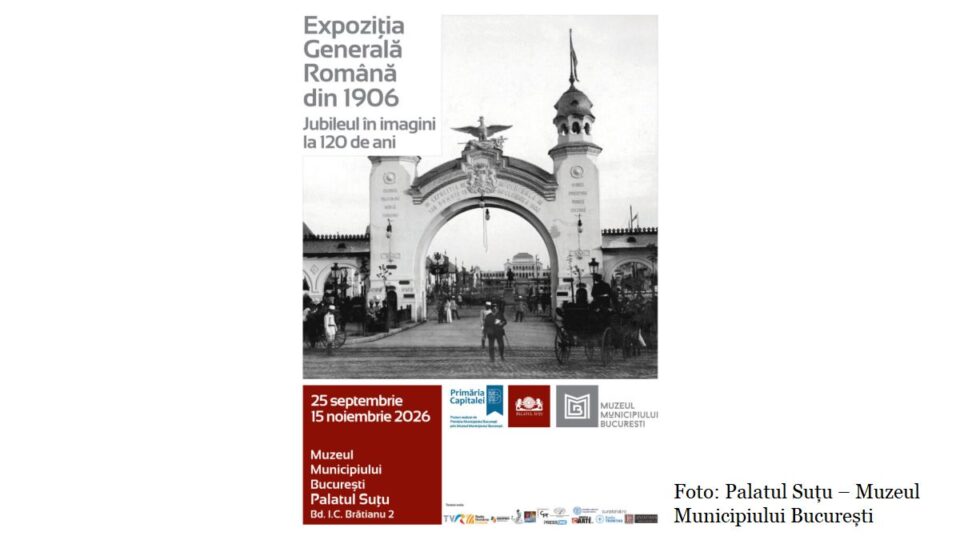
Cezar-Petre Buiumaci, with the Bucharest Municipality Museum, is the curator of a photo exhibition about the 1906 General Exhibition. He highlighted the symbolic significance of the chosen location:
Cezar-Petre Buiumaci: “Images from that time show us ‘Filaret’s Field’, named after the Metropolitan Filaret who had built a public fountain there with four spouts, beautifully adorned with the zodiac signs. Even the street leading to this area was called ‘Filaret Street,’ as it headed toward that specific landmark. During the 1848 Revolution, specifically on June 11, 1848, this site became the place where the ‘Islaz Proclamation’ was read, earning it the name ‘Field of Liberty’ (Câmpia Libertății). This historical association played a significant role in naming the site. It was precisely for these reasons that this location was chosen for the development of a large park, the largest built at that time. I have come to think of it as a ‘park for the King,’ as it was built to host the grandest celebration of the early 20th Century: the commemoration of the four-decade reign of Carol I and the 25th anniversary of Romania becoming a kingdom. Furthermore, this was the intended venue for all the events marking the 1,800 years since the conquest of Dacia by Trajan. Perhaps this was the most crucial factor in the selection of the site, as Prince Carol, who later became King, sought to embrace the Roman and Latin heritage of the nation that he governed. Upon first setting foot on Romanian soil, he declared that he had become a Romanian.”
But it was a celebration for all Romanians, as evidenced by records dating back to that period.
Cezar-Petre Buiumaci: “The exhibition shows how this park was laid out to pay tribute to the King, as well as to the Romanian identity. The park hosted pavilions showcasing the culture and traditions of the Romanian nation, the very best and most beautiful aspects of their heritage, and communities from beyond the borders were also invited to participate. Romanians from Bukovina had a separate pavilion from that of Austria; Romanians from Transylvania also had their own pavilion, distinct from Hungary’s; and others came from Istria and the Balkans, including the Romanian schools in Sofia and Constantinople, to showcase the work they were doing outside Romania’s borders. Basically, the exhibition served as a statement by King Carol, emphasizing this theme of unity. The concept of ‘Latinity’ is further championed, not only through the proclamation of eighteen centuries of history but also through the minting of commemorative medals. This identity also received foreign recognition: in 1906, the Mayor of Rome brought the “Lupa Capitolina”, the legendary Capitoline Wolf, to the exhibition. The she-wolf nursing the legendary founders of Rome can still be seen in Bucharest today. This is why the inscription ‘Gift from Rome, 1906’ is featured on the pedestal. Rome, as heir to the Roman Empire, acknowledged the Latin roots and Roman heritage of the Romanian nation. Such gestures were highly significant within the broader scope of an undertaking of this nature.”
The second symbolic dimension of the exhibition site was its material, economic aspect.
Cezar-Petre Buiumaci: “Mobility was very important. Here, on the Filaret Hill, just a few meters from the park, lies Bucharest’s first railway station, Filaret Station, which connects the capital to the Danube. Naturally, a railway station acts as a focal point for significant economic activity. So this station served as a magnet for industry; the first major factories in Bucharest were established in connection with it. A railway line, built during the reign of Carol I, ran through the area, facilitating transport primarily throughout the southern part of the city. Clearly, there were many complex connections, and it made sense in the context of the decision to host the celebration for King Carol I here—to also include the railway station, which is the first one.”
The 1906 Romanian General Exhibition was a triumph. It brought to life an ambition to take action, and it sparked a generational drive that led to the emergence of Romania as we know it today. (AMP)