PISA results – a warning sign
Romania, which ranked third from last among EU countries in the PISA tests, needs change.
Corina Cristea, 02.10.2026, 14:00
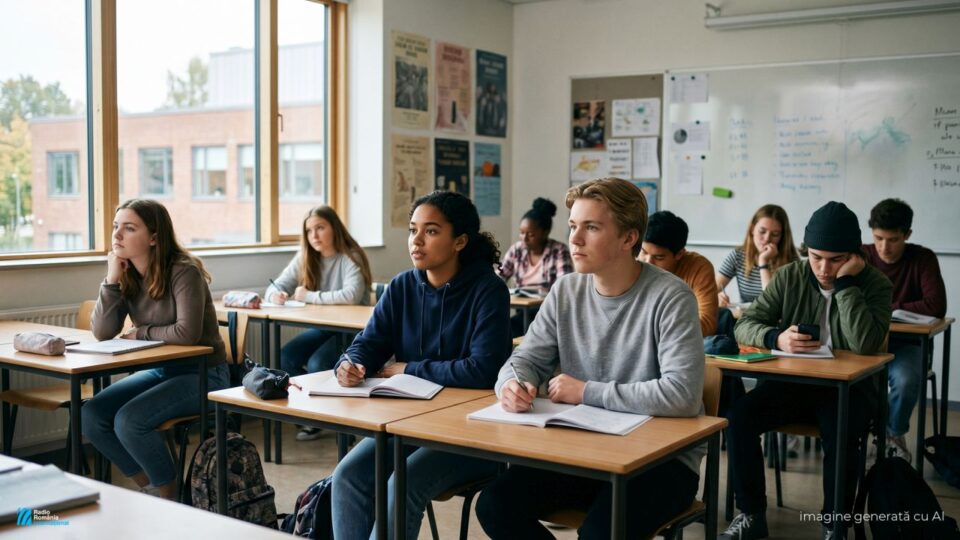
The PISA programme, conducted by the Organisation for Economic Co-operation and Development (OECD), tests students aged around 15 every three years in dozens of countries and economies. The focus is not on reproducing what students have been taught, but on using knowledge of mathematics, reading and science in real-life situations.
The results provide a snapshot of what the education system has managed to instil in the mind of a teenager at this age, such as the ability to understand, apply knowledge, reason and solve problems. In other words, PISA is a tool for measuring the performance of education systems. The most recent assessments were conducted in 2022 and 2025, and the results at European Union level have been far from encouraging. The results released three years ago showed that around 30% of EU students failed to reach the minimum proficiency level in mathematics, while around 25% fell below the minimum level in reading and science.
Announced this September, the PISA 2025 results show that the problem persists across Europe, particularly in reading and mathematics. The European Commission’s official platform highlights the deterioration in basic skills and the need for action on student engagement, the learning environment and the use of technology. Concerned about the severe decline in educational performance, the European Union is preparing a response. European Commission Executive Vice-President Roxana Mînzatu is due to present an education package in November, designed primarily to help member states reverse the negative trend in basic skills.
Romania, which ranked third from last among EU countries in the PISA tests, also needs change. The results show that more than half of Romanian 15-year-olds fail to reach the basic proficiency level in mathematics, while 48% fall below the basic level in reading. In science, 46% of students are also below the basic proficiency level.
Professor Marian Staş, an education expert and president of the Club of Third Millennium Leaders Association, explains why these tests matter: “PISA provides an international reference point; technically, it is called a benchmark. A benchmark means looking at statistics that are valid worldwide and measuring myself against them, because I am part of that world. What we have at the moment is yet another confirmation of a negative trend in the quality of schooling in Romania. It confirms, year after year, our mediocre performance in the bottom third worldwide and our third-from-last position in terms of performance within the European Union. Obviously, grades, rankings or the position itself are not what matters, because that is not why we have schools – to look good in PISA. But PISA is a consequence, an effect of a very deep cause, which is the fundamental mismatch between Romania’s education system and the realities of the 21st century.”
This does not mean that there are no children with extraordinary performances in Romania; on the contrary, participation in the school Olympiads and other international competitions often places Romanian children among the medalists. But the PISA results reveal a double problem for Romania: too many children who do not reach basic skills and too few who reach advanced levels. For the education system, this translates into a loss on both ends: it fails to bring those left behind to a functional level, and to develop excellence on a large scale.
Ever since 2022, the PISA results have shown an unprecedented worsening in the performance of many education systems. At OECD level, the average in mathematics showed a decrease of almost 15 points compared to previous tests, and in reading by about 10 points. The COVID-19 pandemic played a role in this, with schools closed, educational processes disrupted, and students missing important learning periods.
But the pandemic does not explain everything, and the OECD study shows that some negative trends already existed before 2020, including in Romania, where reading and science results were relatively stable in the long term, and in maths the 2022 scores were below those in 2012 and 2015. The conclusion is that the pandemic deepened an existing problem, rather than create it.
Professor Marian Staş: “The diagnosis, in my opinion, is essentially that Romania’s educational model remains 99% stuck in a communist paradigm, with only 1% beginning to change. The communist paradigm means a hypercentralised curriculum, centralised management and so on. Why is this happening? The system is poorly designed. A second cause or a second category of causes is related, for example, to the abnormal growth of private tutoring, huge socio-economic and demographic disparities, inconsistent resource allocation between urban, small-town, and rural environments, etc. So if you asked me how do we do it differently, I would say the two essential interventions are necessary. One is the redesigning, the structural transformation of the school system, and the second one is changing the administrative-territorial architecture of Romania. It is impossible for 21st Century Romania to function efficiently at all levels with an administrative-territorial map drawn 50 years ago. How can it still be valid and give good results in the economy, in healthcare, in education, in infrastructure and so on? We are in 2026, this is the 21st Century.”
The priorities identified by the education ministry include lifelong professional training for teachers, with an emphasis on effective practice in the classroom and on checking how training translates into real changes in teaching, and more resources for the schools that have the biggest problems. Treating rural areas as a strategic priority, along with placing less emphasis on memorisation as against practical skills could also change something for the better. (EE, AMP)