Ecaterina Teodoroiu’s Centennial Commemoration
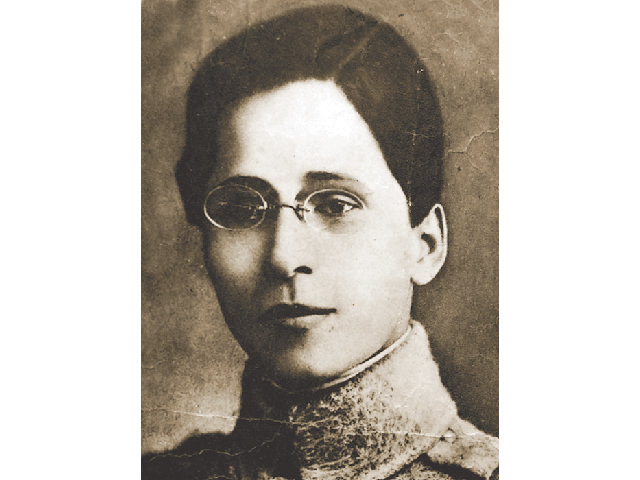
Ecaterina Teodoroiu was a symbolic figure of WWI thanks to her personal sacrifice. She was the soldier-woman who refused to stay behind the front line, where battles were fought, choosing instead to be present where clashes were fiercest
Steliu Lambru, 18.09.2017, 13:21
At the tender age of 23, Ecaterina Teodoroiu was killed in the line of duty, in the battle of Marasesti, in August 1917. This year, we commemorate the Marasesti Battle Centennial, also paying homage to many other Romanian women, among whom Ecaterina Teodoroiu, who made the ultimate sacrifice for their country, during the war.
Ecaterina Teodoroiu was born in Gorj County, southern Romania, in 1894, into a family of peasants. She had five brothers and two sisters. She was a hardworking pupil. She attended the German school in Targu Jiu and then a high-school in Bucharest, as she wanted to become a primary school teacher. Ecaterina Teodoroiu also attended a nursing school and was a member of “Romania’s Scouts” organization.
Romania’s entering the war in August 1916 was welcomed by the population at large. A great many young volunteers threw themselves in the spiral of death, fighting for the ideals of their generation. Ecaterina Teodoroiu was one of those youngsters and opted for the tough version of the war, which means that she was conscripted and sent to the front line. It has been said that what prompted her to make such a radical decision was the death of one of her brothers in the autumn of 1916. Notwithstanding, her enthusiasm was an exception for a woman in those days. Historian Ioan Scurtu believes that both Ecaterina Teodoroiu’s upbringing and Romania’s status at that time also contributed to her radical decision.
Historian Ioan Scurtu: “She rose to prominence at a time I could describe as symbolic in the history of Romania’s participation in the war, namely the action taken by the population of Targu Jiu, who defended the town and stopped the German troops from entering the town. Back then she was the driving engine of that initiative, which made the German army give up on the task they had set for themselves. Encouraged by her success, Ecaterina Teodoroiu asked General Dragalina, who was in charge of defending the Jiu Valley, to consent to her being conscripted and he accepted. Consequently, as of October 1916, she took an active part in battles. She got injured twice, once being severely wounded. She was admitted to hospital in Craiova, then she was deferred to a hospital in Bucharest and another one in Iasi. While in Iasi, Ecaterina Teodoroiu received the visit of Queen Mary and it was on that occasion that her name was mentioned by everyone around, as that of a very special person. It was Queen Mary who, while she was still confined to bed, handed her the decoration offered by King Ferdinand for her taking part in the war and for bravery in battle, in the 1916-1917 autumn-winter season. “
A woman in the army, especially one who was fighting on the battleground, that was something so very exceptional. Historian Ioan Scurtu has more on how Ecaterina Teodoroiu was received by her fellow soldiers on the battlefield: “From what I’ve read, I also wrote a book about the heroes of World War One, among whom Ecaterina Teodoroiu, she was welcomed with a lot of respect and a great deal of consideration for her unique gesture. The fact that she was taking part in all military activities, the fact that she did not back off from doing any chores or duties as regards training, getting acquainted with the weaponry that was newly-received early into 1917 from the allies, all that triggered respect and loads of appreciation for that young woman who was so brave and so unwavering in the battle she fought for her motherland.”
For her participation in battle, Ecaterina Teodoroiu was decorated and was promoted to the rank of second lieutenant. On August 22nd, at 21.15 hours, her regiment was attacked by the German army and the Romanians had no other choice than to withdraw. During the defensive operations, second-lieutenant Ecaterina Teodoroiu was shot dead by two machine guns, on the Secui Muncel Hill. We’ve asked Ioan Scurtu whether the army-rank she received was a symbolical one, meant to boost the morale of the troops, or whether she aptly deserved it, thanks to her merits in the line of duty.
The posterity of the young schoolmistress generously matched her sacrifice, as she became an iconic figure of World War One, just as the historian Ioan Scurtu underlines: ”As early as 1917-1918, Ecaterina Teodoroiu became a legend, those who were by her side and fought in the same units gave their account about her behavior, courage and heroism. The fact that a woman, a girl, effectively engaged in battle had a symbolical value. As soon as she was discharged from hospital, people kept asking her to stay and work for the Red Cross, jointly with other ladies, alongside Queen Mary, but she turned down the offer. She said her place was on the battleground, where she could fight, gun in hand. In 1921, when Tudor Vladimirescu’s Revolution Centennial was celebrated, Ecaterina Teodoroiu’s earthly remains were moved from Marasesti to her native town of Targu Jiu, where a sarcophagus had been built for her by sculptress Milita Patrascu. King Ferdinand, Queen Mary, historian Nicola Iorga, Marshall Averescu and all those high-ranking Romanian officials who wanted to create a symbol of Romanian soldiers and pay homage to the 800,000 Romanian military who died in the line of duty, paid tribute to Ecaterina Teodoroiu and highlighted her personality.“
The example set by “the Jiu heroine”, as Ecaterina Teodoroiu was called, might mean very little for today’s generation, but what matters most is that Ecaterina Teodoroiu, just like any ordinary person of that time, made the choice she thought the best for her country.