
Ion Ratiu and the Rebirth of Romanian Democracy
Politician Ion Ratiu was one of the role models for Romanian society as it was beginning to rebuild democracy in 1990
Steliu Lambru, 27.01.2020, 14:14
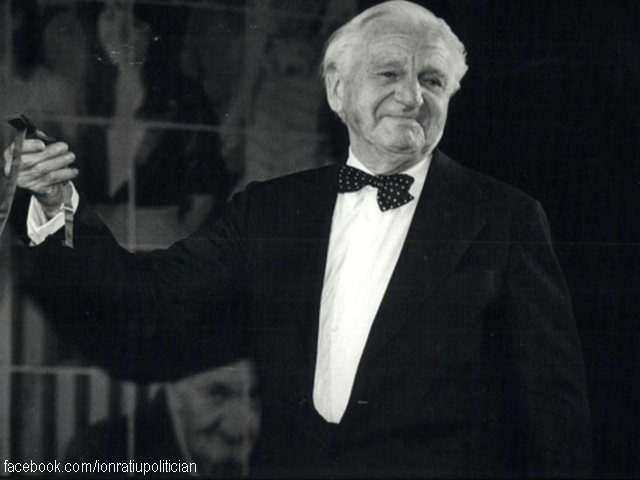
Politician Ion Ratiu was one of the role models for Romanian society as it was beginning to rebuild democracy in 1990, after 45 years of communism. He was a descendant of a family that was instrumental in fighting for the national rights of Romanians in the Austro-Hungarian Empire. Ion Ratiu had a considerable contribution to the improvement of the Romanian political climate after December 1989. He stood out by his signature bow tie, by his supremely polite way of expressing himself, and the slight English accent he had when speaking Romanian. Ratiu was one of the most important democratic Romanian politicians after 1990, one who had previously militated against both the Fascist and Communist dictatorships. Upon his return to Romania in 1990, he was instrumental in rebuilding the Christian-Democratic National Peasant Party, and got deeply involved in rebuilding a democratic climate.
Ion Ratiu was born to a family of intellectuals on June 6, 1917, in Turda, in what is now western Romania. He had a degree in law from Cluj, and one in economy from Cambridge. He was active in the youth organization of the National Peasant Party. In 1940 he was appointed as a diplomat with the Foreign Ministry, and was sent to London right away, in February of that year, before the fall of France. After France was occupied, a country which used to be one of Romanias most important allies, Ratiu continued to work at the Romanian legation to the UK until early September 1940, when power in Romania was grabbed by General Antonescu and the Iron Guard. As an anglophile and francophile, Ratiu refused to accept his countrys joining the alliance with Nazi Germany.
In 1985, in an interview with Radio Free Europe for the Romanian Current Events feature, preserved in the archives of the Center for Oral History by Radio Romania, Ion Ratiu described how he got to remain in the UK:
“After King Carol II departed, and the Legionnaire state was set up, I resigned, in September 1940. I went to the British Foreign Secretary and asked for political asylum, which they granted me right away. I had the great luck to get a scholarship at Cambridge, and I studied there for three years and got a Master of Arts degree in economic sciences. While I was at Cambridge I made several radio broadcasts on patriotic topics with regard to Transylvania, especially after Northern Transylvania got taken away in 1940, and I was active in student life in the association of Romanian students in Great Britain.”
Ion Ratiu got involved in the propaganda to get Romania out of the Axis and have it join the Allied side. He deeply wished for CEE, Romania included, to remain under the influence of Western democracies after the end of the war:
“I worked on the International Student Council, where they made me vice-president during the war, and in the World Youth Executive Committee. Because we were all concerned about the future of Europe after the war, as exiles in England, we set up an organization we called Central East European Students for a New Society. Also, even though I was young, I was co-opted into the movement of free Romanians who opposed Romanias falling in line with Nazi Germany policy, and who said that Romanias place was next to the great democratic powers in the West who had created Greater Romania. During that time I wrote articles, I held conferences, and I spoke on the radio, as I said, at the BBC, of course.”
As the prosperous businessman he became, Ion Ratiu did not watch passively from afar as Romania was being turned communist. He set up an anti-Communist organization, the World Union of Free Romanians, and printed democratic leaning publications, such as The Free Romanian, one of the most influential publications for Romanian exiles. In 1985, Ion Ratiu was convinced that only the unity of all Romanians could make democracy return. The organization welcomed all who wanted to help in the effort of restoring democracy:
“In 1980, together with Professor Brutus Coste from America, we launched an appeal telling everyone that it would be the time to do something for this country to be represented in a dignified manner in the West. Until 1975 we had had the Romanian National Committee, which ceased its activities that year. We believed that this struggle needs to continue, and so we launched the appeal and we set up in 1984. We said from the beginning that this cannot be done around parties, we said that all Romanians who want to make an effort for the national cause should join us, irrespective of party, past or present. This did not mean that parties should not function. Quite the opposite, parties have to function, because there is no democracy without parties.”
On January 3, 1990, the National Salvation Front issued a law decree on the creation and official registration of political parties in Romania. This act meant the renaissance of political parties and political pluralism in Romania, after 45 years of absence. Returning to Romania in 1990, right after the decree was issued, Ion Ratiu continued to display the same firm democratic beliefs, as a true moral compass. He passed away in London on January 17, 2000, and, as per his wishes, was laid to rest in his native Romanian town of Turda.


























