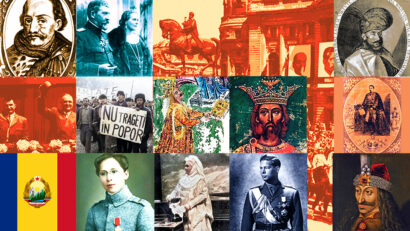
Landmarks of Romanian historical identity
The Union of Romanian Principalities on January the 24th

Steliu Lambru, 24.01.2022, 02:00
All
things considered, the foundation of Romania, as it is today, was laid in early
1859. Specifically, that meant the twofold election of colonel Alexandru Ioan
Cuza, on January 5th and 24th, as the ruling prince of Moldavia
and Wallachia, in then the capital of the two Romanian Principalities. The
person of a single ruling prince was the epitome of a tremendous amount of
effort the elites had made, for two generations, in a bid to build a Romanian
state following the modern European model.
We
have made an attempt to reminisce the key moments of that age at national but
also at international level. Joining us in our endeavour was historian Marian
Stroia, of the Romanian Academy’s Nicolae Iorga Institute of History.
Marian Stroia:
For the south-eastern space, the most important event with a strong
bearing on the situation of Romanian principalities is the Crimean War,
1853-1855. It was a pretext the Russians resorted to, so that they could put pressure
on the Ottoman Porte to grant rights to the Ottoman Empire’s Christian nations.
In effect, it was a mere pretext for their expansionist tendency towards
central and eastern Europe.
The
Romanian elite and the Romanian society were caught between three empires that
meant no good for Romania, as it was at that time. They were the Austria-Hungarian,
the Tsarist and the Ottoman Empires. Through negotiations, the elite succeeded
to find the most favourable of the three empires.
Historian Marian Stroia:
We can say that, broadly speaking, the Ottoman Porte was more receptive
to Romanians’ wants and needs and was also less conservatory than Russia. All modernization
efforts the Romanians had attempted after 1848 benefitted from its low-key
support. Whereas Russia, at the other end of the scale, sought to impede all
reformist attempts. During his reign, colonel Cuza tried to avert any situation
that could jeopardize the young Romanian state in its relationship with Russia.
In 1855,
Russia was defeated in the Crimean War. The Treaty of Paris in 1856 provided
great novelties as regards the historical destiny of the Romanian space.
Marian Stroia:
After 1856, there is another crucial moment. Just as Dumitru Bratianu had told
his brother, Ion C. Brătianu, in 1849, when Russia would get soft, then
the Romanians could achieve all their national objectives. The most important consequence
of the year 1856 meant that the Romanian space was no longer under the Russian-Turkish
suzerainty, being under the protectorate of the great European states. At one
fell swoop, the political situation changed, making it possible for a much wider
context to occur, for the development of the domestic political energies.
The
strongest domestic energies were indeed unleashed. The Unionist, Europhile party
was the most tumultuous one, being capable of writing memorable pages of
history at that time.
Marian Stroia:
The Ad-hoc
(purpose-held) election of 1857 made the most important event in the domestic
Romanian space. On that occasion, the Romanian nation’s political identity
landmarks were expressed. Among them, definitely worth mentioning here, apart
from political autonomy, neutrality and the separation of state powers, is the fundamental
issue of the foreign prince, viewed as a necessary prerequisite of the young Romanian
state, in a bid to draw its own roadmap towards independence. That was point
number 4, which was no less important than the others, the enthronement of a
foreign prince. Ruler Alexandru Iona Cuza’s reign was an intermediary stage in
the Romanians’ undertaking to gain their national independence.
The
Romanian elites came up with a simple geopolitical and geostrategic scheme. Lying
at the crossroads between the three empires, Moldavia and Wallachia had to look
for support outside the zone where empires clashed. The ultimate solution to
the quest for support was France, the great model of modern ideas, the
staunchest carrier of the message of the universality of man and his rights.
Today, historians have unanimously agreed that Romania was a creation of
France.
Marian Stroia once again, with the details.
A crucial role in the Romanians’ endeavour to carry the union through and
forge their own way to independence, that was played by France. Cuza had
Western training. In 1845-1846 he graduated from the Stanislas College in the
French capital. His own shape-up as well as the shape-up of the entire unionist
movement of 1848 were closely linked to the West and to France, especially. For
the Romanians, the most consistent support was provided by the French state,
then headed by Napoleon III. It is something that cannot possibly be denied.
The Union
required certain forms of sacrifice, made by the elites and the grassroots
alike, according to their possibilities. However, the example was set by the
elites.
The historian Marian Stroia:
For its greater part, the Romanian elite back then was inspired
by a complete material disinterest and by an utterly unusual patriotic spirit. Costache
Negri, one of Cuza’s aides and the Principalities’ ambassador to Constantinople,
had a complete state financial support for his funeral, so he didn’t even have
enough money for his own interment. And when Ion C. Brătianu left for
Dusseldorf to obtain Carol de Hohenzollern-Sigmaringen’s candidacy for the throne
of the Principalities, he had to sell two of his estates so that he could pay for his
trip and his stay in the Sigmaringens’ German residence.
Cuza
was jointly elected on January the 5th and the 24th,
1859, in Moldavia and Wallachia. That clearly meant both principalities were definitely
taking a European path.
(EN)