Mining and Labor Protection in the 1980s
Mining, especially strip-mining, was believed to be the hardest economic activity, with extreme work conditions and a lot of work accidents and deaths.Labor protection had a social factor, but also one of control.
Steliu Lambru, 09.12.2013, 14:00
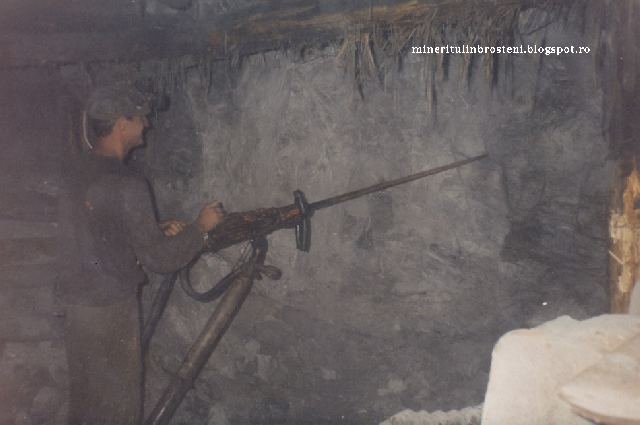
Heavy industry was one of the pillars of the communist system, based on mining, steel and machine building. Mining, especially strip-mining, was believed to be the hardest economic activity, with extreme work conditions and a lot of work accidents and deaths. Since miners had a high level of solidarity, they had the potential of going on strikes, creating problems for the regime. Which is why they were offered high wages and a lot of social protection, but that came at the cost of being constantly under surveillance. Labor protection had a social factor, but also one of control. Accidents happened a lot, but the communist regime swept them under the rug.
Electrical engineer Petru Gherman, who was recorded by the Center for Oral History of Romanian Radio in 2003, told us about a fatal accident in a mine in Jiu Valley.
Petru Gherman: “We had this sloped mining equipment, digging at around 150 meters depth, self supported. It had pillars for self-support. I was operating a combine. At some point, a crevice about 17 meters formed, and buried my combine completely. I managed to get away, but one other miner, a young fellow, did not, and they dug him out three days later. His name was Vasile Muresan and I’ll never forget him. He was a great guy and we got along really well. Even though I was operating the combine that got caught, he was the one who got buried.”
Bokor Miklos became a miner not only because it was traditional in his family, but he also liked it. It would be tempting to believe that miners took on this risky job for the benefits. However, according to their testimonies, a lot of miners actually loved the job. This was the case for Bokor Miklos, who worked in the Aninoasa Mine, a depth mining facility.
In 2003 he told us how he broke his leg at work: “I worked there for 31 years, and there were two accidents underground during that time. One of them was a rock fracture and another was a mine collapse, a ceiling collapsing. We had a high degree slope, measuring 50 or 60 degrees. You can see how fast a boulder would roll on that kind of slope. A boulder fell from about 20 or 30 meters above me. I heard the noise, and I wanted to dodge it, but my leg was caught, and I had three toes broken. You can hear it coming a mile away. If you’re a miner and you have your wits about you, the earth speaks to you, so you know every time something fishy happens. You can hear the mine shedding tears, crying, and the boulder comes as if it were a tear. If it’s quiet, you realize that something is afoot, and you have time to get your people out.”
Mining accidents were major events, prompting investigations and trials. Engineer Iulian Costescu was a technical director at the Livezeni mine. In 1980, two explosions killed 53 workers. The first killed 32, the second 21. A labor protection commission which included officers of the Securitate (the former political police) investigated, and found him guilty.
Iulian Costescu: “That’s how it was back then, the higher ups, such as the mine director and head engineer, did hard time. Political police general Macri came to supervise everything. The minister of mines, Virgil Trofin, put me in charge of rescue. I had a row with Macri, he wanted to investigate right after the explosion. It was within my rights to bar him from doing that, there could have been another explosion, which had happened on other occasions, such as the one in Vulcan, where the accident killed even professors from the school of mining in Petrosani. Even the head of the school of mining security got killed like that. Macri indicted me and I was prosecuted. It lasted for a year, but I was acquitted. That morning, Paul Romanescu was the head of labor protection in that complex. They told him to go to the mine to check ventilation. He was a great guy. He went down in the mine. If I had gone with him, maybe it would not have happened. Maybe the measures I was taking would not have killed this many people. The explosion would have happened anyway, I believe, but maybe we could have gotten the people out. I don’t know what I would have done.”
Mining accidents did not scare people off, even though labor protection cannot guarantee lives will not be lost. One can never tame the depths of the earth, just as one cannot completely tame the depths of the ocean.