Political opposition in the 1980s – Doina Cornea
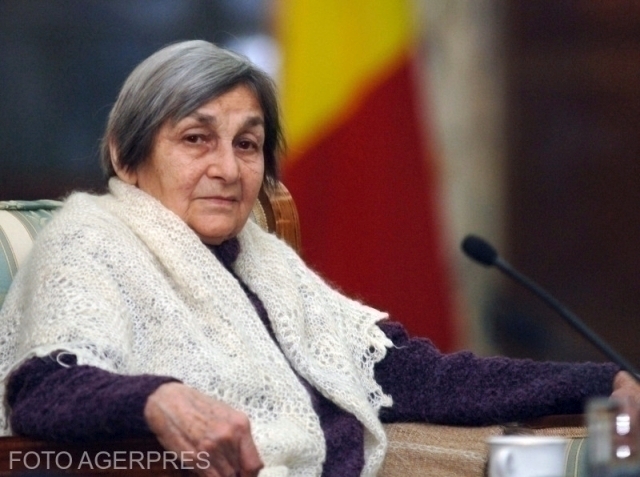
A political figurehead of the Romanian
anti-communist opposition, 88-year old Doina Cornea passed away in Cluj on May
4, 2018. In Romania but also in the European civic activism circles, Doina
Cornea’s name needs no introduction. She was one the intellectuals who put up
the staunchest opposition against the communist regime in the 1980s Romania.
Doina Cornea openly expressed her opinions in a country that at that time was
fearful because of the violence of the then communist regime and the long
period of time when rights and freedoms had been brutally trampled on.
România Internațional, 23.07.2018, 12:21
A political figurehead of the Romanian
anti-communist opposition, 88-year old Doina Cornea passed away in Cluj on May
4, 2018. In Romania but also in the European civic activism circles, Doina
Cornea’s name needs no introduction. She was one the intellectuals who put up
the staunchest opposition against the communist regime in the 1980s Romania.
Doina Cornea openly expressed her opinions in a country that at that time was
fearful because of the violence of the then communist regime and the long
period of time when rights and freedoms had been brutally trampled on.
Between 1945
and 1989, in Romania, women paid dearly because of the way the country had been
led immediately after the end of World War Two. Intellectuals or workers,
country girls or city dwellers, women in Romania fought and died in the armed
resistance, alongside their husbands, others had to do time in prison for a
great many years, with some of them even dying while serving their sentence.
Famous or unknown, such heroines as Marina Chirca, Ana Simion, Maria Plop,
Arlette Coposu, Ecaterina Bălăcioiu proudly include the name of dissenter Doina
Cornea among them. Those figure heads refused to be accomplices to the
instatement of an utterly inhuman regime in Romania.
In 1982,
52-year old teacher Doina Cornea decided she could no longer go hush-hush about
what was going on in Romania at that time. She wrote a letter to Radio Free
Europe denouncing the abuse and the way the country was being led by the then
communist party. In 1996, Doina Cornea gave an interview to Radio Romania’s
Oral History Center. Back then she recalled how her relationship with the
communist regime began.
Doina Cornea: The first text, titled ‘An open letter addressed to all those who have
never stopped thinking’ primarily targeted teachers, whose moral obligation was
to always say the truth to those they educate. It was a great lesson l also
learned during the Stalinist regime, from my former professor at the Faculty of
French Philology, Mr Henri Chaquier. I was very much impressed with that idea
he tried to instill in our souls and our minds, since that was the age of the
most horrendous Stalinist regime, it was in the 1950s, or thereabouts. All the
time I felt there was something urging me to write it, even against my will.
But I did not want to sign that letter. I wrote it, my daughter dispatched it,
she came to the country for the first time after she had left, and I went
something like, ‘I am not going to sign the letter, they should present it just
as they want to.’ I drew a line at the end of the text, but, in order for them
to be certain it was an authentic text and not a ‘fabricated’ one, written on
somebody else’s behalf, I wrote the following: ‘For Radio Free Europe, Doina
Cornea, a teaching assistant with the Faculty of Philology’.
Doina Cornea
was afraid to cry out her revolt, and she confessed so many times. Yet a new revelation of her existence was
honor, which made Doina Cornea regain her strength, having heard her name on
air at the then most strongly blamed foreign radio station.
Doina Cornea: I was in Vama Veche with my husband, who
did not know anything about the text, neither that it was written nor that it
was snail-mailed, and I brought my radio receiver with me. I didn’t listen to
Free Europe too often, but this time I insisted to take the receiver with me.
‘But what’s got into you?’ he asked. And I told him I wanted to listen to Free
Europe. There were two beds in those peasant rooms, I was sitting in the near
bed, my husband in the second one, and the radio receiver was on the window
sill. And when I heard the voice on the radio going ‘let’s just say
than I was of the political repercussions. There followed a moment of silence,
and I was waiting for him to start shouting at me. But he did not say anything,
as if we could no longer breathe. And then I said: ‘What are we going to do
now?’ And he grabbed my arm and said: let’s go for a walk.
There followed the meeting, at the workplace, aimed to
judge and sentence her. Her colleagues, with just a very few exceptions, showed
no solidarity with her, although some of them tried to find ways to keep her
away from the rage of the regime.
Doina Cornea: It was a terrible meeting, I remember rector
Vlad, whom I love dearly, he was my colleague, and I did not hate him. I
understood the way in which the system worked. Still, there was something else
they could have done. But they wanted to hear self-criticism from me, at that
meeting, and I did not do anything of the sort. They kept asking: ‘What is your
problem with Mircea Eliade? Why are you saying that intellectuals are liars,
that economists provide false statistics? I was telling students those things,
stressing that no society, even a socialist or communist one, cannot be built
on lies. ‘Why do you say that intellectuals are cowards?’ they’d ask. ‘Because
they are’, I would respond. At a certain time, I burst into tears, when the
head of department told me to get a medical certificate and get hospitalized,
in the psychiatric ward. That’s all I need, to get hospitalized for mental
problems! That offended me a lot. I cried then, but I said nothing that would
incriminate me.
Eventually, Doinea Cornea was fired, but she didn’t let
them beat her down. She kept writing letters to Free Europe and supported the
workers’ strike in Brasov, in November 1987. In August 1988 she was placed under
house arrest, until December 1989, when she faced the bullets of the
revolution. In 2016, Doina Cornea got one final struck from destiny: the death
of her daughter Ariadna Combes, who carried the words of her mother to the free
world.