
Romania in the Great War
A look at the Romania's participation in World War I
Steliu Lambru, 10.12.2018, 12:51
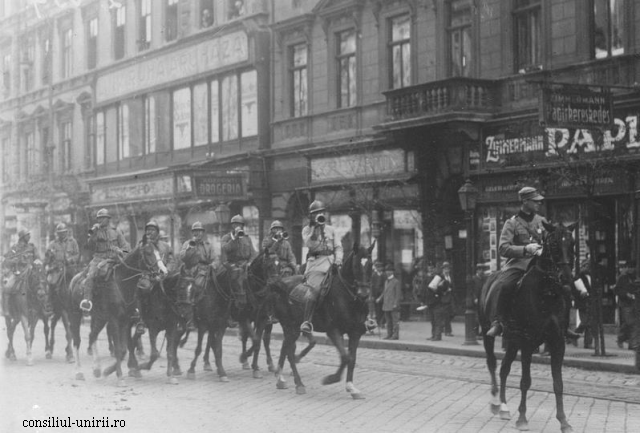
The First World War was also known as “The Great War since until then the world had not witnessed such horrendous atrocities. Romania participated in the war with loads of enthusiasm, in much the same way as all nations did. Yet the conflict would soon turn into a collapse. After two years of neutrality, in August 1916, the Romanian army enters the war taking sides with the Entente and crosses the border of the Austro-Hungarian Empire in Transylvania, a predominantly Romanian-inhabited province. In the wake of four months of battle, in December 1916, Bucharest was occupied, and the state institutions were relocated to Moldavia. In the long run, however, in 1918 Romania was on the winning side, going from agony to ecstasy.
The Romanian Radio Broadcasting Corporations archives comprise testimonies revealing a country where people went to great lengths to create a better world. General Titus Garbea, who was interviewed in 2001, recalled the buoyant atmosphere that dominated the Romanian society ahead of the war.
“My father was a descendant of Tudor Vladimirescu, originating from Gorj. Mother was from Fagaras, she was the daughter of a priest who was schooled in Vienna and then moved on to Italy. The Italy he knew was the only thing on his mind, so he had his children learn Italian as well. Little wonder, then, that poor mother spoke Italian, and she taught us Italian as well. At home the atmosphere was very patriotic. I remember her having us kneel in front of the icons of our peoples martyrs: Horia, Closca and Crisan, with Michael the Brave holding pride of place. And we sang and prayed to God for them. Then there was the king. We were royalists, we were fervent supporters of the monarchy! He was Carol the Great! And so we sang “Long Live the King! Intellectuals had a significant contribution to that spirit.
General Constantin Duncan fought in the First World War as an orderly.
“In 1916 I was officially deployed at the hospital hosted by the Petru Rares high-school. I was assigned to a stretcher carrier, back then we had a company of stretcher carriers, which was divided in two: a section was run by general Prezan, while another one was under General Averescus command. The stretcher-carrying vehicle is a car used for the transportation of the wounded from the battlefield, from the first-aid posts to the inland hospitals. It was a vehicle with an engine, driven by a corporal, and I was the stretcher-bearer. We were driving the wounded to the hospital, we filled the beds at the hospital in Piata Neamt. There were several hospitals back then, since all schools had been turned into hospitals. “
Politician Constantin Moiceanu was a member of the Social Democratic Party, an anti-communist party headed by Constantin Titel-Petrescu. In 2000, he told Radio Romania about the front near his native village and the relations between the civilians and the Russians, who were the Romanians allies:
“With the frontline so close to us, no one was in the mood for any holiday celebrations. My brothers, and other soldiers from the area, would come to the village at night, when there was no fighting, and tell us how the battles went, who had died and so on. We had the advantage that we were familiar with the places. Secondly, at some point the Russian troops came. They were known as heavy drinkers, and as being really rude. My parents were well-off people, they had a big house and more than a hectare of vegetable gardens, and had barrels of wine and plum brandy down in the cellar. So one day they heard the Russians were coming over, and they got some people to take out the barrels in the yard and empty them. They didnt have anywhere to hide them, so they chose to get rid of all the wine and spirits, because they knew the Russians got violent when drinking.
Gavril Vatamaniuc was the only survivor of an anti-communist resistance group in Bukovina. In 1993, he told us about a fellow prisoner at the Gherla penitentiary, a Frenchman who had been a volunteer in the war and stayed in Romania after the war ended:
“I will never forget this man. He was more than 70 years old, and he told me that in 1916, as a young French officer, he had come to fight together with the heroic Romanian army against Germany. He fought on the Moldavian front, he was wounded, taken to a hospital in Iasi, and there he met a very nice young Moldavian girl, a nurse called Maricica. He pronounced ‘Marishica and we used to laugh about his Moldavian accent, you could swear he was born and raised here. He fell in love with this girl and when he got better he decided to marry her. He sold all his property in France and came to Romania with the money. He bought a small farm and, as you can imagine, he did pretty well. But then the communists came to power and they decided this farmer must be destroyed.
One hundred years after the Great War, Europe still remembers acutely the conflict that marked the beginning of a new era. Like all times in history, this period, too, had its share of tragedies, heroism, fulfilled or shattered dreams.


























