Romanian Democracy Reborn
In March 1945, the Petru Groza government, controlled by the Communist Party was installed to power, under Soviet pressure. Before 1989, the communist regime considered this its founding moment. I
Steliu Lambru, 21.12.2015, 15:18
In March 1945, the Petru Groza government, controlled by the Communist Party was installed to power, under Soviet pressure. Before 1989, the communist regime considered this its founding moment. In reality, the Groza government wiped out democracy in Romania for almost half a century.
The communist ideology tried to inoculate in people’s minds a way of seeing the world from the perspective of the state, one built on Marxist-Leninist ideology. The state controlled everything, from the economy to people’s spare time, and meddled in everything. The communist state meant the atrophy of freethinking and free will, and an encouragement of hatred and intolerance.
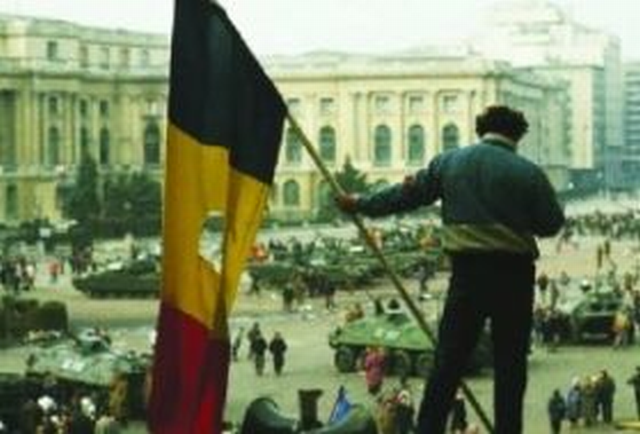
The beginning of the anti-communist protests in Timisoara on 16 December 1989 was something most Romanians eagerly awaited. Historians and political scientists said that 1989 was a return to democracy, which regular people saw as a restoration of basic human needs. Politics also returned in the proper sense, that of allowing the citizen to express himself in the public sphere. On December 22, 1989, when a helicopter flew Nicolae Ceausescu off the roof of the Central Committee building, freedom ensued. The days that followed were euphoric, but soon people had to grapple with a new reality. Quite soon after, however, the euphoria was replaced by a negative attitude, of profound frustration and a sense of helplessness, since things were not changing as fast as people would have wished. Triumph was replaced by cynicism and nostalgia.
Political scientist Ioan Stanomir believes that the date of December 22, 1989, has all the features of a founding moment: “December 22 is indisputably the final point of the communist interval. We should emphasize this fact because some politicians, after December 1989, tried to minimize the anti-communist dimension of popular protests that led to the fall of the Ceausescu regime. I insist on this dimension. It was not just about removing a dictator who dishonored this country, but also about affirming some values that, though not precisely defined, represented the wish to remove the communist regime with its entire retinue of material privations and dramatic political constraints on freedom.”
Romanian democracy recovered with great difficulty, and there have been some milestones, which were more like hurdles in the beginning. The first was the communist heritage and its role in the new society. This heritage was the economic reform that brought about downsizing, closing down industrial units and financial insecurity. The second was the return to “Romania of before 1945” and the critical look on the democratic heritage from a half century before. The third, and not last, was the feeling that the young people who sacrificed their lives died in vain in the revolution. In spite of the wish to break with the recent past, people started feeling that democracy was a burden. Shedding the scales of communism proved to be a lengthy process, which few understood at the time. It was a painful process of telling public right from wrong, looking to the past versus looking to the future.
Ioan Stanomir: “December 22 is like the Roman god Janus, an event with two faces. On the one hand it is a celebration of freedom, on the other it is the moment when the adventure of the so-called terrorists begins. If it hadn’t been for the so-called terrorists and if there hadn’t been all the deaths that occurred under circumstances as yet still muddled, December 22 would have had a different outcome. One should not forget that there is a cemetery of the Heroes of the Revolution, and that the people buried there are, to a great extent, the result of the action of the mysterious terrorists after 22 December 1989.”
Romanian democracy was reborn, and plurality of opinion was a sign of society getting nursed back to health. One rebirth was undergone by the historical parties removed by the communist regime, people were free to propose ideas and then take action. Their voices were listened to more and more, and the behavior of politicians started adapting to the wishes of voters.
Ioan Stanomir: “December 22, 1989 was truly a moment of fraternity, followed quickly by a moment of break down of unity. Romania’s citizens became divided, and the factors that divided them were Ion Iliescu and the National Salvation Front, which appropriated, in a partisan manner, December 22 and took over its heritage on behalf of a state-party. It was the beginning of the end for this dream, this illusion of fraternity. December 22 became just as another day, what followed was, in historical sequence, the tragedy of the terrorists, the month of January 1990 with protests from democratic parties and their violent repression, February 1990, March 1990 and the incidents in Targu Mures, University Square, and finally the miner raids of June 1990.”
On December 22, 1989, Romania knew what it had to do after ridding itself of the most detestable form of tyranny in its history. Liberal democracy was back, and, with all its shortcomings, it was still the best political system, one for which over 1,000 Romanians gave their lives.
(Translated by Calin Cotoiu; Edited by Diana Vijeu)