Romanian Palaeolithic
Prehistory may look like a time of adventure and adrenaline rush. In reality, prehistory is one of the most difficult exercises of reconstruction of the oldest period in the history of humankind.
Steliu Lambru, 11.11.2013, 12:26
Prehistory may look like a time of adventure and adrenaline rush. In reality, prehistory is one of the most difficult exercises of reconstruction of the oldest period in the history of humankind.
There are no written documents from that period, also dubbed “the childhood of humankind”, which is usually studied in close relation to anthropology. It’s a field analyzed by geologists, archeo-zoologists, as well as specialists in micro-fauna and date setting.
Items from the Romanian Palaeolithic have been discovered in the Arges River Basin, in the Sibiu Depression and the southern sub-Carpathian area. Archaeologist Adrian Dobos with the Vasile Parvan Archaeology Institute of the Romanian Academy introduced us to Palaeolithic, an era when stone was the expression of human civilisation.
“Etymologically speaking, Palaeolithic means the stone age. Back then, people would exclusively use carved stone. Later, in the Neolithic, people used both carved and grinded stone. Contrary to the general opinion, what we do is rather precise. Sometimes they say it’s speculation, because we analyse carved stone objects and sometimes human fossils, which is rather rare and something that we are eager to find. And then there is fauna. When you study a Palaeolithic site, it’s important and useful to have fauna to study. Besides identifying species, we can learn about the climate in which that site or the various levels of the site appeared.”
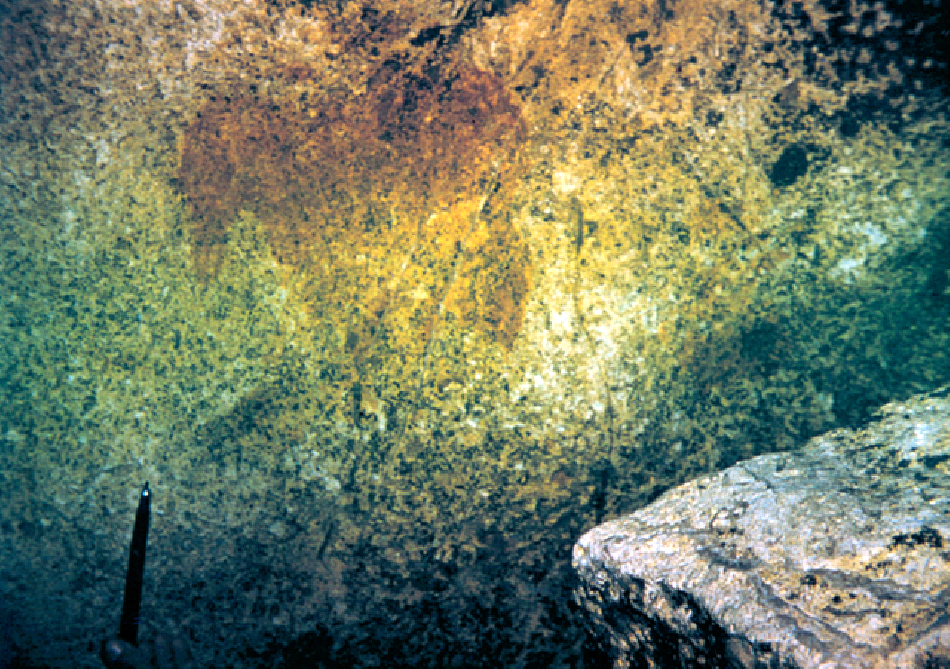
In Cuciulat, Salaj County, north-western Romania, archaeologists found cave paintings going back to the Palaeolithic: a horse and another animal that specialists say could be a feline, maybe a panther. Adrian Dobos was part of a team of archaeologists who in 2009 discovered the oldest Palaeolithic site in Romania in Dealul Guran, Dobrogea.
“Guran Hill is a site that we discovered in 2009 during a project run by the Archaeology Institute together with the Max Planck Institute of Leipzig and the Romanian-German Museum in Mainz. There were six weeks of periegesis and we also dug in 2010 and 2011. That is a silex exploitation area and we managed to go down to a level dated 390 thousand years ago. It is still the oldest site in Romania. There have been other findings from the early Palaeolithic, but most of them in river basins. If the site is not intact, it’s difficult to establish precisely that it goes back to the early Palaeolithic.This is quite impressive for Romania, as the number of Palaeolithic sites in Europe is rather small, around 15-20. “
What did the Palaeolithic man look like? How similar was he to us? Who inhabited the territories of today’s Romania in Palaeolithic times? Adrian Dobos:
“The term ‘hominin’ applied to he who made tools, hence the description ‘homo habilis’, that is the skilful man, the man who carved. The size of the skull is another criterion. Individuals whose skulls exceed 600 cubic cm are considered to form part of our family tree. Locomotion has recently become another criterion and in this respect, even the oldest australopithecines capable of bipedal movement are classified as hominids. Locomotion is a necessary feature of man’s ancestors. The oldest fossil found in Romania similar to modern man in anatomic terms originates from the Bone Cave and is dated 36,000 years ago, which makes it the oldest fossil in Europe. This cave is not, however, an archaeological site, but was discovered by a few cave explorers. The archaeologists found nothing here. No fossils have been found on Romania’s territory of the Neanderthal man. He must have lived in these parts, but we have been unable to find any trace of him so far. The oldest hominid discovered here is Heidelbergensis, a generic term for homo erectus, the upright man. Homo Heidelbergensis was shorter in height and had strong ape-like appearance. His brow ridges were more prominent and also displayed the traces of the sagittal crest in the middle of the skull. We do not know precisely whether this individual was weaker or stronger than his descendents because there aren’t enough fossils available for comparison.”
The site in Bugiulesti is representative for the Romanian Palaeolithic, because scientists long believed that this is where the oldest hominids used to live. Adrian Dobos: ”This is a very important site, in paleontological terms. Around ten points of interest have been noted in this village. Dating back 1.8 to 2 million years, they were discovered in the late 1950s, and mainly consist of stacks of large animal bones. At some point some fragments were found, which were said to be tools made by hominins, therefore by australopithecines. It was definitely an area where the excitement of archaeologists converged with the authorities’ tendency to idealise the history of the country.”