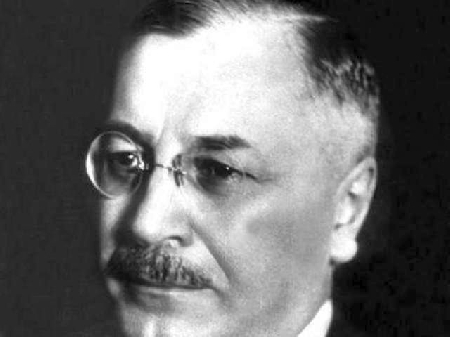
Sociologist Dimitrie Gusti (1880-1995)
Dimitrie Gusti is the most important Romanian sociologist of the first half of the 20th Century.
Steliu Lambru, 11.03.2013, 13:42
Dimitrie Gusti is the most important Romanian sociologist of the first half of the 20th Century. Most of Romania’s sociology’s progress is connected to his name. A university professor, member of the Romanian Academy and education minister between 1932 and 1993 Dimitrie Gusti set up the Romanian Institute of Sociology and coordinated several sociology magazines. He initiated the famous ‘mixed teams’ made up of students and researchers from various fields, who went from one village to another to observe and then write monographies of the places they studied.
He was also a promoter of social services, by means of which academic research blended with social action and social pedagogy. His main goal was to improve the living standards of peasants, who lived in precarious economic, political and cultural conditions, and to turn them into citizens of the Romanian state built after 1918. In 1936 Dimitrie Gusti set up the Romanian Peasant’s Museum, which is now a landmark of the capital Bucharest. He is also known as the founder of the Romanian school of sociological thinking. Dimitrie Gusti and the ‘Gusti school of thinking’, were revisited by the French magazine ‘Les Etudes Sociales’, in a double issue of 2011, under the title “Sociology and politics in Romania between 1918 and 1948”. Sociologist Vintila Mihailescu will tell us next whether Dimitrie Gusti can be considered an innovator or not:
“Gusti was not an innovator, his work is part of the Romanian tradition of rural studies. This is a very sensitive issue. If someone wanted to turn sociology into a tool that served the nation, he could very well do it. As long as it was not a nationalistic tool. Gusti put it clearly: ‘since the national construction is a priority of the current society, sociology can deal with that too’. If in the 21stcentury sociology was only dealing with the issue of vassal peasants, that would be pretty ridiculous. After WWII Gusti focused on a completely different concept, that of United Nations. Therefore sociology had to change contexts. But in the context of a society that was 85% rural, to accuse or suspect a sociologist of focusing only on peasants is odd, to say the least.”
Dimitrie Gusti founded the Bucharest school of sociology, which looked at the changes occurring in society, at how tendencies could be predicted and how social processes could be analyzed. He was the promoter of the monographic research method, according to which a subject could be understood if analyzed from the perspective of several disciplines. Sociologist Dumitru Sandu answered the question asked by the magazine “Les Etudes Sociales”, namely whether Gusti’s method was indeed a school of thinking:
”I was asked ‘what sort of school is the Gusti School?’ Well, I believe it is a school, but the question is what kind of school? We know how it was labeled at the time: The Gusti School, the Bucharest School of Sociology, the monographic school, the Romanian school. And we know there were three types of schools, focusing on method, on theory and on methodology-epistemology. I would add a 4thtype of school that promotes a model of social action, in other words a school of intervention. The Gusti School has all these components.”
The French magazine “Les Etudes Sociales” blames Gusti, among other things, for being a supporter of Fascist ideas. Antonio Momoc, a lecturer at the Bucharest Faculty of Journalism and Communication Sciences, explains why Gusti was labeled a Fascist.
“The Romanian Social Institute was hosting debates, which brought together all the leading intellectuals of the time. Dimitrie Gusti made a remark during one such debate about political parties’ doctrines. It was in 1922 and the paper was published two years later. It was back in the early days of the Italian fascism, a movement that didn’t exist at that time in Romania. Fascist ideas emerged in Romania around 1923 as a reaction to the Constitution issued that year. In the 1920s the support for extremist parties was quite small, standing somewhere at 3-4%, and fascism was nothing but a curiosity. Dimitrie Gusti was the only person who referred to Mussolini’s fascism during that debate. And none of the other persons attending the debate considered important what was happening in Italy at that time. It is not clear why he was accused of fascism. What he did was to make a clear distinction between political parties, and from his point of view and in accordance with his own system of the political and ethical sociology, he believed there were two types of political parties: parties with a platform and opportunistic parties. He provided arguments that the Fascist party did have a platform and people were enthusiastic about the fascist doctrine. That was all he said about Italian fascism. So, it’s rather strange to accuse Dimitrie Gusti of being a Fascist.”
After the War, Gusti discretely collaborated with the communist party, which shows that nobody can escape the influence of the times they are living in, as happened with many intellectuals whose political views influenced their scientific work.