The 1907 Peasant Revolt and Anti-Semitism
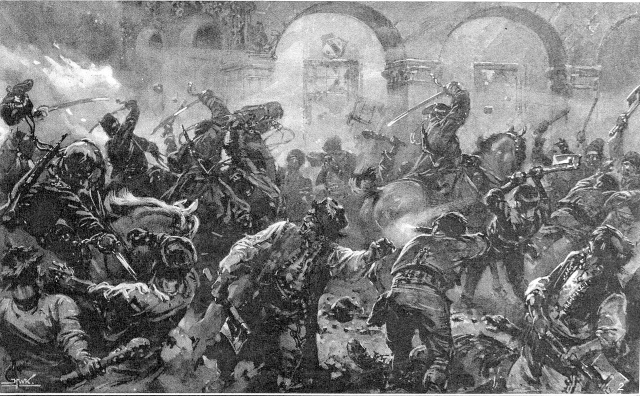
Considered to be the last large scale popular revolt in Europe, the Peasant Revolt of 1907 started in northeastern Romania.
Monica Chiorpec, 08.02.2016, 12:55
In early 19th century, serfdom had been reintroduced as
agriculture converted from pastoral farming to export oriented farming. This
feudal formula, binding the peasants to the landowners, was abolished by the
agrarian reform of 1864, which turned land definitively into private property.
Almost 59% of the total arable surface owned by large landowners was rented.
The renter paid a fixed amount for the land they were managing, trying then to
maximize profits by exploiting the peasants. This is one of the main causes for
the widespread discontent among the rural inhabitants. Here with details is
historian Alin Ciupala.
Alin Ciupala: The 1907 Peasant
Revolt produced a real shock in Romanian society, not only by the size of the
event, but also because it brought to the surface, in a violent form, the
failure of that society, the failure to modernize. Let us not forget that less
than a year before the revolt, an exhibition opened in Carol Park in Bucharest
wanted to show the Romanians, but also the rest of Europe, the achievements of
Romanian society during King Carol’s reign, between 1866-1906. In other words,
we have two moments, which, set next to each other – the jubilee exhibition and
the 1907 revolt – showcase both the achievements of Romanian society, but also
the discrepancies, contradictions, failures.
The bloody peasant revolt started on 21 February 1907, in the
village of Flamanzi, in Botosani county, northeastern Romania, and quickly
spread all over the country. The government cracked down on the revolt using
armed force. At that time, the peasant uprising, violently repressed by the
authorities, gained an anti-Semitic component, in the idea that it was the
Jewish land managers that exploited the Romanian peasant. Alin Ciupala believes
this to be a simplistic vision.
Alin Ciupala: If we look at the
event as a whole, we notice that its causes were much more nuanced, we cannot
talk about the excesses of Jewish land managers as being the main reason for
the revolt. In fact, if we make an analysis of statistical data at our
disposal, we notice that the Jews were by no means the predominant group among
land managers. We can see just as many Romanians, we find westerners who came
here for business, for getting rich. And land management was a capitalist means
of exploiting the land, as Romanian society was mainly agrarian.
The 1907 revolt is an important event also because it shows how
widespread anti-Semitism was in Romanian society. Alin Ciupala again.
Alin Ciupala: It was, I could say,
some sort of Dreyfus affair. Just as a few decades before that the Dreyfus affair
had brought to light anti-Semitism in the French society, the same thing
happened in Romania with the 1907 Revolt. The revolt is very important for
understanding the size of the agrarian problem in Romania, probably the most
important in Romanian society, but also an opportunity to evaluate the
dimensions of Romanian society, and also an element helping us to understand
Romanian anti-Semitism.
There have been voices doubting the exclusively peasant dimension of
the 1907 Revolt, and historian Alin Ciupala explains.
Alin Ciupala: This interpretation
was favored by the communist regime, in the wish to present this event as a
general protest of the exploited against the exploiters. Not at all! It is a
mostly agrarian event. It is also very important to notice that it was not the
poorest of peasants that revolted, as one may believe, but first and foremost
the middle class of peasants, which owned land, to a certain extent. This shows
us that the revolt was not caused by ownership relations, so the main cause was
not the lack of land.
Between 21 February and 29 March 1907, 140,000 soldiers were
mobilized to smother the revolt. According to some western sources, 11,000
people lost their lives, even though there are indications that the real figure
was not as high as that. Historian Alin Ciupala believes that the number of
victims is not that important, but rather the inappropriate reaction of the
authorities, in a 20th century conflict reminiscent of the Middle
Ages.
Alin Ciupala: We can say that the peasants
were the main actors of this event, the others being the authorities. The
position of the authorities, at least in the first weeks, was very tough
because of the panic. As I said, Romanian society was unprepared. The revolt
spread all of a sudden and the phenomenon was ample, especially in Moldavia.
There was general panic, a real psychosis, which explains the authorities’
extreme measures. Ionel Bratianu, minister of the interior, wanted to temper
these excesses, appointing new prefects in the counties affected by the revolt,
among them Constantin Stere, who had a very important role in Moldavia, in
order to calm spirits and end this forceful intervention.
The main cause of the 1907 revolt remains, therefore, the
dysfunctional local administration system, which was quite corrupt. The Liberal
government at the time initiated inquests that established the fact that it was
not Jewish land managers’ excesses that caused the revolt, which had widespread
coverage in 20th century European press.