
The Cucuteni-Trypillian Culture
Today's Pro Memoria gives you an insight into Romania's distant past.
Steliu Lambru, 21.10.2013, 13:05
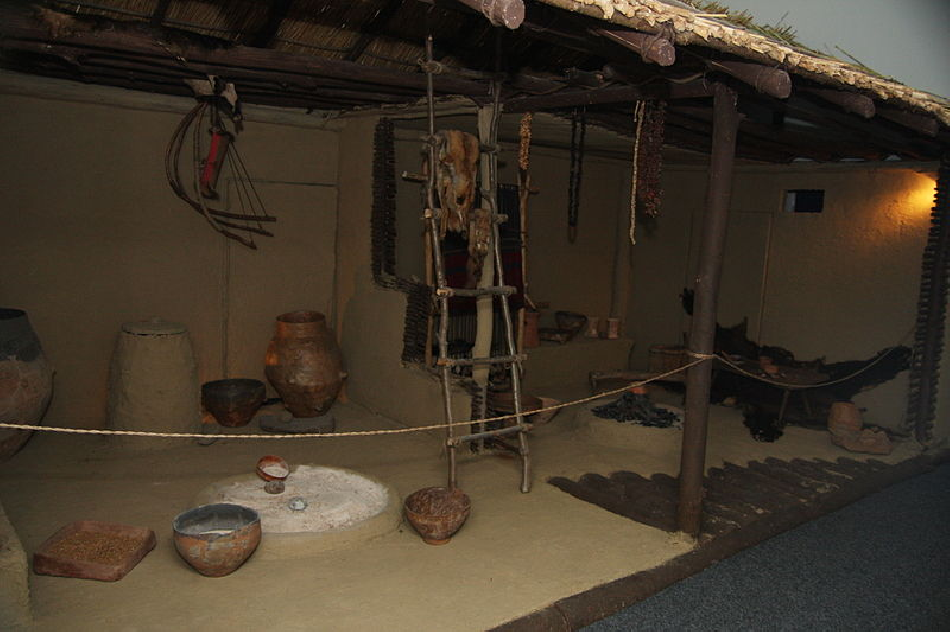
The Cucuteni-Trypillian culture is one of Romania’s most impressive Neolithic archaeological cultures. It stretched across a surface area of 35 thousand square kilometers including northeastern Romania, the Republic of Moldova and southwestern Romania. It took its name from Cucuteni, the village where in 1884 the first archaeological vestiges had been discovered. The Cucuteni culture is famous for its superbly painted ceramics and has been dated around 4,800 BC. People back then were known as “Cucutenieni”. Hunting, fishing and farming were ingrained in their lifestyle.
Apart from that they specialized in household crafting and salt mining and trading. The village of Poduri in eastern Romania’s Bacau County is one of the most notable settlements where traces of the Cucuteni culture first emerged. A rich archaeological site was unearthed here in 1979, with lodgings, tools, supply storage areas, painted ceramics, statuettes and even a mill among the most important finds. The Cucuteni people’s tale is buried underneath the Ghidaru hill. It is that tale we’ll be trying to tell today, with the help of Radio Romania’s Oral History Center, which made a documentary about the archaeological site in Poduri. Dan Monah is the archaeologist supervising excavation works on the premises.
“The fist inhabitants settled in Poduri around 4800 BC. They built their first village which at a certain point in time was destroyed by a fire. The people returned on the premises and rebuilt the village. And that is how the phenomenon repeated no less than 15 times. The surface area we managed to research is, unfortunately, limited. We’re getting close to doing research for a surface area of 1,000 square meters or thereabouts, while the hillock’s surface area
exceeds 12 thousand square meters, and the settlement’s overall surface area accounts for 60 to 80 thousand square meters. Sedentary farmers used to inhabit the settlements in Poduri. They were also fishing, hunting and collecting fruits. But the salt springs nearby were something those farmers heavily relied on. There they extracted salt which they subsequently traded with the populations from areas with no salt deposits.”
Historian Dan Monah also spoke about the most relevant items and constructions that were unearthed in Poduri.
“We dug up large granaries, and I also mention a lodging where no less than 16 cereal storage rooms were unearthed. We excavated box-shaped with the surface area of one square meter and with 45-centimeter- high walls, so they had a capacity of half a cubic meter. But the most spectacular discovery in the region is the so-called mill. It is a construction with 4 panhead-shaped granaries about one point ten meters tall, with a lid and a vent hole. When they were dug up, they were filled with charred cereals for up to three thirds of their capacity. It’s interesting that each granary was meant for storing a specific type of cereal, since two of them had barley for their most part, while the other two stored wheat. Close to the two granaries there is a square-shaped construction where 5 hand-mills were placed, 3 bigger and 2 smaller ones. They were fastened in white-painted clay plinths. The construction had one groove through which the corn and grain milling was evacuated. It is one of the oldest grinding mills in South-eastern Europe.”
The inhabitants of Cucuteni worked hard, but they also prayed. We have a comprehensive inventory of worship items Dan Monah and his team unearthed in the Poduri archaeological site.
“A construction was discovered, with two hearths. Near the first hearth there was a statuettes complex, made of six feminine items, a burnt clay throne and a small ceramic jar. We called the complex the Sacred Family, as it looked like it reflected the feminine part of a family. So we had a matron and six other feminine shapes which, judging by their dimensions and certain somatic features, appeared to have been younger than their matron. But the most interesting discovery is the one we made in the same construction, where near the second hearth a pot was found, with 21 feminine statuettes, 13 thrones and two objects which at that time we called unidentified historical objects. The pot with the sacred objects was protected by another pot placed with its bottom up. All items were broken because the walls of the construction had crumbled, and because of subsequent sediments. The complex, which we called The Gods’ Synod is a portrayal of the pre-Cucuteni inhabitants’ pantheon, and not only for those from Poduri. 28 years later, in Isaia village, Iasi County, a vase was dug up in a pre-Cucuteni settlement, containing 21 miniature statues, 13 thrones, 42 perforated spheres, 21 cones, 21 partially perforated spheres. Thus we discovered a link between the two worship sites, underscoring the religious unity of pre-Cucuteni tribes”.
Romanian physician Romeo Dumitrescu is a Cucuteni pottery collector and one of the sponsors of the excavation operations.
“The most valuable items are those found in the Bohotin treasury, made up of 21 deities, of which 13 are seated on a clay chair. Adding to that is an extremely rare item for that period, which is also part of a set of 21 clay figurines, which has a beautiful image of a couple engraved on the side of a chair. Every object is beautiful in itself. Each has its peculiarity. They make up a pattern that is specific to no other culture and sticks to the mind”.
The Cucuteni culture is a palpable manifestation of the Neolithic man, whose creativity is no less powerful than today’s artists. Its history rolling back to the present Today’s archaeological finds never cease to marvel the mind and delight the eye.


























