The First Documented Mention of Suceava. The End of Serfdom in Wallachia.
This weeks feature offers an outlook on medieval Suceava and discusses the abolition of slavery in Wallachia.
Steliu Lambru, 11.02.2013, 13:02
One of the oldest urban settlements in medieval Moldavia is Suceava, the first attested capital of that old kingdom. Located in Romania’s extreme north, Suceava has developed as a result of the expansion of the medieval Hungarian kingdom towards the north. The birth of the city is linked to the emergence of the medieval state of Moldavia.
Around mid-14th century, Romanians from Maramures, led by a local warlord, Dragos, were sent by King Louis I of Hungary to guard the Mark of Moldavia, a buffer region, against the Tartar threat from the east. After the state of Moldavia consolidated in the 14th century, Suceava became the royal seat for two centuries, and the first king to rule from there was Petru I Musat (1375-1391).
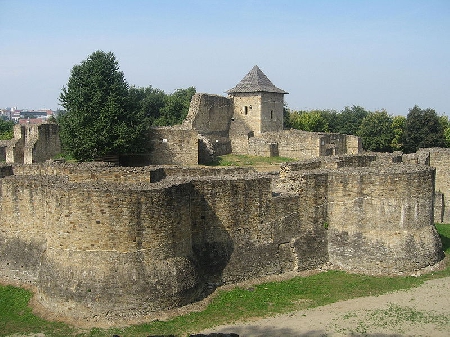
There are two versions as to where the name of the city comes from. One version is that the name comes from the Hungarian word for the craft of making sheepskin coats. Other sources claim it comes from the word for elder tree forest. The city itself has developed between two fortifications. One of them was Scheia, or the Western Citadel of Suceava, in north west of the city. It is on a hill 384 meters high, 80 meters above sea level. It was a part of the system of fortifications erected by Prince Petru I at the end of the14th century. In the 15th century, during Alexander I of Moldavia, also known as Alexander the Good, , the fortification fell out of use. The ruin is now an archeological site and has been turned into a local monument.
The second fortification, the Royal Seat of Suceava, is in the east, on a plateau 70 meters high. It was built by Petru I too, but was preserved and expanded by his descendants. It was fortified by Stephen the Great, but in 1675 was destroyed. It too has fallen to ruin and has been included on the county’s list of historical monuments. Medieval Suceava was a multiethnic trading hub, home to Romanians, Germans, Hungarians and Armenians alike. During Alexandru Lapusneanu’s reign, by mid-16th century, the capital was moved to Iasi, but Suceava remained a princely residence until the early 17th century.
The 1848 revolution is considered the advent of the modern era in the Romanian principalities. It was the result of increasing contact with western states, and the dwindling of Ottoman influence. All nations in Central and Eastern Europe were seeking economic development and spiritual growth. Romanian revolutionaries were no different, fostering many ideals of modernization as vistas for social, political and economic advancement. The new model of society was based on the idea that man should be free from serfdom and be creative for himself and his community. In this context, slavery or serfdom was the worst sin of the past.
In the Romanian principalities, many peasants were serfs. There was also a much harsher type of servitude, full-fledged slavery, this time enforced on racial grounds. The Roma, or gypsies, were in slavery, as actual property to be bought and sold. The origins of the gypsies are lost in time as documentation goes, but it has been established that around the 13th century, northern Indians were recruited as auxiliaries by Mongol armies in their campaigns.
The Romanian principalities had three categories of gypsy slaves: slaves of the state, of the church, and of private citizens. Slavery was well regulated in medieval and modern Romanian society, and laws were clear: slaves had no rights, and their treatment was at the mercy of the owner. The great obstacle in freeing the Roma was convincing the owners to grant them equal rights under the law. For abolitionists, the idea of slaves in modern society was abhorrent. Society had a hard time accepting abolition, and the first attempts were made as late as 1837-1838. Gradually, the idea gained popularity around the 1848 revolution.
As humanitarian arguments did not resonate with slave owners, the abolitionists relied on economics. In 1837 Mihail Kogalniceanu, one of the first prime ministers of the Romanian united principalities, and Ion Cimpineanu, the latter being the first landowner who set his slaves free voluntarily, ran a fierce campaign in the press and in speeches. They insisted that slavery was not efficient economically. One of the arguments was that feeding the army of slaves in every nobleman’s household was costing more than what they produced through their work, which was supposed to be free of cost.
After 1850, noblemen owning slaves understood more clearly the economic sense of abolition. On 8 February 1856, around the Paris peace conference that ended the Crimean War, Wallachian prince Barbu Stirbey issued a law that freed 250,000 people, around 7% of the population of his country.