The paratroopers of the Romanian Army
The paratrooper forces are a relatively new army in military history, being closely linked to the development of aviation
Steliu Lambru, 15.01.2018, 12:57
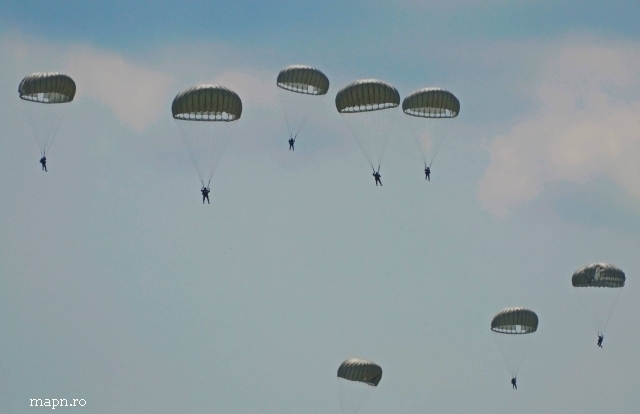
Set up in 1941, the Romanian paratrooper unit has a winding history. In 1944, at the request of the Allied Control Commission controlled by the Soviets, the Romanian paratrooper unit was dismantled. It was re-established in 1950 and then expanded in 1980 during Nicolae Ceausescu’s regime. During the anti-communist revolution of December 1989, the paratroopers from the Boteni regiment, 160 km northwest of Bucharest, sacrificed their lives for the cause of the revolution.
The firing squad who executed the Ceausescu couple was formed by three paratroopers from Boteni, a commissioned and two non-commissioned officers. After Romania’s accession to NATO, the paratrooper forces were reduced and resized in keeping with NATO standards.
In 1997, Radio Romania’s Oral History Centre had the chance to interview Gheorghe Angelescu, one of the first young men to enter the paratrooper unit. He remembers how he became part of the future elite troops of the Romanian Army: “Like any young man, I was attracted to the idea, except that it was a long road from wishful thinking to reality, because I wasn’t of the right age yet. We had a neighbour who was a private secretary at the Ministry of War and I went to him behind my parents’ back and told him my mother asked him to help me. He told me to bring him my birth certificate and a written application for an age dispensation. Around the 1st of November, I was announced my request had been approved. I went to the train station, got on the train and went to the aerostation, which was the first stop after Pantelimon, to the east. The aerostation, in fact a unit for air balloons that were no longer in use and were no longer even there, was in the middle of the forest. All you found there were a few elderly guards.”
Gheorghe Angelescu began a strict instruction and training programme. Like any school, the paratrooper school combined physical training with academic classes: “Apart from customary military training, lessons about weapons and how to handle them, there was a lot of emphasis on sports. We used to practise a lot of sports to become fit and stay fit. There was also a series of special courses involving a lot of nighttime activities to get used to moving about in darkness. I even started to believe I could see better at night than during daytime, we did so much night orienteering. They would wake us up while we were sound asleep, whether in winter or summer. I began in November, so I did a lot of my training in winter. We would be marching for 15 to 20 km every night, carrying all our weapons. I used to carry a machine gun, a Beretta pistol and a knife. We’d be trained for hours on end on how to handle and throw a knife, and how to be able to use the handle, not just the blade. We wore special boots with three layers of rubber soles, leather puttees and proper socks and not foot- wraps like soldiers from other armies.”
One of the most important components in a paratrooper’s training was naturally the parachute jump. Gheorghe Angelescu recalls: “We started skydiving training in the summer of 1944. After three jumps you would be made a sergeant and receive your skydiving licence. Our instructors were our colleagues who finished the training course before us and they gave us a hard time. We hated them at the time, but looking back I think they did well. By the 23rd of August I had already jumped eight times from the Junkers aircraft we used for training. There was only one parachute available for training. We trained for months, learning how to fold back the parachute and take it with us, for we couldn’t just leave it to the enemy. Preparing for the jump was really hard work. We used to dig a hole and fill it with sand, which we then covered with wood planks and to which we added some windows, which were supposed to represent the plane’s trap door. We would train by jumping in the sand pit. I even jumped from a height of 5 metres. In 1944 or 1945 I went to visit my grandparents and they asked me to fix something about the house. I climbed on a ladder and jumped from there. People were shocked, but for me it was the easiest thing in the world.”
When Romania came under Soviet occupation, the requisitioning began. The paratrooper unit was dismantled and its assets considered spoils of war. Gheorghe Angelescu: “They told us we had to get rid of our Junkers plane because it was made in Germany and was therefore considered spoils of war. We also handed over our parachutes, which were taken by the Russian Army. We handed over parachutes, German machine guns, everything that was made in Germany and was thus considered spoils of war. I don’t know what they did with the plane, it was a piece of junk anyway, but I suppose it was fine for the war, it had been useful to us and could be useful to others.”
Romanian paratroopers had some notable achievements, and their ranks also included parachuting and aviation pioneer Smaranda Braescu, a world record holder. (Translated by C. Mateescu, edited by D. Vijeu)