Tudor Vladimirescu and the Romanian national idea
The Greek and Romanian national ideas at the beginning of the 19th century had common roots.
Steliu Lambru, 12.12.2022, 13:43
In January 1821, several thousand men from Oltenia, today a province in south-western Romania, led by Tudor Vladimirescu, a former officer in the tsarist army, were marching towards Bucharest. That was the Romanian response to the national movement of freeing the Greeks of Eteria, a Greek national organization seeking to free Greece from the Ottoman rule and build a nation state. Vladimirescu thus answered the aspirations of the nationalist Wallachian boyars, who wanted, just like the Greeks, to free their country from the Ottomans. Personalities like Dinicu Golescu, Eufrosin Poteca and others made up the first generation of Romanian nationalist elites, who started to separate themselves from the Greeks in terms of ideas, attitude and language, in spite of their profoundly Greek education. The Greek and Romanian national ideas at the beginning of the 19th century had common roots. The Phanariot period, which had started a century before, had formed a Greek-Romanian symbiosis at the level of the elites.
The rulers of Wallachia and Moldavia were selected especially from among the Greek elite in Phanar. Through rulers, the Orthodox Church, the education system, mixed marriages and the circulation of capital and property, the Greeks and Romanians committed themselves to getting free from the rule of the Ottoman Empire and to forming nation states.
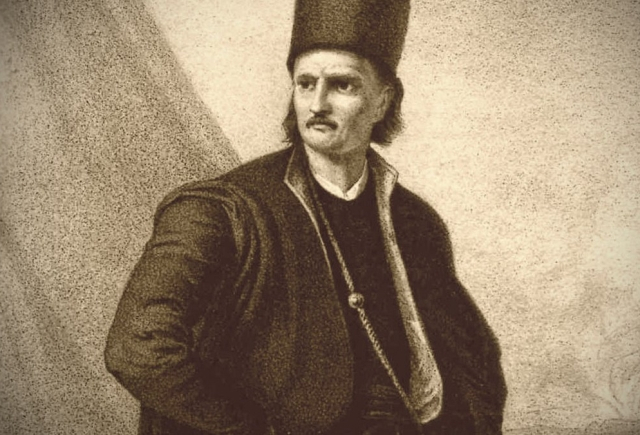
However, the Greek-Romanian solidarity eroded progressively and two different national movements emerged — the Greek and the Romanian ones. The 1821 moment of the insurrection led by Tudor Vldimirescu is regarded as the peak of the tesnse relations between Greeks and Romanians. Tudor Dinu is the author of a recent research book on Tudor Vladimirescu: “Tudor Vladimirescu was an overwhelming personality, quite different from the one we know from old history books. I would say he was the most important self-made man in Romania’s history. He was a simple person, driven by extraordinary ambition, which can be positive up to a point, who tried everything to make a brilliant career. He fought in the Russian-Turkish war of 1806-1812, when he met the future members of the Eteria organization, Iordache Olimpiotul and Iane Farmache. He worked for a famous boyard, Glogoveanu, in whose house he learned how to read, in Craiova. He was not very educated, as his family could not afford it. At the officials meetings with Greek personalities, such as Ipsilanti, he was always accompanied by a translator. His translator was the archbishop of Arges, Ilarios, who adviced Vladimirescu to kill Ipsilanti. So there were not always amicable feelings on both sides.”
Having left his native Oltenia, Vladimirescu settled in Bucharest, in the spring of 1821, where he ruled Wallachia without having formally invested to do so. The Greek army, led by Ipsilanti, who was a general in the tsarist army, was to be supported by the Russians to cross the Danube and take part in battles against the Turks. Not having received any support from Russia and faced with the Turkish danger, the suspicion of treason emerged between the two, following which Vladimirescu was assassinated by Ipsilanti’s men.
Vladimirescu was potraied as a hero in Romanian history books, in particular between 1945-1989, during the communist rule, when he was even described as a hero of the fight of the poor against the rich. According to Tudor Dinu, Vladimirescu was not quite the one described by historians during communism: “Tudor Vladimirescu saved money as administrator of the Gloveanu estate, opened his own businesses with everything that would make him money during those times, from cattle and fish to meat and alcohol. He had inns and wind mills and even tried to become rich by taking advantage of the corrupt administration. He was administrator of a mountain province, a position that he use to buy, just like all other positions were bought at the time. This was the only rule back then. Public positions were auctioned, just like the leadership of monasteries. He even managed to become, before 1808, supplier of the Princely Court and of the army, in the turbulent period of the Russian-Turkish war, and he did not stop there. This was his great quality, he believed in himself.”
The main practical effect of Vladimirescu’s actions was that the princes appointed by the Ottomans at the helm of the Romanian principalities were no longer Greek.