Typhus fever in Romania during the First World War
Historical records of epidemics in Romania include some terrible pages about the typhus fever.
Steliu Lambru, 13.04.2020, 13:02
Historical records of epidemics in Romania include some terrible pages about the typhus fever. According to statistics, in the winter of 1916-1917, the typhus epidemic killed some 350 thousand soldiers and 450 thousand civilians in Romania, being more deadly than war. Romania had entered WWI in August 1916 alongside the French-English-Russian Antante, through a military offensive in Transylvania. The German-Austrian-Hungarian counteroffensive in the North and the German-Bulgarian one in the South, forced the Romanian army to go into defensive. After four months of fighting, the Romanian army withdrew to Moldavia, together with the authorities and a part of the population. In December 1916, Bucharest was occupied by German, Bulgarian and Austro-Hungarian armies and a tough military regime of requisitions and restrictions was imposed.
The military occupation of Bucharest also meant the emergence of a new enemy: the typhus fever. At the end of December 1916, the first cases of infection were detected among the poor people of Bucharest. The disease spread and it soon turned into an epidemic. War and the lack of food and heat contributed to the spread of the disease. A second typhus hotbed, even more dangerous than the one in the South, was the one brought to Moldavia by the Russian army. Historian Delia Balaican with the Romanian Academy Library has researched the impact of the typhus epidemic on the Romanian society.
Delia Balaican: ”What did the typhus epidemic mean? The cause of it was the lice, which is indicative of poverty and lack of hygiene among civilians and the military. The disease had been brought to Romania by the Russian troops and had also been present in the Balkan area. It spread at the countryside when the Romanian troops withdrew to Moldavia. The situation got out of control and in March 1917 the mortality rate reached 30% among civilians an dup to 40% among the medical staff. ”
In spite of the chaos, Romanian authorities reacted and drew up a plan to contain the disease. Delia Balaican: ”In January 1917 the disease was officially recognised. The peak of the epidemic was registered in March. In the occupied Bucharest, the Institute of Bacteriology was being headed by scientist Victor Babes. In Iasi, following appeals of the French Red Cross, medical services were unified under the leadership of doctor Ion Cantacuzino. In Bucharest, Victor Babes was trying to produce serums and vaccines against typhus and other diseases, as, during the war, cholera and malaria outbreaks were also reported. Unfortunately, epidemics were also politicised and authorities were being blamed for not being prepared. However, typhus was a novel disease, unknown in the Romanian area, so there was no vaccine for it. ”
In any critical situation, however, there are people who have a clear mind and take the best measures. One of the the heroes of the fight against typhus was doctor Ion Cantacuzino. Delia Balaican: ”Doctor Cantacuzino, as mentioned in the memoirs of the personalities of that time and in the archives, made wonders in Iasi, in a very short time and managed to isolate the patients with typhus. A team of 150 engineers was commissioned with building some barracks in order to isolate the sick people from the healthy ones. The barracks were made of wood and were in fact military medical units in which soldiers and civilians were committed, irrespective of age and sex. The rural population was still living in huts and had no light. The humidity inside favoured the disease. The first measures taken was to move the sick people from these huts into the barracks, disinfect them, strict hygiene of the sick people twice a week and disinfection of their personal items. The items that were not burned, were disinfected in ovens. When this was not possible either, items were disinfected with petrol or vinegar. These were the measures at hand at that time. The same measures were also taken in Bucharest. In Iasi, the main problem of the authorities was to clean the town. The hard winter and heavy snow made this task even more difficult. Another big problem was collecting the corpses from the streets.
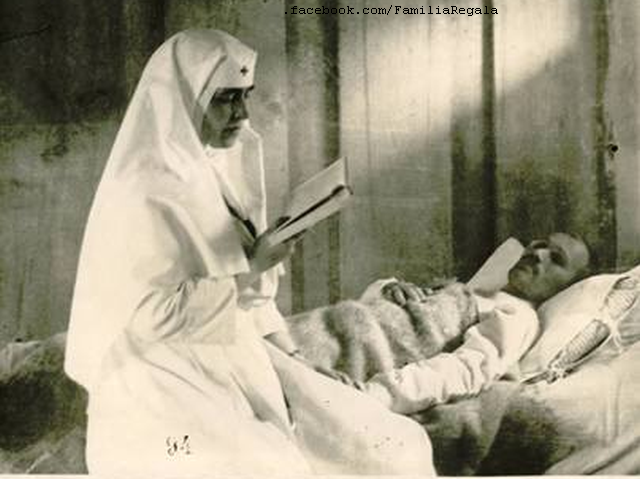
At those critical times, Romanians needed true leaders, able to help them cope with the disease. Delia Balaican: ”Queen Mary was a key-character not only during the unfortunate episode of the typhus epidemic. Pictures from the war show her caring for the sick, encouraging them and bringing them food due to the personal relations she had with foreign missions, especially with the American, French and British ones. Queen Mary was a role model for the Romanians and ladies from the high society took her example. War memoirs are describing Queen Mary in a touching way, as she was a symbol of the fight against the disease and perhaps the only bright image of a very difficult time.”
The measures taken were very effective, with the results being obvious by June 1917 when typhus had already been eradicated. It was the signal of recovery and it anticipated the victories of the Romanian army in Marasti, Marasesti and Oituz, that eventually lead to the final victory. (Translated by Elena Enache)