Brâncuși – Photography. The Invisible Studio
Târgu Jiu hosted the "Philosophy of Form" International Conference from October 22 to 26.
Ștefan Baciu, 07.11.2026, 14:00
In 2026, proclaimed by law as the “Constantin Brâncuși Year” to mark the 150th anniversary of the famous sculptor’s birth, conferences were held and exhibitions were opened, both in Romania and abroad, to celebrate the man who exerted a major influence on universal modern art. Consequently, the city of Târgu Jiu hosted the “Philosophy of Form” International Conference from October 22 to 26, dedicated to the renowned Romanian artist. Constantin Brâncuși was born on February 19, 1876, in the village of Hobița, located a short distance from Târgu Jiu; between 1894 and 1902, he studied at the School of Arts and Crafts in Craiova, followed by the School of Fine Arts in Bucharest. In 1905, he arrived in Paris, where he caught the attention of Auguste Rodin. After a period of apprenticeship in Rodin’s studio, he began creating his own sculptures in a studio in Montparnasse. In 1916, he established his studio on Impasse Ronsin, where he would create works that became known throughout the world. From the moment he arrived in the French capital, Constantin Brâncuși was drawn to photography; once he acquired a camera, he began photographing his own sculptures.
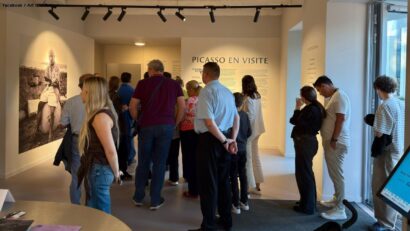
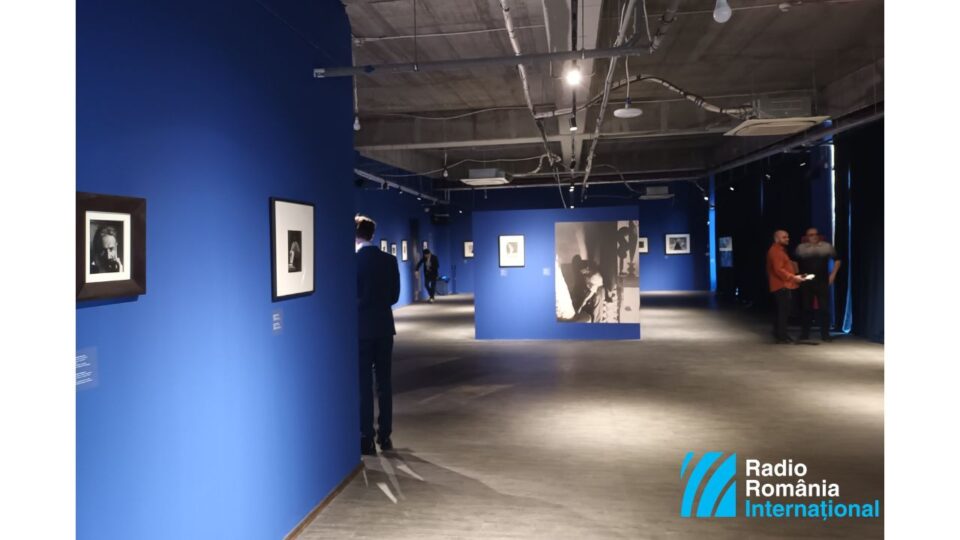
In the exhibition “Brâncuşi – Photography. The Invisible Studio,” recently opened in Târgu Jiu, the public can view 33 original photographs taken by Constantin Brâncuşi, which come from the David Grob Gallery collection. Initially, Brâncuşi photographed his works in an effort to raise money to cast his clay-modeled studies into bronze. The photographs in the exhibition were taken at a later stage, most of them within his studio, and capture how light fell upon the sculptures and their pedestals.
Eduard Enache, a young researcher of Constantin Brâncuși’s work, is curating an exhibition for the first time; he explained to us why Brâncuși was drawn to photography: “He experimented extensively and was deeply passionate about photography. In recent years, his photographic work is no longer viewed merely as a footnote to his sculpture, but rather as an independent work of art in its own right. Since we conceived this as an excursion into Brâncuși’s world, we begin at his threshold, specifically, with the mailbox he kept at the entrance. The photograph is anonymous; the identity of the person who took it remains unknown. We then move into an area dedicated to self-portraits. At a certain point, Brâncuși stopped allowing others to photograph his sculptures; instead, he set up a small photo lab in a corner of his studio, a space he painted white, precisely so that he might blend in, vanish, become invisible within his own white studio. From that darkroom, several hundred negatives and over 1,500 photographs have been preserved at the Centre Pompidou in Paris. Vasile Georgescu Paleolog, who knew Brâncuși personally, wrote perhaps the most eloquent account of how Brâncuși ‘sculpted with light’, a concept that is clearly evident here. Brâncuși’s photographs are the only surviving record of certain experiments he conducted. Furthermore, they may well be the only way in which Brâncuși, who never offered explanations for his own works, speaks to us about his sculpture. Through photography, he revealed how he wished for his works to be viewed and how he intended for them to be exhibited, how he wishes them to be illuminated, and, furthermore, how he wishes them to be interpreted, since he created a great many arrangements, installations, groupings of works.”
Eduard Enache is a disciple of Doina Lemny, an art historian and researcher specializing in the work of Constantin Brâncuși. A section of the exhibition “Brâncuși – Photography. The Invisible Studio” in Târgu Jiu is dedicated to Brâncuși’s self-portraits. Here is Eduar Enache with more: “The first section of the exhibition is dedicated to self-portraits; at the center of these three self-portraits we find a document. It is a passport application that Brâncuși submitted in 1933 to the Romanian Legation in Paris. This application offers us a glimpse of him; it includes a description provided by an official working there, who characterized Brâncuși as an apparently ordinary man, of average height, with brown eyes and graying hair. This is perhaps the only instance in the entire exhibition where we see Brâncuși as others saw him: as an ordinary citizen filing an application to obtain a passport. In contrast, the other self-portraits and photographs present Brâncuși exactly as he wished to be seen, and, perhaps, as he wished to be remembered, because he was keenly aware of his own significance and his legacy for posterity. Brâncuși’s engagement with photography began in 1914; during his first solo exhibition in New York, held at Alfred Stieglitz’s gallery, Brâncuși wrote to Stieglitz complaining that the prints had been poorly executed, declaring that, from that moment on, he would handle the photography himself and photograph his own works. Later, Man Ray helped him acquire a camera and a tripod, even offering to send the negatives to a professional lab for processing. However, Brâncuși, a true ‘tinkerer’ or ‘bricoleur’, as Doina Lemny often describes him, insisted on developing the images himself. He created his own darkroom, his own personal photo laboratory.”
The exhibition curator, Eduard Enache, highlighted that Brâncuși required all visits to his studio to be announced in advance; they followed a specific ritual, dictated by the lighting conditions. If it was cloudy outside, the visit was most likely to be cancelled. One section of the exhibition is dedicated to Brâncuși’s studio. Eduard Enache: “Moving on, we enter Brâncuși’s studio, the space to which he dedicated his entire life and existence. The exhibition also features excerpts from films by Brâncuși, some shot by the artist himself, alongside video material filmed by Doina Lemny and her team from the Centre Pompidou. These elements bring us into the present day, illustrating an ongoing dialogue with Brâncuși’s work across time. In 1926, as his ship entered the port of New York, Brâncuși saw Manhattan in the distance, with its characteristic skyscrapers of that era, and remarked that the city resembled his own studio. He was suggesting that nothing is fixed or rigid; indeed, this is precisely what we observe throughout his work. He experimented extensively with pedestals, a subject I have recently begun to research, and one that I believe remains under-explored in the study of Brâncuși.”
Constantin Brâncuși’s studio in Paris has been reconstructed based on the photographs left behind by the famous Romanian sculptor. In his will, Brâncuși bequeathed approximately 700 negatives and over 1,500 photographs to the French state. (LS)