Poet Leonid Dimov
Poet Leonid Dimov is less known to the Romanian public, but is acknowledged as an outstanding poet by fellow writers and poets
Corina Sabău, 20.09.2014, 01:14
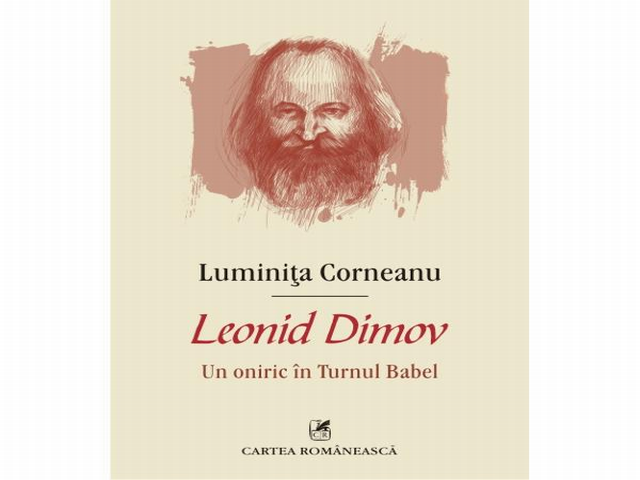
‘Leonid Dimov. A dreamer in the Tower of Babel’ is the first ever monographic work by Luminita Corneanu that has been published recently. With documents provided by the National Council for the Study of Securitate Archives, Luminita Corneanu has re-constructed a dramatic human and literary destiny marked by the collective tragedies of the 20th century Romania including the persecutions of the Jews in the 1940s and the surveillance and monitoring activities carried out by the secret police during the communist period.
Famous for his rebel spirit, Leonid Dimov, the writer who urinated on Stalin’s statue in 1957, could only have written a special kind of poetry. “You, Dimov, are doing something amazing, I can say you have changed the direction of an entire literature”, the poet Emil Brumaru used to write to Dimov in 1968. Exploring the inner mechanisms of Dimov’s poetry, Luminita Corneanu’s book explains how Dimov influenced the generations that followed.
Luminita Corneanu: “I became interested in Leonid Dimov during my student years, when I first discovered his poetry and the group of oneiric poets. Later, after becoming a teacher myself, I saw that Leonid Dimov’s poetry was on the reading list for the school curriculum. High-school literature textbooks included his poem ‘The Werewolf and Clotilda’, an ironical love story between a werewolf and a tennis player. It so happened that I had a second encounter with Dimov’s poetry, since, as a literature teacher I tried to make his work accessible to high school children during a peer classroom observation session. And Dimov has since become even closer to me. When I chose the theme of my doctoral thesis, I decided to write a monograph about Dimov, given that such monographs are essential for the Romanian literature.”
Writing about Luminita Corneanu, literary critic Paul Cornea said “she provides us with the most surprising, credible and authorized image of Leonid Dimov in a fresh critical voice”. Here is Luminita Corneanu with more about the oneiric group of writers to which Leonid Dimov belonged.
Luminita Corneanu: ”Back in the late 1960s, around 1966 -1967, the writers who later made up the oneiric group used to meet at the Luceafarul Literary Circle led by Miron Paraschivescu. They were different from the rest of the writers, they were rebels fighting for the freedom of expression, for the freedom of writers etc. At a round table discussion in 1968, Dumitru Tepeneag laid the foundation of this movement which gained momentum shortly afterwards. Leonid Dimov remains one of the most representative writers of this group together with Dumitru Tepeneag, Sorin Titel, Daniel Turcea and Virgil Mazilescu.”
Here is Luminita Corneanu again, this time speaking about how oneirical writers managed to write and get their works published at a time when censorship was very strong.
Luminita Corneanu: ”Once oneirical poetry came to be known thanks to Dumitru Tepeneag’s theoretical writings, tough reactions came from the cohort of writers who were officially accepted and protected by the communist regime. So oneirical poets were criticized and the ‘gratuitous’ character of their art was brought into question. They were blamed for not being committed to the social project of creating ‘the new man’. They were rated as a bunch of white-collar criminals, and this crime in the Proletarian Culture period was one of the most serious. If you did not create art for the working class, to help create a new society, you were labelled as bourgeois and therefore society marginalized you. So Dimov’s statements and confessions give us an insight into Dumitru Tepeneag’s and his vision on literature and art, and into the official reactions regarding their writing and attitude. And that because the then political police started to follow them especially for their rebel spirit and their political activity. And of course, for their wish for freedom, which they had clearly stated.”
Between July 20 and September 14 1971, Dimov took a trip to France at the invitation of Dumitru Tepeneag. In September 1971, the two writers gave an interview to Radio Free Europe. The reactions of the political police, the Securitate, were quick to appear. As soon as he returned to Romania, Dimov was placed under close surveillance, and for a while he was officially banned from publishing.
On December 5th 1987, the poet died because of a heart attack. He left behind 12 volumes of poetry and lots of translations. Dimov was twice the recipient of the Bucharest Writers’ Association Award for the volumes ‘The Dialectics of the Ages’ of 1978 and ‘The Eternal Return’ of 1982. However during his lifetime he was not spoiled by critics or literary juries. The Writers’ Union granted him an award only once in 1980, for his 1979 edition of Gerard de Nerval’s poetry in translation brought out by the Univers Publishers.
Due to the nature of his poetry, which was not very accessible to the public, and his introvert personality and self-isolation, Leonid Dimov was for a long time a name familiar only to the connoisseurs.