Protests against the salary law
The draft law on unified salaries continues to bring people into the streets.
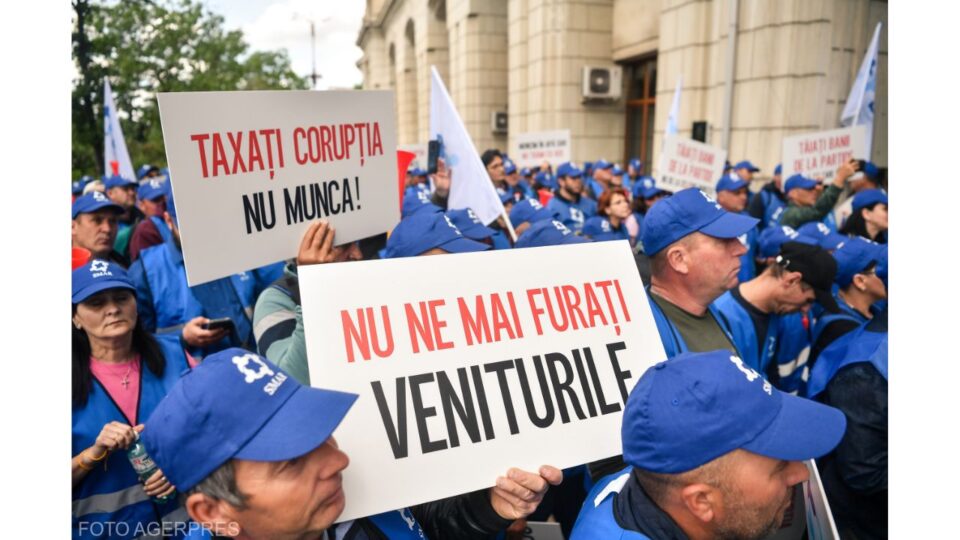
Sorin Iordan, 17.06.2026, 14:00
Romania’s draft law on unified salaries continues to generate dissatisfaction among various categories of state employees. Put out for public debate at the end of May, the draft legislation proposes a complete structural reorganization of the public system, targeting the hierarchy of positions, salary grids, bonuses, and performance evaluation. The law introduces a new unified structure made up of 12 salary grades and sets a maximum ratio of 1 to 8 between the lowest and highest salary in the public sector. At the same time, all positions would be reevaluated nationwide based on a methodology coordinated by the Ministry of Labor, with the aim of eliminating disparities between institutions and professional categories.
The interim Minister of Labor, Dragoș Pîslaru, recently stated that the new law will not lead to a decrease in any salary paid at present in the public sector, nor in pensions. He acknowledged that the draft has several issues but said that solutions are being sought to fix them.
Despite the government’s assurances, major trade union confederations have warned that the changes will lead to lower incomes for public-sector employees. Ambulance service workers protested against the reduction of bonuses for night shifts, public holidays, on-call duties, and hazardous conditions, as well as against the decrease in net income resulting from the proposed salary coefficients. The federation representing them requested a revision of the draft and the preservation of salary rights for this category of medical staff. They were joined by thousands of employees of the National Agency for Fiscal Administration, territorial pension offices, and the courts.
The Higher Council of Magistracy (CSM) harshly criticized the draft law on unified salaries, saying it “will permanently undermine the functioning of the justice system.” The CSM stated that, after the law is adopted, the income of a beginning magistrate “will be at an absolutely unacceptable level” and that magistrates will lose income if they are promoted to a higher court or prosecutor’s office.
Teachers are also dissatisfied. One of the most contested provisions in the draft law concerns the merit grade, which currently means a 25% salary increase for a teacher. Representative unions warn that it could be removed from the base salary grid and replaced with an uncertain performance bonus, granted quarterly, semiannually, or annually, and limited to at most 30% of employees. According to the unions, the draft law also provides for integrating the neuropsychological overload allowance into the base salary and eliminating the bonus for homeroom teacher activity.
There is unrest as well among customs employees, who organized a warning strike on Wednesday. The adoption of the salary law for public-sector employees is a commitment Romania made through the National Recovery and Resilience Plan and conditions access to more than 700 million euros in European funds. (EE)