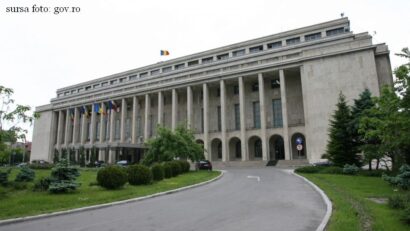
Romania, ahead of the Standard & Poor’s report
Interim Liberal Prime Minister Ilie Bolojan met, in Bucharest, with a delegation from the international rating agency Standard & Poor's.
Mihai Pelin, 25.09.2026, 13:50
Interim Liberal Prime Minister Ilie Bolojan held talks with a delegation from the international financial rating agency Standard & Poor’s, present in Bucharest within the context of the periodic evaluation process of Romania’s economic and fiscal developments. Finance Minister, Alexandru Nazare, also attended the meeting.
During the meeting, the two sides examined the current political context and Romania’s fiscal-budgetary situation, which is on a path toward balancing and stabilizing public finances. Ilie Bolojan emphasized that the budgetary adjustment must be supported by changes that yield long-term effects: a more efficient administration, reformed state-owned enterprises, better-prioritized public expenditure and investments that generate economic growth. The Prime Minister also pointed out that to maintain Romania’s external credibility, including among investors, continuing the reforms pledged by the current government is essential.
Budget execution and the continuity of fiscal consolidation are Romania’s main arguments in the current country rating evaluation, wrote the interim Finance Minister in an online post following the meeting with international experts from Standard & Poor’s, who are in Bucharest to prepare the report to be published early next month. Alexandru Nazare stated that talks also addressed the difficulties of the current period, including political uncertainties, external pressure and pressure on financing costs, while also presenting the ministry’s strategy for the next stage, with the main focus remaining on spending discipline, prioritizing investments, and leveraging European funds. Maintaining the rating remains the primary objective of this period. Upon this depends the conditions under which Romania secures financing, investor confidence and the resources we can direct toward development instead of consuming them on interest payments, the minister further emphasized.
During the last review, S&P set the sovereign rating at the lowest notch of the investment-grade category, and currently, according to analysts, a downgrade for Romania is not ruled out. In this context, the European Bank for Reconstruction and Development (EBRD) maintains its forecasts regarding the performance of the Romanian economy in 2026 and 2027, in line with its June forecast, and warns that downside risks persist, according to a recent report. Following a 0.7% growth in Romania’s economy in 2025, the EBRD expects a 0.2% decline in 2026 and an advance of 1.8% in 2027. Although external imbalances have begun to moderate, Romania’s current account deficit remains among the highest in the EU, while inflation remains at the highest level.
The depreciation of the leu against the euro, coupled with higher energy prices, could prolong inflationary pressures, the report adds. Since the start of its operations in Romania in 1991, the EBRD has invested over 12.7 billion euros in more than 600 projects, the majority in the private sector. (VP)