The Baal Shem Tov Synagogue in Piatra Neamt
Located in northeastern Romania, the city of Piatra Neamt was a major trade hub in the Middle Ages.
Christine Leșcu, 21.11.2015, 13:50
Located in northeastern Romania, the city of Piatra Neamt used to be an important trade hub as early as the Middle Ages. A genuine melting pot, inhabited by Romanians, Saxons, Hungarians and Jews, back in the time of Stephen the Great, the city was one of the kings princely courts.
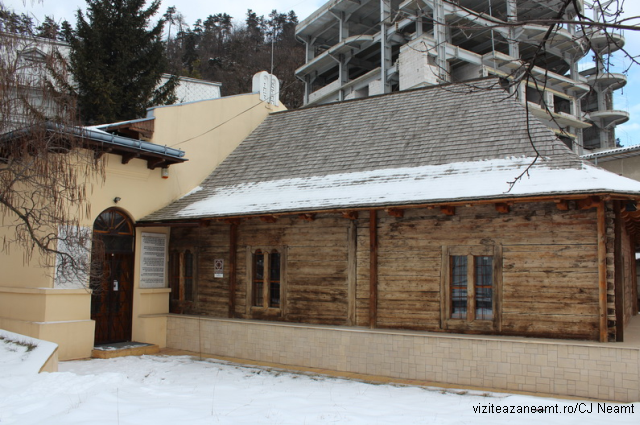
The Jewish community there grew in time, accounting for half of the citys population at the end of the 19th century. The Baal Shem Tov synagogue is living proof of the Jews flourishing history in this area, being the only wooden synagogue in the Eastern Europe, as writer Emil Nicolae Nadler, president of the Jewish Community in Piatra Neamt says.
Emil Nicolae Nadler: “There were several synagogues of this kind in historic Galitia – currently on Polands and Ukraines territories – but were destroyed in World War Two. It was a miracle the synagogue in Piatra Neamt survived, and today it is the only one left in Europe to have preserved its original design, without being rebuilt. It only saw refurbishing works and bears the name of Baal Shem Tov, founder of Hasidic Judaism, a significant strand of Judaism. This brought popular elements into the religious ritual and Jewish tradition as well as many interesting things concerning magical practices. This strand of Juadism was barely accepted by the rabbinic tradition, but that eventually happened due to the large number of followers. There is a local legend connecting the name of Baal Shem Tov to the synagogue in Piatra Neamt. Legend has it that at a certain moment he had withdrawn to mount Ceahlau to meditate and he would go to spend the Sabbath in Piatra Neamt at the synagogue; not the one we have today, an older one that had been built before this one, on the same place. Baal Shem Tov died in 1760, six years before the construction of the present-day synagogue, but when they started refurbishing it, they found evidence of the existence of a an older synagogue on the same site.
Although there are no documents attesting the truth of the legend about Baal Shem Tovs withdrawal to Ceahlau, there is however evidence on how old the Jewish community in Piatra Neamt is. The old cemetery in Piatra Neamt has tombstones dating back to 1620 and 1640, which proves that a thriving Jewish community had lived in Piatra Neamt before the advent of Hasidic Judaism. The synagogue was founded back in 1766 through an edict by Moldavias ruler at that time, Grigore Ghica the 3rd. Although he allowed the Jews to build a synagogue, certain conditions were imposed, which are visible even nowadays.
Emil Nicolae Nadler: “It is made of wood, and its foundation lies 1.80 meters below ground level, in keeping with a decree issued by the then ruler Stephen the Great, imposing that any non-Christian building located 100 meters from a Christian one should not be taller than the latter. However, on the same street, opposite to the synagogue, 30 meters from it, lies the wall of the former Princely Court in Piatra Neamt. Its other typical element, the fact that it is made of wood, as well as the architectural elements such as the dovetail corner joints, but also the wood used in construction, oak and fir-tree, all make it similar to the wooden monasteries on the Bistrita River valley. So it was erected with craftsmen from Piatra Neamt, and the material coming from the same place, its just that it was commissioned by the Jewish community there.
So, apart from the construction material, what makes Baal Shem Tov unique is also its outer shape, resembling Orthodox churches in the region. They have all been preserved as a result of the restoration works carried out over 2007 and 2009.
Emil Nicolae Nadler: “We have designed the synagogue quite opposite to the other one in town, which is more recent. We wanted it to be a cultural landmark, a museum, a tourist objective. That is why inside you can find a sacred wooden urn, a heritage item dated 1835, a very interesting one, lavishly decorated in traditional style. It holds a Torah brought from Israel in 2009, when the synagogue was reopened after refurbishment. We have turned the women and childrens traditional seating area into a small museum of worship objects collected from the other synagogues in Piatra Neamt. The synagogues disappeared or were brought down as a result of the successive town-planning works, and now only the Baal Shem Tov and the Leipziger Temple are left standing. The objects that were retrieved from the former synagogues, but also from families in town, worship books, Menorahs, photographs and various other documents, – we exhibited them all in the museum.
The interest for Hasidism, but also for the synagogue as such, each year brings around 2,000 to 2,500 visitors to Piatra Neamt, from April to October.
(Translation by: Eugen Nasta)