
RRI Live!

Listen to Radio Romania International Live

The Romanescu Park in Craiova, southern Romania

Stretching over 100 hectares, the Romanescu Park in Craiova is certainly one of the largest in Romania and also one of the largest in Europe.
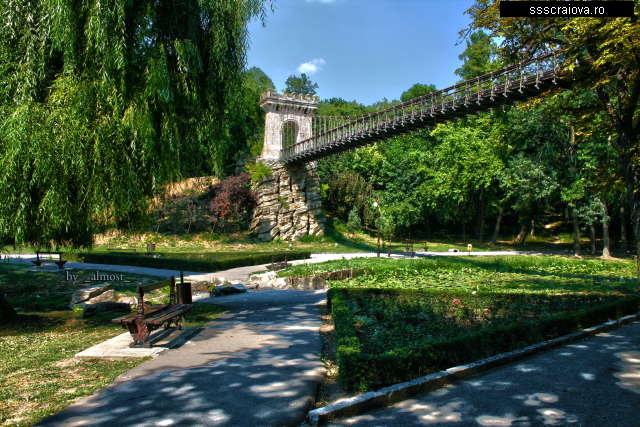
The Romanescu Park in Craiova, southern Romania

, 08.08.2015, 15:51

The park’s history is intertwined with that of the Bibescu-Stirbey
boyar family, which gave two rulers to Wallachia. In the 19th
Century, the plot the park lies on today belonged to great chancellor Iancu
Ioan Bibescu. He built a garden there, with banks and gazebos, allowing people
to take a stroll through the park in their leisure time. So this public garden
is dating back from mid-19th Century. In the following minutes
researcher Toma Radulescu is telling us how this private garden, originally
Iancu Bibescu’s promenade, turned into a public park.


Toma Radulescu: The garden was very carefully looked after for from its early days. The
lake it has dates back to that time and swans were living there. Later, back in
the time of Barbu Stirbey, this plot was bought by the local authorities, which
turned it into a public garden. Unfortunately, the administration’s sloppy
management turned it into a squalid place. Waste from an army barracks nearby
was dumped there and a group of nomad gypsies set up camp on the premises. This
issue was first mentioned at the time of the independence war of 1877, when the
Bibescu family was hosting a hospital for wounded soldiers. When the city got a
stronger administration, under the lead of Nicolae Romanescu, a significant
amount of money was allotted for clean-up and one of Europe’s best garden experts,
Eduard Redont, was hired. He drew up the project of a Romantic park after a
common French pattern.


Eduard Redont, the French designer who worked
on the Carol Park in Bucharest and drew the plans for the National Exhibition
it hosted back in 1906, was granted the golden medal for the project of the
future Romanescu Park at the International Exhibition in Paris. The project
included a lake, a horse race track and even a fairy-tale castle up on a nearby
hill. Suspension bridges and a bandstand were also built, and the premises also
included a mini Zoo. Initiated towards the end of the 19th Century,
construction works were completed in 1903, and on September the 29th
of that year King Carol I and Queen Elizabeth, accompanied by crown princes
Ferdinand and Marie, officially opened the park. Toma Radulescu tells us what
it looked like back then, and how people used to spend their time here:


Toma Radulescu: The park
was very modern. It had a horse race track and it was the place where all sorts
of competitions were held. The royal family would participate in the horseback
riding contests organized there, and also in other important events, such as
the National Day, on May 10th. The parade, which used to be held
every May 10th until the communists came to power, would take place
in front of the park and of the Independence Monument, one of the most majestic
such monuments in Europe. When it was built, in front of the Romanescu Park, it
was the second tallest. Also, during the winter, people would come and skate there,
a tradition preserved for a long time. I still remember admiring, as a child,
the elegance of the ladies who were skating. The park used to be host to
athletics events, as well as re-enactments of major historical events.


Along the years, the
park has had several names. In the beginning it was called the ‘Bibescu
Garden’, after the name of its original owner, then it became the ‘People’s
Park’, during the short ruling of Marshal Averescu, at the end of the first
world war. In the 1930s, after the death of the mayor of Craiova, Nicolae
Romanescu, the park was named after him, but then the communists called it The
People’s Park again. After 1990 it was given back the name of the most
important mayor of Craiova, Nicolae Romanescu. These days the park is undergoing
a large-scale rearrangement and modernization process.


Sergiu Celibidache (1912-1996)
RRI Encyclopaedia Sunday, 18 October 2026

The Institute of Forensic Medicine, or Bucharest’s lost heritage

  On the left bank of the Dâmbovița, after the river leaves the central area around Unirii Square, stood until 1985 the building of the Institute…

The Institute of Forensic Medicine, or Bucharest’s lost heritage
RRI Encyclopedia
RRI Encyclopaedia Sunday, 11 October 2026

Alburnus Maior, Roșia Montană

Alburnus Maior is the ancient Roman name for the town of Roșia Montană, located in central Romania, in the historical region of Transylvania, in the A…

Alburnus Maior, Roșia Montană
RRI Encyclopedia
RRI Encyclopaedia Saturday, 03 October 2026

Forensic Medicine in Romania

Forensic medicine is the branch of medicine that makes it easier to establish the truth and ensures that the law is applied fairly. The institutional …

Forensic Medicine in Romania
RRI Encyclopedia
RRI Encyclopaedia Sunday, 27 September 2026

The “Anastasie Fătu” Botanical Garden in Iași

The “Anastasie Fătu” Botanical Garden in Iași is celebrating its 170th anniversary — 170 years devoted to science and culture in the service of nature…

The “Anastasie Fătu” Botanical Garden in Iași
RRI Encyclopaedia Sunday, 20 September 2026

The Sip Canal

The most spectacular section of the Danube, along its 2,850-kilometer course from the Black Forest Mountains in Germany to its mouth on the Black Sea …

The Sip Canal
RRI Encyclopaedia Sunday, 13 September 2026

Historian Gheorghe Brătianu

Among the leading figures in 20th-century Romanian historiography, Gheorghe I. Brătianu holds an important place. Gathered around the ‘Revista Istoric…

Historian Gheorghe Brătianu
RRI Encyclopaedia Sunday, 30 August 2026

Princely and Royal Thrones

  A symbol of royal authority, thrones held a central place in the representations of power in the Romanian space. Before 1945, they were a natur…

Princely and Royal Thrones
RRI Encyclopaedia Saturday, 29 August 2026

The University Museum in Bucharest

The University of Bucharest was established and has operated under this name since 1864, following the founding of Romania through the union of the Pr…

The University Museum in Bucharest

Partners

Muzeul Național al Țăranului Român Muzeul Național al Țăranului Român
Liga Studentilor Romani din Strainatate - LSRS Liga Studentilor Romani din Strainatate - LSRS
Modernism | The Leading Romanian Art Magazine Online Modernism | The Leading Romanian Art Magazine Online
Institului European din România Institului European din România
Institutul Francez din România – Bucureşti Institutul Francez din România – Bucureşti
Muzeul Național de Artă al României Muzeul Național de Artă al României
Le petit Journal Le petit Journal
Radio Prague International Radio Prague International
Muzeul Național de Istorie a României Muzeul Național de Istorie a României
ARCUB ARCUB
Radio Canada International Radio Canada International
Muzeul Național al Satului „Dimitrie Gusti” Muzeul Național al Satului „Dimitrie Gusti”
SWI swissinfo.ch SWI swissinfo.ch
UBB Radio ONLINE UBB Radio ONLINE
Strona główna - English Section - polskieradio.pl Strona główna - English Section - polskieradio.pl
creart - Centrul de Creație Artă și Tradiție al Municipiului Bucuresti creart - Centrul de Creație Artă și Tradiție al Municipiului Bucuresti
italradio italradio
Institutul Confucius Institutul Confucius
BUCPRESS - știri din Cernăuți BUCPRESS - știri din Cernăuți

Affiliates

Euranet Plus Euranet Plus
AIB | the trade association for international broadcasters AIB | the trade association for international broadcasters
Digital Radio Mondiale Digital Radio Mondiale
News and current affairs from Germany and around the world News and current affairs from Germany and around the world
Comunità radiotelevisiva italofona Comunità radiotelevisiva italofona

Providers

RADIOCOM RADIOCOM
Zeno Media - The Everything Audio Company Zeno Media - The Everything Audio Company























