100 Years since the Battle of Tutrakan
The battle of Tutrakan took place between September 1 and 6, 1916, and represented the first big WWI defeat for the Romanian army.
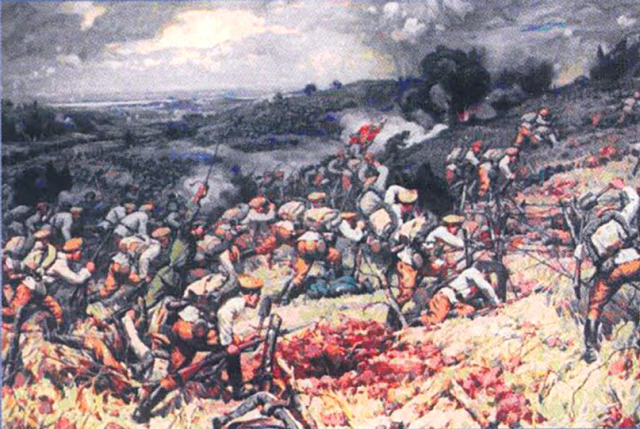
Steliu Lambru, 03.10.2016, 13:33
On August 27, 1916 Romania declared war on the
Austro-Hungarian Empire, entering the First World War. An ally of Germany
Bulgaria, which had entered the war a year earlier, immediately sent its army
to attack the town of Tutrakan, south of the river Danube, opposite the
Romanian town of Oltenita and 70 km southeast of the capital city Bucharest.
Tutrakan, or Turtucaia by its Romanian name, was regarded as the main base of
operations for the Romanian army south of the Danube, and had become
incorporated into the Kingdom of Romania under the Peace Treaty of 1913 that
put an end to the Second Balkan War.
The battle of Tutrakan took place between
September 1 and 6, 1916, and represented the first big defeat for the Romanian
army. Seen by historians as a disaster, the defeat at Tutrakan led to the
collapse of the entire operations plan of the Romanian army general staff. The
Romanian troops on the defence totalled some 39,000 soldiers, while the joint
Bulgarian and German forces amounted to 55,000 military. Over 6,000 Romanian
soldiers were killed or wounded, while the Bulgarian-German troops sustained
casualties of over 7,700 soldiers. Some 28,000 Romanian soldiers were taken
prisoners.
Much ink has been spilled over this topic by
historians, military and eye-witnesses. Sorin Cristescu is a historian and
professor at the Spiru Haret University in Bucharest. He says two aspects were
key for the outcome of the battle: the training of the Romanian army and its
morale.
The battle of Tutrakan had two underlying
factors. First of all, the Romanian troops were poorly trained. Some 800,000
had been mustered, but there were only enough rifles for less than 500,000 of
them. Some 120,000 Lebel rifles were imported from France over 1914-1916. Of
the 500,000 rifles, around 100,000 were left over from the 1877 war. 460,000
Romanian soldiers had crossed the Danube as part of the 1913 war, but only
300,000 of them were carrying rifles. The same thing happened in Tutrakan. The
army had low stocks of ammunition and weapons and the cannons were mounted the
wrong way, so they had no effect on the enemy. It was a disaster.
Apart from military equipment and training, the
morale of the army is also key to winning a war. Sorin Cristescu believes low
morale also played a part in the defeat at Tutrakan:
The military disaster was also caused by low
morale. By September 6 1916, Bucharest was flooded with large numbers of
injured soldiers in a terrible state. The low morale was caused by the rumour
circulating in Bucharest that after Tutrakan, the German-Bulgarian troops would
start advancing towards the capital. An extraordinary panic took hold of people
and also spread among those in charge of the military. It was decided that the
offensive in Transylvania be halted to focus instead on the retreat in
Flamanda. But not all people were seized with the panic. The famous journalist
and editor-in-chief of the daily Adevarul Constantin Mille published an
article explaining that’s the way war is. One day you have a good victory in
the north, the next you suffer a defeat in the south. You shouldn’t let your
actions be dominated by panic. He said the German and Bulgarian troops couldn’t
possible reach Bucharest that quickly. Mille advised people to stay calm and
not panic after the first defeat. However, the impact of the Tutrakan disaster
in terms of people’s morale was immense.
The defeat in
Tutrakan has left deep scars in the Romanian collective psyche. Sorin Cristescu
blames it on the bad organisation of the Romanian army. But for a better
understanding of the Tutrakan disaster, one should also take into account the
haste with which Romania had entered the war and the material and social
situation of Romania’s mainly rural population:
There are memorable
accounts of the battle of Tutrakan by George Toparceanu and Gheorghe Bratianu
among others. It was a tragic moment that proved the Romanian army was
unprepared. Why? Because it was mainly made up of farmers and, as historian
Nicolae Iorga put it before Parliament in 1908, Romanian farmers were Europe’s
poorest farmers. Looking back today we could say the lack of ammunition proved
crucial in the Tutrakan disaster. Every sldiers was allotted 100 bullets and
the factory couldn’t produce at that time more than one bullet per day for
every soldier. So troops had to spare bullets because the next supply was in
100 days and we know that Bucharest surrendered without a fight on the 100th
day of the war, the city being abandoned on December 6,1916. There
was no possibility to provide fresh supplies to the troops in Tutrakan.
Secondly, cannon and machinegun fire from our troops constantly missed the
enemy who was better prepared and knew how to avoid it. So the Romanian army
faced a quick and terrible defeat.
After the battle,
28,000 Romanian POWs spent two gruesome years in Bulgarian prison camps until
liberation came in 1918, when the entire Europe celebrated the end of the Great
War and peace was instated.