
Testimonies from Auschwitz
A look at the notorious death-camps from the lens of eye-witness accounts.
Steliu Lambru, 26.01.2015, 12:57
For the European Jews, the concentration camps in Auschwitz-Birkenau meant their systematic elimination through a program masterminded by the Nazis. The number of those killed by the largest Nazi death camp is hard to estimate, the figures proposed by various authors varying between 1 and 1.5 million Jews. From northern Transylvania the Hungarian authorities sent to Auschwitz 150,000 Jews starting with the spring of 1944. 70 years after the prisoners were freed from the camp on January 27, 1945, we selected from Radio Romania’s audio archive a few testimonies of those who survived the ordeal.
Eva Berger from Cluj was taken with her mother through at least 10 labour camps. She stayed in Auschwitz only 3 days, but that was enough for her to understand what was really happening there. The recording is dated 1996.
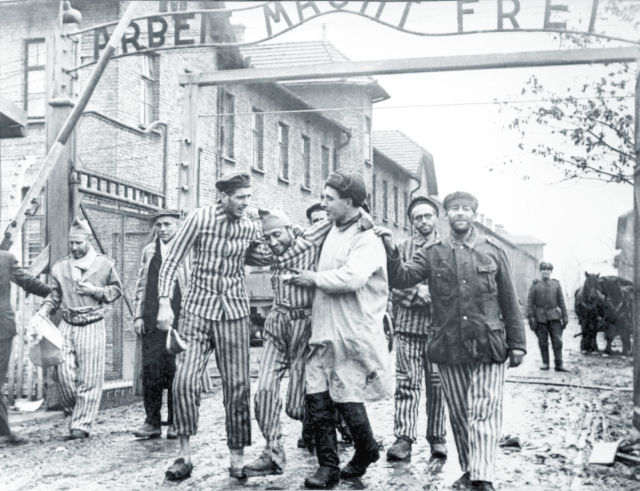
“The right side meant life, the left side death! I was with my mom and they did not tie our hands, although we looked alike. Most probably they did not realize that we were mother and daughter and put us both on the right side. I did not know what that meant, all the other members of my family were pushed to the left side, because I had aunts, cousins with small children, and those with small children could not be used, they had to be exterminated, one way or the other. What I had noticed, and I told my mom about that, was that I could hear no birds singing, although there was a forest nearby. It was in June and there were no birds singing. I found it strange that birds were not singing. Later I realized that there had been gas chambers there, and animals and birds could not survive there with all that gas and smoke. Subsequently I also saw my father whom they had put on the left side, next to those who were to be killed in the gas chambers. They were telling us to keep calm because we would meet our families later, but that now we had to be separated, the elderly and the children together, because that was best for us. We went through a gate on which you could read “Arbeit macht frei” and I told myself that things were going to be OK for us. We were working, so we were going to be free. They put us up in shacks and cut our hair. I could hardly recognize my mom. I could only recognize her voice, because she looked like a man without hair. We were holding our hands. I was lucky enough to stay only 3 days in Auschwitz. After only 3 days I got out, putting the squalor, the hunger and all those horrors behind me.”
In May 1944 Mauritiu Sabovici from Sighetu Marmatiei was taken to the Viseu ghetto following the Horthyst occupation of northern Transylvania. In 1997 he was recollecting how he came to live near the death camp in Auschwitz. As a young certified locksmith he worked in a factory just outside the camp.
“A usual day in the camp went as follows: you woke up at 5, you took a quick shower, then they lined us up and gave us breakfast which consisted of 100 g of bread, tea or black coffee and margarine. At 6 we had to be ready to go to Gleiwitz, as the factory was about 2 kms away. And on the way to the factory those walking on the sides of the line were beaten, while those in the middle were not. That is why everybody tried to stay in the middle of the line. In the factory they did not beat us, only the civilians beat us. SS troops were deployed around the factory to prevent us from fleeing, but inside the factory those who controlled us were arrested German Communists. They were supervising us to see if we were working or just sitting around. There were also Polish Jews that treated us badly, just like the Germans. They did not care that we were Jews like them. They were angry with us because we arrived there too late, in 1944 when the front was already crashing, and not in 1939. They gave us hell there, instead of helping us.”
Back in 1997 electrician Otto Sarudi from Baia Mare was recollecting events similar to those experienced by other survivors. In June 1944 the Jews in Baia Mare were gathered in the ghetto before being put into freight trains headed to Auschwitz.
“From Auschwitz the train took us to Birkenau where the extermination camp was. In Birkenau I ended up in a gypsy camp, the commanders of the camp were gypsy. They drove us forward with their clubs, to make us walk faster. You can imagine 1,000 people in a stable hurrying outside. I stayed there for about one week. Meanwhile the Germans came asking if there were any workers amongst us, namely a bricklayer, a carpenter, a mechanic and an electrician. We introduced ourselves and they gave us numbers, I received number 13034. From there they took us 6 kms away to the Auschwitz camp. They gathered us all outside, and placed us in groups, by jobs. There were 16 electricians and they took us to a workshop. There was a large workshop with poles, and you had to climb those poles and pull a cable. They were actually testing us. Out of the initial 16 electricians only two were left, and I was one of them. They had me control the fences, there were electric fences and they had me control them”.
Hearing all these testimonies from the survivors of the Auschwitz death camp, the epitome of the Nazi crime, one cannot help but shudder in horror.


























