Statements by the central bank governor
After joining the OECD, which is in its final stages, the country's next project is to switch to the euro, says the National Bank Governor Mugur Isărescu
Ştefan Stoica, 03.04.2026, 13:50
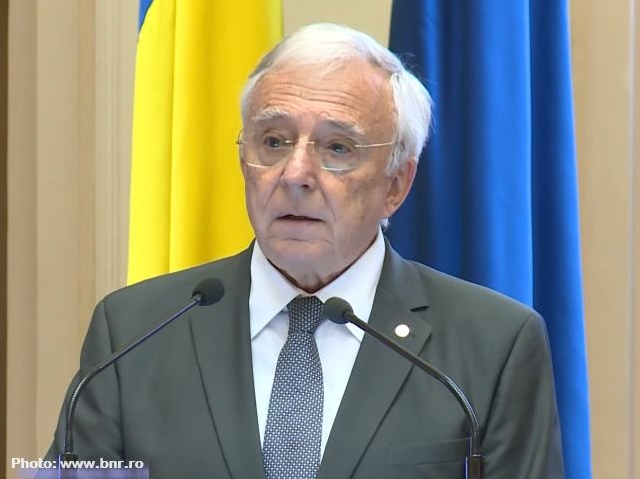
The long-serving governor of the National Bank of Romania, Mugur Isărescu, rarely speaks in public, and only does so regarding fiscal-budgetary and economic topics, which are part of his job description. He avoids grandstanding, but he does not try to hide or sugarcoat the problems Romania is facing.
A meeting between central bank experts and relevant academia, organised in a complicated geopolitical context which comes with serious economic consequences, was a good opportunity for Isărescu to take stock of these problems.
The meeting focused on risks and opportunities in the Romanian financial and banking system, reflecting the current concerns of business and financial circles in an international context that is volatile and hard to predict, as the central bank governor said. In his opinion, the escalation of tensions in the Middle East has already triggered visible effects in energy markets, and continues to amplify the volatility of international financial markets.
At the same time, trade tensions between major economies and growing economic fragmentation trends contribute to maintaining a global climate overshadowed by uncertainty, Isărescu believes. For the Romanian economy, he emphasised, these international developments overlap already known domestic weaknesses, such as the long-lasting budget and current account deficits.
Mugur Isărescu advocated for financial education. A better financially prepared society, he argued, is better able to understand developments and trends in the economy, to manage unexpected shocks and to help maintain financial stability.
Romania, on the other hand, already has a country project represented by joining the OECD, which is in its final phase, and the next strategic goal will be to switch to the euro, Mugur Isarescu announced. However, this will happen after the economy has been balanced and the substantial fiscal deficit has been reduced, he said. Mugur Isarescu insisted that fulfilling the nominal criteria for adopting the euro must be done in a sustainable manner.
In 2015, Romania was close to meeting these criteria, he mentioned, but since 2016 public policies and social pressures have pushed the country away from this goal. And now we have the same problems meeting the nominal criteria, namely pressures from the real economy and from the poorer parts of the country, Mugur Isarescu explained. In his opinion, the disputes between political parties reflect precisely these realities.
The country project of joining the eurozone has already been announced by the president of Romania, but it must be prepared carefully, Isarescu stated. According to the governor, the future of the Romanian financial system depends to a large extent on its capacity to invest, without delay, in education, performance and solid partnerships. (AMP)