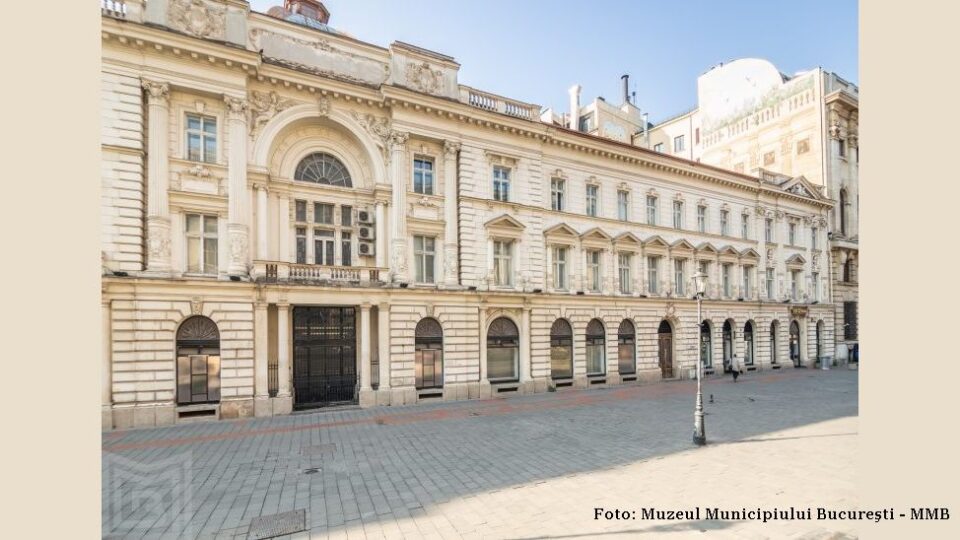
The Dacia-România Palace in Bucharest (reposted from 24.05.2026)
The Dacia-România Palace has been the headquarters some of the most prominent institutions linked to Romania's traditional financial and banking system.
Steliu Lambru, 09.08.2026, 14:00
Bucharest’s old city centre is an area bordered geographically by Regina Elisabeta Boulevard to the north, Halelor-Splaiul Independenței Street to the south, the Ion C. Brătianu Boulevard to the east and Calea Victoriei to the west. The site is also home to the oldest traces of urban habitation in the Romanian capital.
Also known as the Lipscani area due to the name of the street that runs through it from east to west, the old city centre is a traditionally trading area. You will find here the headquarters of the financial and banking system of modern Romania, from the second half of the 19th century. These include the buildings that used to house the Marmorosch-Blank Bank, the Chrissoveloni Bank, the former Bucharest Stock Exchange and the National Bank of Romania itself. Opposite the first building of the National Bank of Romania on Lipscani Street is the Dacia-România Palace, the headquarters of one of the most prominent institutions of Romania’s traditional financial and banking system.
Adrian Majuru is the manager of the Bucharest Municipality Museum and he will tell us more about the site on which one of the most beautiful buildings of old Bucharest would be built:
“In the oldest part of the city, an Aromanian from the Balkans built a church, sometime in the 16th century. His name was Ghiorma, but he wasn’t Greek. He spoke Greek, obviously, because he needed it in the trading business. Later, an inn called The Greeks’ Inn was built near the church. You can see its mark left on Lipscani Street, following street rehabilitation works. This arrangement of buildings was preserved for a very long time, almost throughout the Middle Ages, until, at the end of the 18th century, after the great earthquake of 1838, the church was so damaged that could no longer be used, the inn likewise, and they would be demolished sometime after the reign of Alexandru Ioan Cuza. The site remained derelict until, sometime around 1874, an insurance company called Dacia decided to build its headquarters on Lipscani, not far from the editorial office of the newspaper Timpul, at the end of Lipscani Street, on the corner with Calea Victoriei.”
The Romanian insurance market was developing at the end of the 19th century and the newly founded Dacia-România was also making its way. Historian Adrian Majuru:
“Around the time of the war for independence, in 1877, another insurance company called România appeared. After this war, the two banking companies merged and, because Romania was a new, independent country, with new financial opportunities, the two firms decided to build a truly new representative office, which would show the country’s new status. This structure was built on the vacant land and bought through public tender. It was built sometime between 1888 and 1895 by an Austrian architect. Unfortunately, the property deeds of this financial company, like that of others, went to Moscow in 1916 together the Romanian treasury and disappeared. As a result, we do not have a lot of documentary evidence about this financial company, about the architect who built the palace and about the old land surveys and plans.”
Dacia-România had a capital of 4,000,000 francs. Most of the insurance policies taken out were for natural disasters, transport and life insurance. By 1906, Dacia-România had paid compensation worth 180 million francs. The Board of Directors included important names from among the Romanian financial and political elites such as Nicki Chrissoveloni, Alexandru Lahovary, Ion Kalinderu, Petre S. Aurelian, Emil Costinescu and Grigore Triandafil.
In 1914, the palace was sold to the Romanian General Bank, which represented German financial interests. The German troops that occupied southern Romania in 1916 also requisitioned some of the assets of the Romanian General Bank.
During the interwar period, the bank changed its name to the General Bank of Wallachia, a name that the building would also bear. In June 1931, the General Bank of Wallachia went bankrupt and the palace would be taken over by the National Bank of Romania. In 1938, the latter sold the palace to the Union of Royal Cultural Foundations, and the Royal Publishing House and several other banks would have their headquarters there.
In 1948, the building was nationalised by the newly installed communist government. Between 1948 and 1990, it housed the Ciprian Porumbescu Conservatory of Music and Dramatic Art, then a restaurant, a cafeteria and a store of the Applied Arts Cooperative. Between 1979 and 1983, the palace was consolidated, having been damaged in the earthquake of March 4, 1977. After the restoration, it housed a canteen, stores selling shoes, leather goods, fabrics and knitwear, as well as fashion houses.
After 1990, banks returned to the building, with the Romanian Commercial Bank and CEC Savings Bank having their headquarters here. Since 2013, the Bucharest City Hall has been the owner of the palace. Historian Adrian Majuru.
“It is a banking palace, that was its destination. It had to have an entrance that would convince a client that it was worth keeping their valuables here. Among the valuables kept were, of course, pieces of art, from jewelry to paintings.”
For the last several years, visitors and Bucharest residents have become accustomed to the cultural events held at the Dacia-România Palace, and soon the palace will become a major cultural hub in the old city centre as a large-scale rehabilitation project of the building and interior redevelopment are under way to make the building suitable to house the Bucharest art collection.