State of the Union 2026
The President of the European Commission has called for a stronger, more independent Union that is better equipped to cope with an international context marked by the war in Ukraine
Mihai Pelin, 17.09.2026, 13:50
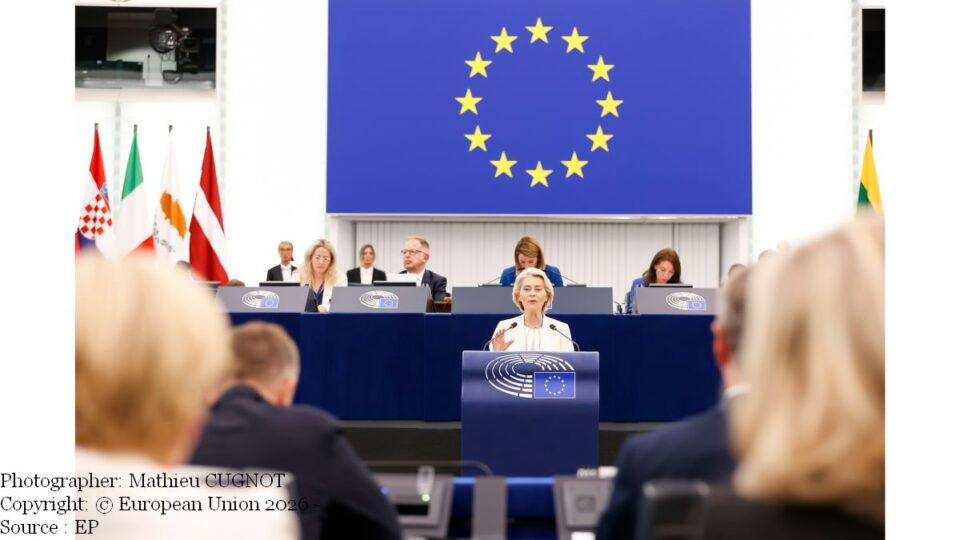
Europe must build up its own defence capabilities, reduce its energy and trade dependencies, and restrict children’s access to social media. These are some of the priorities set out by the President of the European Commission, Ursula von der Leyen, in her State of the Union address, in which she also proposed a European mechanism for responding to security threats, similar to Article 4 of the NATO Treaty. One of the EU’s pressing concerns stems from the online environment, ranging from manipulation and disinformation to the impact of social media on children. Ursula von der Leyen wishes to restrict children’s access, and the Commission is proposing a European law for children, featuring a phased system of protection. Thus, children under the age of 13 will not have access to social media, and those under 15 will no longer be allowed to have a personal account. These accounts will be set up and supervised by parents, with limited functions and time restrictions – one hour per day.
In the field of security, von der Leyen has announced a new European strategy and proposed an emergency mechanism. If a Member State were to activate it, all the others would come together to coordinate responses to threats that do not constitute an armed attack but which endanger national security. She is also reviving the idea of a European Security Council. With regard to Ukraine, Brussels wants to develop, together with Kyiv, a modular and affordable missile defence system called FREIA. Ursula von der Leyen says that the purchase of American Patriot missiles was approved last week, but that Europe must not depend on a single supplier in future. On the global stage, the President of the European Commission is looking to Canada. She proposes moving from a trade agreement to an alliance for the future and invites Ottawa to become the EU’s first associate member. The Canadian Prime Minister, Mark Carney, was, in fact, present in the plenary session of the European Parliament and applauded at length.
Relations between the two blocs have grown increasingly close against the backdrop of the Trump administration’s economic and political aggressiveness. One of the key issues remains energy and dependence on imports, amid the crisis caused by the closure of the Strait of Hormuz. The European Union has paid an additional 90 billion Euro for the same volume of imported fuels. To counter this, Ursula von der Leyen wants to accelerate electrification and investment in energy grids. The goal is to double the share of electricity by 2040, which could cut the EU’s fossil fuel import bill by €260 billion a year.
When it comes to dependencies, China is also a major concern. More than 80% of rare or critical raw materials come from China, while for some rare earth elements the level of dependence reaches 90%. To address this imbalance, Ursula von der Leyen has announced the creation of a European critical raw materials corporation aimed at securing the EU’s supplies from alternative sources. This dependence is compounded by the trade deficit with Beijing, an issue Brussels has been negotiating with China for some time, so far without results. (MI)