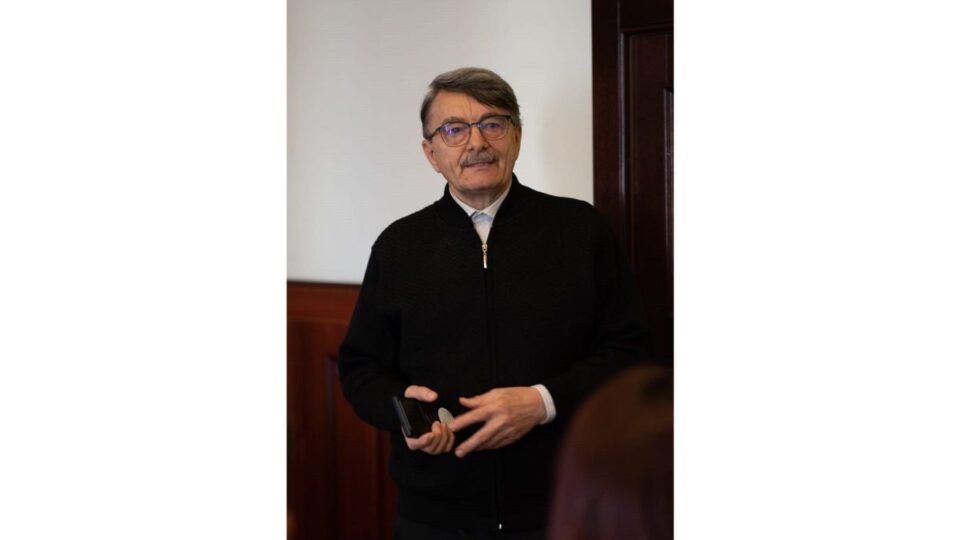
Ion Mariş – A life devoted to words, memory and the cultural identity of Sighet
The portrait of a writer, publisher and cultural organiser whose work has helped preserve, develop and promote the cultural identity of his home town.
Elena Enache, 06.11.2026, 14:00
This is the story of Ion Mariș — a life devoted to words, memory and the cultural identity of Sighet.
He was born on 16 April 1961. He graduated from the Faculty of Machine Building Technology at the Polytechnic Institute in Cluj-Napoca in 1986. His professional journey subsequently extended into several fields, including banking, stock markets, tourism, consultancy and the pharmaceutical sector. Yet literature remained a constant presence in his life. His interest in writing began early. As a student at Dragoș Vodă High School in Sighet, he took part in literary circles. Later, as a university student in Cluj-Napoca, he continued to develop his literary interests. He published poetry and prose in various literary magazines and periodicals, gradually building an increasingly diverse body of work. His bibliography includes poetry collections, prose, journalism, interviews, collaborative publications and cultural albums.
Among his poetry volumes are Vesperare, published in 2017; Ultimul Poem / The Last Poem, in 2019; Sentimente neasigurate / Uninsured Feelings, in 2021; Semne pe semne / Signs, on signs, in 2022; and Re-semnat / Re-signed, in 2024. His 2025 volume, Cu spatele la Centru / With the Back to the Centre, received an award for journalism and publicistic writing at the Books of the Year event organised under the auspices of the Romanian Writers’ Union, Cluj branch, and the cultural magazine Nord Literar.
This year, he published his sixth poetry collection, entitled …65…. The title refers to the age he reached in 2026. But the number is more than a biographical reference. It becomes a point of reflection, a moment of personal accounting. The volume contains 65 poems, exploring the passage of time, the fragility of human existence, memory, identity and mortality. Death appears throughout these poems not simply as the end of life, but as a quiet presence accompanying the human journey. It is a more intimate dimension of Ion Mariș: the writer looking inward, taking stock of the years behind him and contemplating what remains.
And yet, 2026 has also been a year of collective celebration — both for the author and for the town that has accompanied so much of his personal and professional journey: “The year 2026 has been an interesting one, quite a spectacular year for me. First of all, I published my sixth poetry collection, entitled 65. The meaning of the number 65 is probably quite obvious: it is the age I turned this year. It has been an interesting year because we have also celebrated 700 years since the first documentary attestation of Sighet, the town where I live, where I have expressed myself and where I completed my primary and secondary education. And, alongside all this, there is the success of Valea Verde Publishing House, which I coordinate and which is just 16 years old. It has been a prolific year from an editorial point of view as well. We have published several poetry collections by writers from Sighet: Paul Romaniuc, Antonia Dubovici, a young writer who lives in France, my own volume, and another book by a teacher from Poienile de sub Munte, a commune near Sighet. Some of the most interesting publications are still to come. Two important books have been published by Valea Verde Publishing House in Sighet, the publishing house I coordinate. These are very substantial works. One is The History of Sighet, by Teofil Ivanciuc. The other is Sighet 700, which includes 81 personalities who have made history for Sighet. It was written by Professor Ion Ardeleanu Pruncu and myself.”
In the cultural life of a town, publishing is more than a commercial activity. It is an act of preservation. It gives ideas a physical form, allows local voices to travel beyond their immediate surroundings and ensures that the work of one generation can become part of the inheritance of the next. For Ion Mariș, this understanding is reflected in his work at Editura Valea Verde, the publishing house based in Sighet, which he coordinates: “The two volumes dedicated to Sighet, both focused on the town’s history, have very distinguished scholars writing their prefaces. For both books, the prefaces are signed by academician Ion-Aurel Pop and Dr Livia Ardelean. The volume The History of Sighet also includes an additional contribution to its preface by the writer and university professor, Dr Ovidiu Pecican. These are two books that will stand the test of time and will probably provide a starting point for further additions and updates in the years to come. Returning to the history of Valea Verde, I should mention that during its 16 years of existence, we have published more than 200 titles. First and foremost, I have tried to publish authors from Sighet, but they have not been the only ones at the centre of my attention. We have also published authors from abroad, including a jazz music volume — actually a collection of musical scores — by a well-known Italian-Brazilian trumpeter. We have published French authors and Romanian writers living outside Romania’s borders. We have also published poetry written by a teacher who lives beyond the River Tisza, in the village of Apșa de Jos. The books published by Valea Verde have recently received awards at the International Poetry Festival in Sighet. Three of the volumes we published this year also received awards at this year’s festival, its 53rd edition.”
Ion Mariș’s cultural activity is also reflected in his involvement with civil society. Among His achievements are two public art memorials dedicated to important religious figures in the history of Sighet. But perhaps equally significant are the publishing projects, which have helped bring attention to two personalities whose contributions to Romanian education and cultural identity deserve recognition.
Perhaps the most revealing aspect of Ion Mariș’s story is the connection between his own creative work and his commitment to the community. Through literature, publishing, journalism and community initiatives, he has helped make Sighet more visible as a place of cultural identity, historical memory and creative expression. Ion Mariș is not simply writing about Sighet. He is helping Sighet write its next chapter.