Medieval Weapons in the Romanian principalities
In theory, weapons and sacred areas should not coexist, but people of yore had a different mindset.
Steliu Lambru, 08.04.2013, 13:42
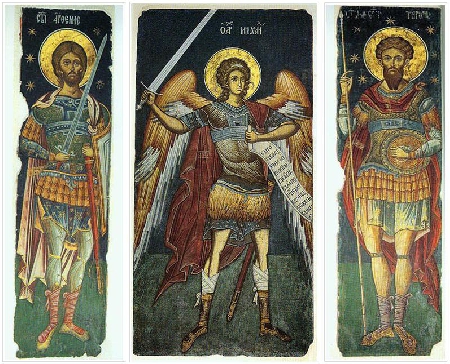
Proof of their belief is the great number of icons and frescoes representing weapons as a major social reality. Images of soldier saints, defenders of the Christian faith, painted on church walls in the 16th century, document the presence of various types of weapons used by the Romanian armies of the Middle Ages. Experts in mural painting have made amazing discoveries. Here is curator and medieval weapons expert Carol Konig.
Carol Konig: “We have spotted a harquebus in a fresco at the Voronet monastery. It was a major discovery for us, as nothing had been known about this very interesting weapon until 1978, but we know that it was exactly the type of weapon in use at that time in Europe. It was on a matchlock, a mechanism widely used in the Western world. There was no representation of that weapon in the Romanian principalities, as none of them was preserved to present times. However, we have plans and documents about those weapons and today we know exactly what they looked like. So our conclusion is that the painter depicted exactly the weapons used by the armies of his time.”
Of all the medieval weapons, the saber was conveying the strongest religious symbolism. The military saints painted on church walls appear with their sabers, as the main element of their mission, of the battle they were waging against unbelief. The main prototype is that of Archangel Michael – commander of the heavenly armies against the fallen angels – who is carrying a saber. That weapon had a mystical form; its long blade and horizontal guard suggested a cross. And as sabers were made out of steel and had flexible blades, they were standing for another two powerful symbols of Christianity; the toughness of this faith and the believers’ unflinching stand against unbelief. The blade’s flexibility mainly stood for the human soul in an all-out struggle against temptation. Carol Konig has described the characteristics of this weapon as they appear in the picture of a soldier saint on the walls of the Curtea de Arges monastery, in southern Romania.
Carol Konig: “The most representative weapon in use at that time was the saber, a sharp implement very reliable in any battle, as it could be used for both cutting and thrusting. Sabers were double edged, with a straight blade, and that’s the difference between a saber and a sword, the latter had a single-edged curved or straight blade. I was particularly impressed by its hilt, typical for that time, proving that type of saber was a replica of a real one, in use when the fresco was painted. Another weapon that appears in the fresco is the spear. Medieval soldiers used to fight with spears and javelins. The spear was an infantry weapon; it was longer and its tip came in various forms – triangle, leaf etc. The javelin was shorter, had a hardened tip and was particularly in use with the cavalry. Its metallic parts were smaller in order to cut through the enemy’s armour.
But the weapon of choice of the Romanian soldiers was the longbow.
Carol Konig: “Another weapon you could find in paintings or frescoes is the longbow. Armies in the Romanian principalities were fitted with longbows, sabers, or javelins if they were cavalry units. However the longbow remained the weapon of choice, being used in all the main battles the Romanians fought. The victory in the battle of Posada in 1330 was possible thanks to the archers. And in 1395 at Rovine, Mircea the Old relied heavily on archers who helped him get a resounding victory against Turkish sultan Bayezid. The Romanians were expert at firing these deadly weapons. Alexander the Kind, another Romanian ruler sent 400 warriors, most of them archers, to beef up the Polish troops in the battle of Marienburg in 1422. And archers from the Romanian principalities made a name for themselves all across Eastern Europe. Almost all soldier saints have longbows, but the one in this fresco is of an Oriental type. Here you can see the quiver for the arrows, just like it was back then. For defence, soldiers wore breastplates, spaulders and faulds. The breastplate presented in this fresco is not exactly what they used back then; this one is more adorned, with a lot of details. I believe the medieval painter was a little bit creative here. But even so, it is clear that a real breastplate, one that fitted the medieval armies, served as a model.”
The medieval principalities inhabited by Romanians are known to have developed their own weaponry. There was a certain type of saber used mainly in Moldavia. It was mentioned by famous ruler Stephen the Great in a letter to Italian manufacturers in Milan, when he ordered ten sabers of that kind. The manuscript is still on view in a museum in Istanbul, which also displays three of these sabers, one of which is known to have belonged to the great Moldavian ruler.