The Tablets in Campina-Sinaia
Radu Bajenaru attempts to dispell the controversy revolving around the 60 tablets discovered in Campina.
Steliu Lambru, 27.01.2014, 13:12
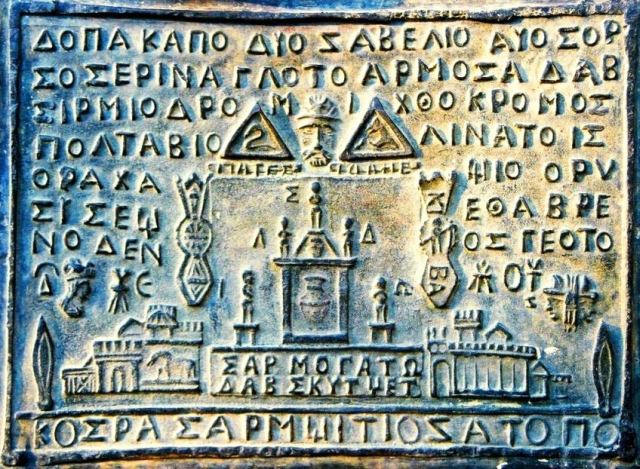
The basement of the “Vasile Parvan” Institute of Archeology in Bucharest has long been home to a number of 60 lead tablets, each measuring 15 cm in length and 10 cm in width. Their recent discovery has flared a genuine frenzy among history and mystery fans. Each tablet bears a variety of inscriptions such as letters, symbols and images that apparently seem unrelated. History enthusiasts believe the tablets to be of Dacian origin. Many stories revolve around the tablets, each more eccentric than the next, with a somewhat strong impact in the Romanian public sphere. Specialists have repeatedly come up with evidence that the tablets date back to the mid-19th century. Their claims however have done little to reign in the imagination of the population, who continue to feed on the alternative accounts of history enthusiasts. Some say the tablets, which were originally discovered in Campina, some 100 km north of Bucharest, bear inscriptions in Dacian.
Radu Bajenaru, an archaeologist with the “Vasile Parvan” Institute of Archaology explains some of the arguments of specialists who challenge the authenticity of the tablets.
“There are two sides as to the origin of these tablets. On the one hand there are archaeology and old history specialists who by and large seem to argue against their authenticity, claiming they originated under Dacian administration, as far back as 200 years ago. On the other hand there are certain history enthusiasts, people passionate about old history and myths who are trying to legitimate their authenticity with no other basis than their own knowledge. They are trying to reconstruct Geto-Dacian society from two thousand years ago. Of course there are pros and cons to each side of the debate. I for one believe that evidence in favour of a more recent point of origin, some time in the 19th century, are much stronger. More specifically, recent analysis of the metal they are made of clearly show that the lead from which they were forged was typical of 19th-century printing craft. Secondly, all the engravings, the entire iconography and the inscriptions on these tablets reflect things that were known in the 19th century. They tell us nothing new about the history of Geto-Dacians as compared to what we knew 150 years ago. We are told nothing about what was discovered afterwards. Thirdly, great historians specializing in antiquity, and by that I particularly refer to Parvan, whose scholarly expertise and accuracy are unchallenged, were familiar with these tablets. When Parvan wrote his works he didn’t pay much attention to them, as he already knew their story”.
What was the broader cultural climate at the time the tablets were discovered?
“Those who challenge their origin mistakenly call them fakes. A fake is in fact a forged copy of an original work of art or object. Rather these are genuine 19th-century creations from the Campina-Sinaia region, most likely belonging to Bogdan Petriceicu Hasdeu. Hasdeu was an encyclopaedist and a man with a wide cultural background. He had both the financial means and the intellectual ability to produce such objects. It is quite obvious, at present, that they are representations of Hasdeu’s vision of Geto-Dacian history. For this reason these tablets can hardly serve as historical evidence. The only peculiar thing about them is that sign language, which is allegedly Geto-Dacian, a weird grouping of Greek, Cyrillic, Latin and Oriental characters. Of course, a refined linguist such as Hasdeu, for all his scholarship, would have found it quite easy to piece them together. There have been attempts to decipher them, some of them successful I’ve been told, which I find absolutely ridiculous. These characters cannot make up a language proper. This would be the only novelty these tablets bring about, the need to decipher the information from the engravings. Even if we did that, no matter how fanciful that may sound, even if we did understand what Hasdeu wanted to convey on these tablets, I still think it wouldn’t be of much help to us, given the level of knowledge in the mid-19th century”.
If we were to believe this side of the story, what pushed Hasdeu into making these tablets in the first place, and how should we identify with them?
“It was not Hasdeu’s intention to be misleading. He was actually a man of his age, he didn’t want to forge objects, he meant no harm, he would have genuinely desired to do good. He must be seen as an enlightened figure, an all-knowing person keen on learning and disseminating as much as possible. And the tablets were but one of the means he chose to do this. It was commonplace at the time to do things like this. I see nothing wrong in that. It is, however, wrong to try and make these objects 2000 years older. If we took them for what they are, namely the production of a learned man, it would be just fine. It is a serious matter that such things become arguments in an effort to legitimate a history we know little about. There is little these tablets can do to change our understanding of this age. What I just don’t seem to understand is why anyone would want to make people believe these tablets are genuine. There were no such things in antiquity, no where in the ancient world can we find this type of engravings. I don’t see any sound reason why we should have them”.
The mid-19th century, an age of so-called “national fakes”, was dominated by Romanticist ideology. Besides the tablets, Hasdeu is also credited for another two creations, the so-called “Diploma from Barlad of 1134”, and the Charter of Yurg Koriatovich of 1347. Fortunately, history today is different from what it meant 150 years ago.