Cremation in Romania
One of the most unconventional ideas in the conservative Romanian society of the late 19th century was the incineration of the dead, to replace the traditional earth burial.
Ștefan Baciu, 24.02.2014, 15:06
Just like any new idea, in Romania crimation was mostly promoted by intellectuals, and had no impact on the ordinary people or on the traditionalist elites, at least in the beginning. In time, people got used to this idea, which had been promoted for reasons related to public hygiene. Cremation was seen as a more practical version of burial.
The concept of cremation brought along new words that had never been used in the Romanian language before, such as cremation and cremationist. The Romanian writer, philosopher and theologian Nichifor Crainic, one of the opponents of cremation in the interwar period, introduced the term asher, the pejorative version of cremationist. Historian Marius Rotar, president of the Romanian Cremationist Association, was our guide into the history of cremation in Romania. He has given us details about the beginnings of this practice.
Marius Rotar: “We are talking about the second half of the 19th century. This was, of course, a western trend, which was also introduced in Romania. Its supporters were members of an elite. Physicians were the first to promote cremation for utilitarian reasons, and there were some famous figures in this respect, such as Constantin I. Istrati. In his PhD thesis of 1876, entitled Removing Bodies, he openly supported the idea of incineration. He was several times minister, mayor of Bucharest and also Chairman of the Romanian Academy. As a confirmation of his belief in cremation, he himself was incinerated at the Pere Lachaise crematory in Paris. Personalities such as director of the National Theatre in Iasi, Mihail Codreanu, and University Professor Constantin Tiron, from the same city, were also staunch supporters of cremation. There were, however, some differences between the way in which Transylvania and Romania adopted the idea of cremation. In Transylvania, it faced more vehement criticism from people. What is interesting is that until WWI, the reaction of the Romanian Orthodox Church to this idea was not as violent as expected. It was only in 1900 that several articles on cremation appeared in the Theological Review and in the Romanian Orthodox Church Magazine. Until 1914 the idea of cremation was foreign to the Romanian space and there was no crematorium there.”
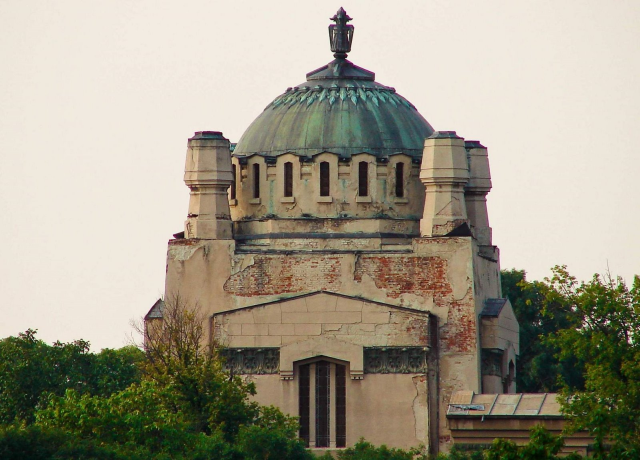
The opening of the “Cenusa” human crematorium in Bucharest, in 1928, marked an increase in the number of cremation supporters. Marius Rotar says, however, that those who embraced that option were not necessarily atheists or anti-Christians.
Marius Rotar: “What is interesting is that in Romania those who supported cremation did not deny Christianity and did not declare themselves supporters of atheism, except for Constantin Tiron in Iasi. Romanian cremationists were idealists; they did not imagine the Romanian Christian Church would react that vehemently. In the interwar period, the Romanian cremationist’s profile did not change, except for the fact that the group of supporters was upsized by member of the lower classes.”
Marius Rotar tells us about the difficulties faced by the advocates of cremation in Romania:
Marius Rotar: “It’s mainly about financial difficulties. It would have been impossible to build the crematorium without direct support from the City Hall. There were at least five mayors who supported the idea of cremation, most notably Ion Costinescu, who was to become a minister of health. He was also the chairman of the Cenusa Society. The idea was to cremate the bodies that remained unclaimed, mainly homeless people and people living on the margins of society. Bodies of dead children were also sometimes cremated, as we can see from articles in Flacara Sacra magazine and the crematorium’s records.”
We asked Marius Rotar what happened after the Second World War?
Marius Rotar: “After 1945, the cremationist movement in Romania received a heavy blow when the publication of Flacara Sacra magazine was discontinued. The idea of cremation did not win more popularity and the number of cremations only increased from 248 in 1928 to 552 in 1947, which is very little, almost insignificant. The installation of the communist regime did not lead to an increase in the number of cremations. On the contrary, their number decreased. Only 260 cremations were performed in 1953, for example. The idea of the New Man and how the communists actively supported cremations is not confirmed by statistics. It wasn’t until the 1970s that the number of cremations started growing again to reach a peak in the 1980s. However, this growth can also be explained by the increase in Bucharest’s population at the time.”
The list of famous Romanians who chose to be cremated instead of buried includes the religious historian Mircea Eliade and his disciple Ioan Petru Culianu, the literary critic Matei Calinescu, the journalist Felix Aderca, the historian Adolf Armbruster, the singer Doina Badea, the acrtress Clody Bertola, the political analyst Silviu Brucan and the linguist Theodor Capidan. Today, cremation is a controversial practice and has very few supporters in Romania.