The 70th anniversary of the mass deportation of the Jews in Northern Transylvania
Following the Nazi occupation of Hungary, which Northern Transylvania was part of, and the installation of a far-right government, many Jews were faced with deportation to labour and death camps.
Steliu Lambru, 18.08.2014, 00:05
On 19th March 1944, Hitler ordered the occupation of Hungary by the German army and the creation of a new government led by the far right, fascist and anti-Semite Arrow Cross Party. Dubbed Operation Margarethe I, the plan was designed to prevent Hungary from leaving the Axis, following the example of Italy in 1943. A similar plan to occupy Romania, known under the code name of Margarethe II, was also in the possession of the German ambassador to Bucharest, Manfred von Killinger.
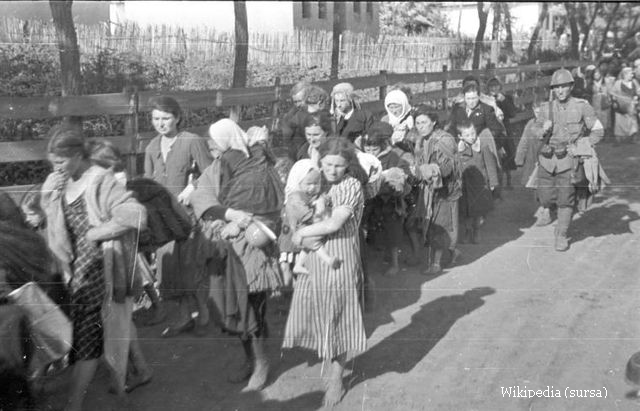
The coming to power of the Arrow Cross Party led by Ferenc Szalasi brought about a massive wave of anti-Semite repression in Northern Transylvania. The region had been under Hungary’s control following the Second Vienna Award of August 30, 1940. Various estimates place the number of Jews who perished in Nazi death camps between May and October 1944 at between 150,000 and 200,000. Some 15,000 Jews were deported in the 1941-1944 period. In Hungary, hundreds of Jews never even made it to the extermination camps, as the Arrow Cross militiamen lined them up along the Danube and shot them in the head, their bodies disposed in the Danube.
70 years have passed since the anti-Semite violence in Northern Transylvania. Back then, both the Romanian and the Hungarian civil population made efforts to shelter and protect the oppressed in Transylvania. Gheorghe Moldovan was only a student back in 1941. 56 years later he told the Centre for Oral History of the Romanian Radio Broadcasting Corporation about an organisation aimed at helping Jews created in the part of Transylvania which was still under Romanian administration:
“After Northern Transylvania was ceded to Hungary, the house of father Macavei in Blaj became a safe heaven for refugees from Gherla. Among them were the history teacher Mihali Semproniu and his wife Natalia and the French teacher Gheorghe Pop. They were all good people. Shortly after my arrival there I learned that they were very well organised. They had an association for helping Jews in Northern Transylvania and Romania led by Mihali Semproniu. I acted as the middleman, letting people know when the time and place of the group’s meetings. At one point, I got in touch with four families: the Veiss family, the Grun family, the Holtzinger family and the Menden family. Of course there were many others. They would usually meet at Mihali’s house or in other locations”.
The members of this association would often cross the border to keep in touch with anyone in need of help. Their small victories in Transylvania also helped shield Jews living in Romania against the laws of racial persecution, Gheorghe Moldovan recalls:
“At the time father Macavei acted as our country’s representative in Budapest, since we had no embassy. He led a group of priests who gathered as much information as possible about the situation of Romanians and Jews in Northern Transylvania. There also was a Jew who often came to Blaj crossing the border illegally. I never knew his name. He would consult with Mihali and his men in order to grant safe passage to Jews fleeing Hungary all the way to Israel or to other free countries. The association operated from 1940 until 1948. There were quite a few Jews living in Blaj at the time and they even had a synagogue. They were all under the protection of the association. No harm ever came to them, they were never deported, not even sent to labour camps. They just minded their own business. Professor Mihali was particularly very active. Whenever anyone had a problem, he would step in and take the matters into his own hands. Together with father Macavei he protected everyone in Blaj and its surroundings against all kinds of oppression. No one got hurt. Their activity was widespread. Mihali’s wife would cross into Northern Transylvania to go to the family house in Gherla or go to Sangeorgiu de Padure for medical treatment, but in fact all this time she was in permanent contact with the Jews in Northern Transylvania, helping them too”.
Gheorghe Moldovan had the rare opportunity to meet face to face with a prominent figure of the time, the Swedish diplomat Raoul Wallenberg, who saved thousands of Hungarian Jews who crossed the Romanian border.
“First of all, he saved them from deportation. In other parts of the country Jews were clustered and sent behind enemy lines or to labour camps, though not to death camps. The Jews in Northern Transylvania, however, faced the threat of being sent to Auschwitz and other death camps. This man would arrange for the Jews to cross the border illegally. I met this man in person. He would often drop by, and he even thanked me personally. He seemed to match all the descriptions I’ve read about Wallenberg. He was a tall man, very special and very brave”.
The ordeal of the Jews in Northern Transylvania would finally end on October 25, 1944, with the liberation of the region by Soviet and Romanian troops.