“Stefan Gheorghiu” Academy of Social and Political Studies
Stefan Gheorghiu Academy of Social and Political Studies was established in 1954 by the Romanian Communist Party, with the aim of training new political activists, able to further the cause of the regime.
România Internațional, 04.08.2014, 11:35
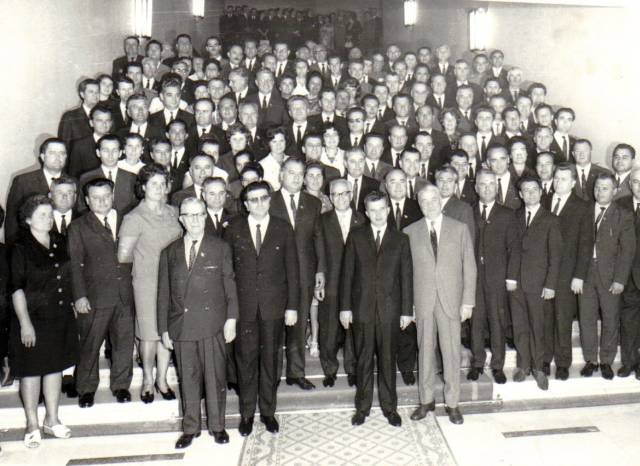
Communism was the first doctrine, political regime and form of societal organization to proclaim its exclusive reliance on rational knowledge. Everything that went against its precepts had to be done away with. Therefore, the truths underlying the new society, all knowledge and science had to be redefined. This is why the “Stefan Gheorghiu” Academy of Social-Political Studies was set up as a higher education institution that would train the new political activists able to further the cause of the regime.
Established on March 21st, 1945, by the Romanian Communist Party, under the name “The Workers’ University of the Romanian Communist Party,” the institution was designed to undermine the traditional concept of “university” and the intellectuals, as a social category. The institution was given the name “Stefan Gheorghiu,” in memory of a 19th Century Socialist activist, whose personality was brought back into the spotlight in 1971 by the communist regime, in response to the growing capitalist ideology. Here is historian Cosmin Popa, from the “Nicolae Iorga” History Institute in Bucharest:
“The establishment of the Academy of Social Sciences in the early 1970s may be seen as a symptom of the Romanian communist regime’s turning to conservatism. It was also an evident signal that the party and its leaders sought to reinstate a particular ideological primacy. The massive changes in power structures, the reinstatement of collective leadership and of the internal party democracy, carrying on the reforms designed to respond to the challenges of a very dynamic capitalism, all these features are specific to all communist states in the 1960s-1970s.”
In Romania, the communist regime was from the very beginning affected by a lack of legitimacy and by the fact that in 1945 the country’s most distinguished intellectuals would not cooperate with the communists. In the mid-1960s however, the regime’s new openness to intellectuals was an offer than not so many people would decline. Here is historian Cosmin Popa again:
“The late 1960s were in Nicolae Ceausescu’s view the time when the Party could assess the success of its efforts to win over the intellectuals. In an address given during a meeting of party activists in the education and research sector in September 1969, and designed to detail and explain the message launched by Ceausescu himself at the Party’s 10th Congress, a senior party leader, Paul Niculescu-Mizil said the distinction between intellectuals old and new was no longer operational. As he put it, Romania had a united intellectual class, whose members mostly came from among the workers. This speech offered a set of clues to read the party policy with respect to the specific features of Romanian communism, pointing to the party’s relation with the intellectuals, and the principles on which the organization of the education and research system was based. The regime was working on the right assumption that society was witnessing a scientific revolution that strengthened the political role of intellectuals. The increase in the number and role of intellectuals also prompted a change in the institutions in charge with the ideological management of this class, because its success was critical to the building of communism.”
On October the 3rd, 1971, the Executive Committee of the Romanian Communist Party passed a resolution on the establishment of the “Stefan Gheorghiu” Academy for social-political education and the training of senior party members, attached to the Central Committee of the Communist Party. The institution was designed to educate new activists, in all fields of activity, preparing them for positions in the party and the government apparatus. The regime’s distrust in the ideological work of the traditional research institutions strengthened the role of the “Stefan Gheorghiu” Academy. One of the pretexts was that traditional institutions had no activity relevant to the country’s economy. Historian Cosmin Popa explains:
“The ideological control over social sciences was not the main goal of these efforts. In fact, nobody doubted the efficiency of the mechanisms of control over intellectuals, which already existed in all institutions. What the party leadership originally intended was to improve the professional training of political leaders and the spending of resources. Economists in particular were subject to Ceausescu’s criticism and were targeted by propaganda workers. The regime saw itself as strong enough to no longer have to insist on the coercive dimension of ideological control. The party was beginning to feel its dynamism was hindered by the bourgeois forms of research organization and professional recognition. In Ceausescu’s view, the old institutions with their intellectuals isolated from real life failed to respond promptly to the needs generated by a fast economic development. Furthermore, they were sometimes a problem for those in charge with propaganda.”
In spite of the regime’s plans to make it an elite university, the “Stefan Gheorghiu” Academy was perceived by specialists as a mere tool of the regime. It constantly failed to become more than an attachment of the repressive apparatus, and shortly after the 1989 Revolution it was dismantled altogether.