1989 in Bessarabia
1989 was the year that brought freedom to Bessarabia, a territory annexed by the USSR in 1939, and again in 1944.
Steliu Lambru, 29.12.2014, 13:23
Bessarabians, just like the Romanians, celebrate a quarter of a century since the fall of communism and the end of the Russification policy that plagued their territory. We spoke to history professor Sergiu Musteata from Chisinau State University, about 1989 in Bessarabia:
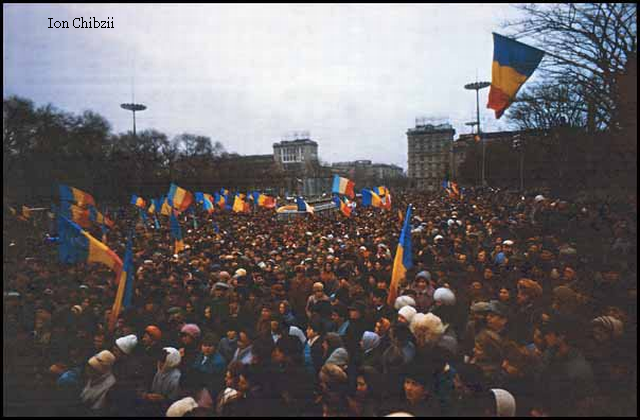
“Between 1985 and 1989, things were changing in the Moldovan Soviet Socialist Republic. It is interesting that the first demands of the people in the capital Chisinau were not just economic and social, they also had to do with the language and alphabet. Of course, the first word was ‘liberty’. If we look closely at the pictures, we notice that in many of them people hold signs with the word ‘liberty’. That was their main concern. People wanted to talk freely, they wanted to tell the truth as it stood. The worst offence for those people was being unable to talk and write in their mother tongue openly. That is why the first demands in Chisinau, which went on for the rest of the year, regarded the language and the alphabet. Starting in January 1989, after discussions started by the Writers’ Union in 1988, people started to join efforts towards having a single language, even though the Politburo of the Communist Party was laying hurdles in their path, even though it was trying to criticize the effort and call it provocation, even though they tried to ban certain public assemblies. People started to assemble in greater and greater numbers, and in the summer of 1989 they numbered several tens of thousands.”
Chisinau was seething, like the other capitals of republics in the union, under the impact of Perestroika and Glasnost policies promoted by Mikhail Gorbachev. The national demands were the same for all the nations oppressed by the USSR for 70 years. Sergiu Musteata believes that it was the Grand National Assembly in Chisinau of August 27, 1989 that triggered true change in Bessarabia:
“On August 31, 1989, the law passed for switching to a Latin language and alphabet. Over the course of an entire year, writers demanded that the Soviet imposition of the Cyrillic alphabet be reversed. They challenged those norms that prevented a good knowledge of Romanian and corrupted it. This way, the elections for the Supreme Soviet brought to the forefront a new elite, men of culture, especially writers, who formed a team on behalf of Moldova to attend the meetings of the Supreme Soviet of the Soviet Union in Moscow. They had the courage, in 1989, to say that the Hitler-Stalin pact was a crime against humanity. They demanded that a commission be created in the Soviet Parliament to discuss the impact of that document. For the first time in Chisinau, the newspaper called ‘Literature and Art’ published the secret addendum to that treaty, which had that far been considered a myth. That’s when it was published for the first time, and it turned out that based on this document the world got divided.”
Liberty eventually triumphed in Chisinau, just as it did in Vilnius, Riga, Tallinn, Kiev, and other capitals across the Soviet Union. Sergiu Musteata:
“What happened in Chisinau marked the spirit of the national liberation movement. In 1987, things were discussed with no small amount of fear, in 1988 publishing started, and in 1989 freedom of expression and association burst forth. For the first time, in 1989, people started waving the tricolour flag at meetings, saying that the tricolour was their true flag. Also in 1989, later that year, for the first time, a large-scale meeting was held around the idea of uniting Bessarabia with Romania, in the context of condemning the Hitler-Stalin pact. The cultural and historical slogans inclined towards social and economic issues: economic independence, autonomous administration, which in the following years led to the declaration of sovereignty, and, in 1991, to the Declaration of Independence.”
Sergiu Musteata recalled how the year 1989 led to Bessarabian Romanians re-gaining their identity. He speaks from experience:
“In 1989 I was a first-year history student, and I remember that I took part in many public manifestations. On November 7, when traditionally there was a military parade to celebrate the Bolshevik revolution, for the first time in Chisinau people had the courage to step in front of the tanks to stop them in their tracks. Since then there have been no more tanks in the marches in the grand national square in Chisinau. People came out with flowers, and the soldiers, no matter their ethnicity, went no further. They stopped, hugged the passers-by, and received their flowers. For the first time, the Communist Party leadership fled the official stand. It was a sign that society was changing, that society wished for a different leadership, that it wanted something else. It was a sign that the time of the totalitarian regime, which had kept millions in fear, was now over.”
Bessarabia had a much smoother transition to democracy than Romania, despite having a much more traumatic past.