The Miner Raids of June 1990
One of the most violent events in post-1989 Romania.
Steliu Lambru, 15.06.2015, 12:48
In June 1990, Romanians took to the streets, unhappy with the fact that, the previous month, the National Salvation Front (the NSF) had won the first democratic elections after the fall of communism. Supported by miners from the Jiu Valley mining basin, security forces in Bucharest intervened brutally against protesters in University Square, as well as against the population. The events of June 13 to 15, the so-called ‘mineriada, known as the ‘miner raids abroad, had a major negative impact on democratic structures and the rule of law. Political scientist Gabriel Andreescu talked about the political background that allowed that crisis:
“These events are not unpleasant, but tragic, in every sense of the word. In the sense of a cost in human lives, individual lives, as well as a collective cost. It definitely has to do with the moment when the NSF was attempting to gain legitimacy, and it decided that it was the moment to use any means at its disposal to gain the control it was used to. Let us not forget that the former secret police the Securitate had been almost completely recycled in the Foreign Intelligence Service, which appeared in 1990, and the Romanian Intelligence service, which emerged officially in March 1990, and which had in fact been functioning previously. There was a visible growing economic power of the former apparatchiks. We are talking about some human groups whose experience was that of full control. From then on, full control was no longer an option. This is why protesters stayed on the streets in spite of the popular vote and in spite of requests for protests to cease.
On June 13, 1990 the tents set up by the protesters in University Square in Bucharest, were destroyed by security forces. The first arrests were made, and workers from the Bucharest Heavy Machinery Factory joined those who were trying to restore order, shouting slogans against the intellectual class. After violent clashes, public television broadcast a message from President Ion Iliescu, who had won the democratic elections a year before. The message said: ‘We are calling on all responsible forces of conscience to gather around the Government building and Television to put an end to the forced attempts of these extremist groups, in order to defend the democracy gained at such great cost.
On the evening of 13 June, three trains brought to Bucharest miners from the Jiu Valley basin. Gabriel Andreescu told us about the events that followed:
“The newspaper Romania Libera, as well as the Group for Social Dialogue and others challenged constantly the power, which had been, however, confirmed by the population. Therefore what happened subsequently destroyed democracy. The miners who came to Bucharest were to liquidate the main sources of opposition. We are talking about Romania Libera, which was attacked, its headquarters destroyed, and the Group for Social Dialogue. I was present there, in the latter case. The miners came to the gate to throw us out, and they were stopped only due to a whole strategy of negotiation.
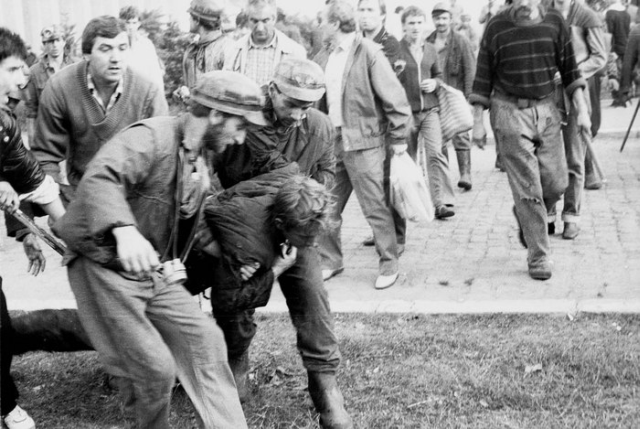
The following day, on June 14, the miners led by Miron Cozma were taken by employees of the Romanian Intelligence Service to all the major points of Bucharest. The building of the University was attacked, illustrious academics, among them Petru Cretia, were assaulted, alongside student leaders. The same thing happened to the headquarters of the National Liberal Party and the Christian Democratic National Peasant Party. Back with details is Gabriel Andreescu:
“The headquarters in historic buildings were destroyed, therefore, normally, after these raids, the opposition was supposed to be reduced to marginal, absolutely inefficient forms. But that didnt happen. The reaction from the inhabitants of Bucharest, and all over the country, was extraordinary. What these events did was to mobilize people even more, bringing together different communities, like labor unions, parties in the opposition and independent intellectuals. These events prompted the creation of the Civic Alliance, the largest civic structure in the country. The Cluj Anti-Totalitarian Democratic Front was set up after that, which then became the Democratic Convention of Romania, which in 1996 ensured a change in power. It allowed the stabilization of the first truly democratic institutions in Romania.
On 15 June, 1990, the miners who had devastated downtown Bucharest and had savagely beaten protesters, intellectuals and students gathered at the Romexpo exhibition complex, and Ion Iliescu personally thanked them for restoring order in the Capital. Political scientist Gabriel Andreescu tells us about the impact of this tragedy:
“There were overwhelming influences in a variety of ways, by mobilizing the domestic opposition. The international impact, however, was terrible, and we still bear the consequences of those terrible, horrible images that people in the West could see live. The way in which, with the blessing of public authorities, gangs of miners assaulted young people, destroyed abodes of learning. It is a huge shame, a stain on history that Romania will be hard put to be rid of.
25 years after the events that shook Bucharest to its core, there is still no definitive review and bottom line drawn on the real toll taken by this phenomenon that brought a new word to the Romanian language, ‘mineriada, a sarcastic and bitter marriage of the words ‘miner, miner, and ‘olimpiada, Olympics.