Corneliu Coposu, Godfather of Romanian Democracy
A martyr of democracy and one of the most important figures in Romania's rebirth after 1989...
Steliu Lambru, 16.11.2015, 14:13
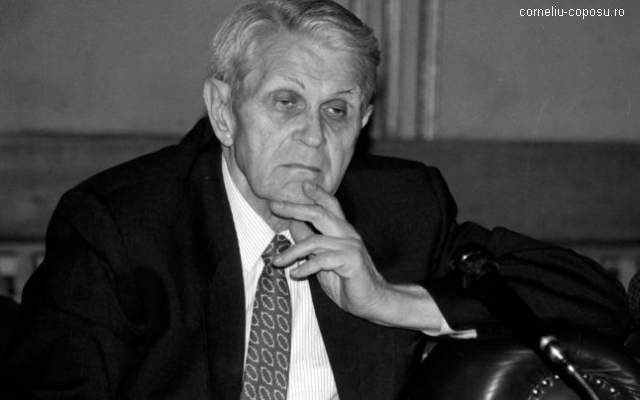
One of the most important things that one can do in life is leave a legacy, which is not as important materially as it is symbolically, especially as a role model. Such was the life of Corneliu Coposu, who died on 11 November 1995. He is remembered as a martyr of democracy and one of the most important figures in its rebirth after 1989, after almost half a century of Communist dictatorship. He left behind a major legacy of political and religious beliefs, integrity and physical and mental resilience in resisting the regime, which coaxed many into collaborating. ‘History’s Devil’, as Polish philosopher Leszek Kolakowski called the red terror regime, plagued Corneliu Coposu until 1989.
The regime tried to co-opt him, to corrupt his soul and convictions, and compromise him. Based on his own testimony, as well as documents found in the archives of the former political police, after being released from prison, Coposu was arrested 27 times for short bouts, his house was searched dozens of times, and 3,000 personal documents were seized.
After 1989, Coposu was a man around whom people clustered in the attempt to restore the Romanian society, with its politics and culture, gravely altered by the Communist past. In 1995, when he passed away, Coposu had on his side a great number of Romanians determined to make a change. His immense suffering during the dictatorship had much to do with the sympathy he engendered. After 17 years of political prison, he managed to confirm that truth eventually triumphs. His modesty was exemplary. He emphasized the fact that he was not an individual role model, but a mere representative of a whole generation that lived to tell the terrible tale of suffering they endured in prison.
He was born on 20 May 1914, in Salaj. His father was a Greek Catholic priest. He studied law, became a lawyer and got his PhD from the University of Cluj. He was a close associate of National Peasant Party leader Iuliu Maniu, as his personal assistant. He was arrested on July 14 1947, along with the entire leadership of that party, and was given a mock prosecution by the newly instated Communist regime. He was sentenced to hard labor for life, but was released in 1964. 9 of the 17 years he spent in jail were in complete seclusion, during which time he almost forgot how to speak.
His worst experience was the time spent in prison in Ramnicu Sarat. Here he is telling us about it:
“The prison in Ramnicu Sarat had 34 cells, 16 each on the ground floor and the top floor, divided by fence wire. It also had 2 side cells and 4 punishment cells in the cellar. Each cell was 3 meters by 2. They were honeycombed, one next to the other, at a height of 3 meters and had an inaccessible little window, 45 by 30 cm, shuttered on the outside, so no light could come through. There was a 15-watt light bulb shining permanently, shedding a mortuary light. There was no heating, the jail had been built around 1900 and it had thick walls. It had two rows of walls, 5 or 6 meters high, and between them was a control corridor. The second wall had the watchtowers where armed soldiers patrolled.”
The totalitarian regime did not call the prisoners by name. It gave them numbers. In 1993, Coposu recalled for us what life for him and the other detainees was like:
“Each detainee had a number which was the cell number, our names were not known. We were identified by our cell number. Each prisoner, being alone, was denied any conversation or relation with any other occupant in a cell, and for a long time conversations were in Morse code, knocked into the wall, until the system was uncovered and severe punishment was meted out. After that, we coughed the Morse code, which was exhausting, especially given the extremely frail condition we were in. I was in cell 1, and above me, in cell 32, was Ion Mihalache, who initially could be contacted by Morse code, until 4 or 5 years later, when his hearing failed and he could no longer react to the knocks on the wall.”
Asked if he would have lived his life differently had he been able to turn back time, he answered: “I looked into my conscience, I reviewed all my suffering and misery in prison, during the years of detention, the persecutions during the years after I got out of the penitentiary, and I believe that I would not have a choice. I would opt for the same destiny at the drop of a hat. I think our destinies are prescribed to us from birth. I am not a fatalist, but I think that even if I had some alternatives, I would choose the same past I have lived, and which I would repeat serenely.”
(Translated by C. Cotoiu / Edited by E. Enache)