The culture of shortages
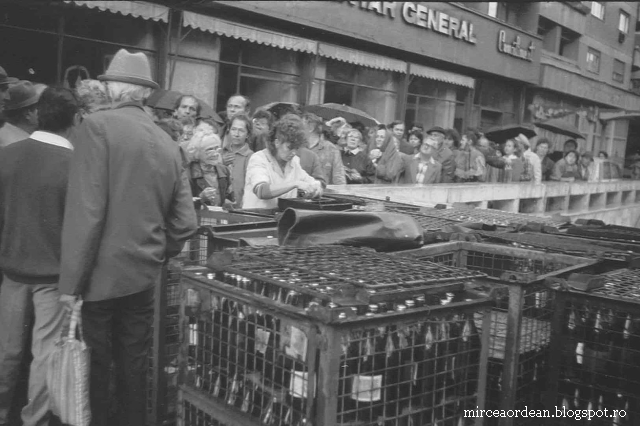
During communist times, shortages were the norm, and some historians even speak of a “culture of shortages.
Steliu Lambru, 04.04.2016, 13:33
During communist times, shortages were the
norm, and some historians even speak of a culture of shortages. In the 1980s,
when poverty had become generalised and more acute than ever, shortages of all
kind were a fact of life. Historians have looked into letters written by
ordinary people to institutions of the state, complaining about this fact.
Given the deplorable economic situation caused
by the policies of an incompetent and obsessive regime, relationships between
people were deeply affected by the culture of shortages. Historian Mioara
Anton, from the Nicolae Iorga History Institute of Bucharest, described the
mechanism:
The shortages, the restrictions, the rations
imposed by the Ceausescu regime to hide a disastrous economic reality often
generated ingenious solutions to make everything permitted and accessible.
Informal networks were thus created able to provide a solution to apparently
insurmountable problems of everyday life, from facilitating an abortion to
obtaining a better job, getting away with a misdemeanour or obtaining goods.
These networks involved people from all walks of life, with all kinds of
interests and needs. Informal networks were based on rules different from the
official norm, and were a profitable alternative, especially for whoever ran
them, but also for the people who had to resort to them. This secondary economy
was dependent on the state sector, using its resources and channels of
distribution.
These social networks overlapped with the
authorities and the official policies. Even though they created underground
societal models, they were closely tied to everyday life, and the authorities
were perfectly aware of their existence. Mioara Anton explains:
Informal networks were typical of communist
regimes. They existed not only in Romania, but also all over the communist
bloc. Documentary sources such as memoirs, diaries, interviews with small time
activists, the people who got by and the artisans of the networks that ran
through every party and state structure allow us to put together an image of
everyday practices at the time. We also have official documents, notes and
reports, which show the development and importance of these networks within the
whole of the command economy. Their multiplication was directly tied in with
the criminalisation of the practice in the sense of an expansion of the
phenomenon of corruption and the generalisation of shortages. For example, the
campaign to eradicate baksheesh initiated in the early 1970, alongside the
fight against social parasites, were among the few public attempts of the
regime to mobilise society to institute norms to be generally accepted, which,
according to official rhetoric, would have led to all citizens behaving
correctly.
The regime attempted to react against the ill
effects of shortages. Historian Mioara Anton once again:
As the state’s economic development programmes
started failing, new rules were issued to manage shortages. One example is a
programme for self-management and self-provision launched in 1981, which barred
people from purchasing goods from anywhere else than their place of residence.
A year later, the Rational Nutrition Programme was introduced, followed by
ration cards, alongside special legislation that punished economic activities
generated by shortagaes. The Ceausescu regime never admitted to the utter
failure of central planning reflected in the five-year plan of quality or that
of scientific revolution. In 1982, Iulian Dobrescu, head of production planning,
tried to persuade Ceausescu to adapt production planning to world economic
trends, but that was to no avail. Dobrescu insisted that a fair quality to
quantity ratio would have led to economic growth and less shortage for the
population. His suggestions were ignored, and he resigned.
At first sight, shortages were the result of
the economic crisis, but in fact they were rooted in the nature of the regime,
according to historian Mioara Anton:
Another factor that encouraged the development
of the informal economy was what American historian Ken Jowitt called the
‘familism’ of the regime. The party’s monopoly was undermined by a culture of
clientelism within the political elites that facilitated illegal or
semi-illegal transactions. The party allowed and even encouraged certain
traditional political attitudes and behaviour in the top tiers of the party and
society. The image that the head of the party had of reality was more than
optimistic. In his opinion, per capita consumption had risen, there was a wide
array of products available in shops, even if they didn’t cater to all tastes,
and healthcare was at normal levels.
The culture of shortages ended in 1989 with the
collapse of the communist regime. Its legacy, however, in the form of informal
underground networks, survived its fall, becoming the foundation of the
emerging market economy.