The Romanians outside Romania during the Great War
he Romanians living outside the country fought four years in the Great War. Citizens of Austria-Hungary, Russia or the Balkan countries, Romanians had been drafted in the armed forces of the combating countries in the very first days of the conflict
Steliu Lambru, 29.08.2016, 12:32
Romania joined WWI in 1916, after two years of neutrality, but in spite of that, the loss of human lives and material damage weren’t less significant though. Although it fought only for two years, Romania registered 6% of the total number of the servicemen killed in action, on the side of the Entente, as compared to the USA, which reported only 1%, after only one year of fighting. In figures, Romania lost roughly 500 thousand troops and other several hundred thousands civilians to an epidemics of typhus. Add to this the national treasure sent to Russia for safekeeping in 1916, and never returned, and you’ll get a complete picture of Romania’s loss in the WWI.
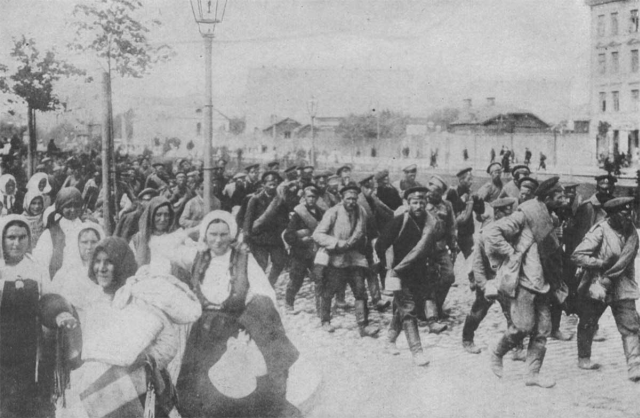
However, the Romanians living outside the country fought four years in the Great War. Citizens of Austria-Hungary, Russia or the Balkan countries, Romanians had been drafted in the armed forces of the combating countries in the very first days of the conflict and many of them made the supreme sacrifice on the battlefield. The Romanians in Transylvania, Banat and Bukovina, territories making up Austria-Hungary, were present on the battlefield from the very beginning, taking part in the biggest military conflict ever seen until that moment, hundreds of thousands loosing their lives on the battlefield or falling prisoner. The Romanians in Bessarabia, which was part of Russia at that time, were serving in the Czarist army against the Central Powers. Many Romanians living in Albania, Greece, Bulgaria and Yugoslavia also died on the battlefield, between 1914 and 1918.
But it wasn’t only the Romanians who had to fight on various front-lines and sometimes against their own convictions. Nationalities in the Austro-Hungarian Empire chose to be loyal to their countries and their emperor and if at the end of the war things went in a different way than it had originally been planned, it was because opinions were changing and former values decayed.
According to historian Ion Bulei, the Romanians were not the only ones fighting for the two belligerent sides in the war; the Poles also found themselves fighting for both the Entente and the Central Powers. Bulei says that the Romanians were actually in a better position than others.
Ion Bulei: “We, the Romanians, had a country of our own at that time, something the Slovaks, the Czech and the Poles were only dreaming of. We and the Serbians had a nucleus, around which a bigger state could be formed. That was the advantage we had at that time. We were between empires and at their disposal, but the other nationalities were part of those empires, be it Austria-Hungary, Russia or Germany. The Romanians weren’t the only ones in a special situation at that time, things were even more complicated for other nationalities. Nationalism, which was prevailing in the 19th century and turned virulent in the early 20th century, manifested itself with all its momentum during the First World War. This phenomenon manifested itself among a mixture of peoples, each trying to find its own way in the world. The Romanians were also in the same turmoil struggling to build a bigger state than the one they had back then.”
Nationalism was the phenomenon that fuelled the fierce clashes of the First World War and it was the same nationalism sparking off feelings of fraternity among the speakers of the same language fighting for opposing sides. It was the source of a conflict between a soldier’s duty and his personal beliefs, a conflict that would further raise people’s awareness over this issue. Romanian writer Liviu Rebreanu tackled this problematics very well in a novel entitled “The Forest of the Hanged”, whose protagonist, an officer in the Austro-Hungarian army, Apostol Bologa, is torn between his duty for the Austro-Hungarian Empire and his personal convictions. When the war ended everything looked different, though. The former enemies, Romanian soldiers fighting for one side or another in the war, had to rub shoulders in the same country after unification.
It’s worth mentioning that the National Guards in Transylvania, Banat and Bukovina were made out of discharged troops. They were in charge of defending the cities and were the ones that made possible the National Assembly in Alba Iulia, which proclaimed Transylvania’s union with the Kingdom of Romania. According to historian Liviu Maior, author of a volume entitled “Two Years Earlier. Citizens of Transylvania, Bukovina and Bessarabia at War, 1914-1918”, apart from winners and losers, a war changes perceptions and leaves unmendable things behind.
Liviu Maior: ”The early days of the Great War prove how fast and unpredictable a war can be, with a dramatic aftermath for humankind. It was a harrowing war. 77,000 of the Romanians outside the country’s borders died on the battlefield, others suffered from all sorts of diseases and plagues a war usually brings about. I researched village life, the simple man’s life during the war, as well as their reactions. It all started from prison camps. It was there that former GIs and officers turned radical, and not only the Romanians. In Transylvania, there were prison camps for Italian and Serbian soldiers, in Arad, for instance, almost 4,000 Serbians died in horrendous circumstances. Italian prisoners were used for road construction works.”
After 1918, the new European order, following nationalities’ principles, tried to straighten whatever had been viewed as being crooked. Nations formed their own states, while people became citizens once again. As for Romanians, no matter what side of the barricade they had fought on between 1914 and 1918, got united in what was termed Greater Romania, a project they believed in and where they wanted to once again find peace and happiness.