
The Battle for Bucharest
The Romanian army began its World War One operations in August 1916 after the conclusion of a military convention between Romania and the Triple Entente.
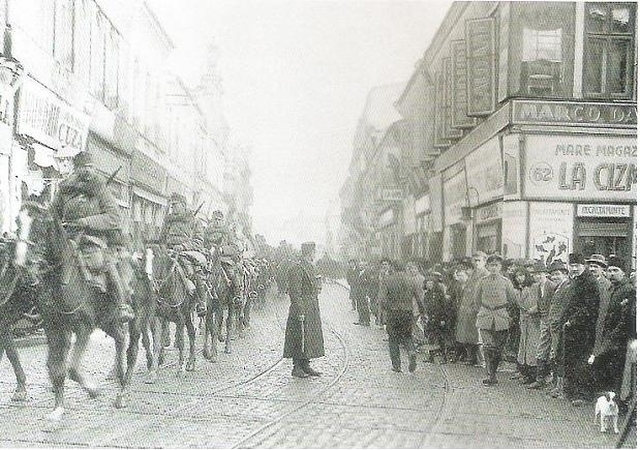
Steliu Lambru, 12.12.2016, 13:19
The Romanian army began its World War One operations in August 1916
after the conclusion of a military convention between Romania and the Triple
Entente and consisted of an offensive in Transylvania. The Central Powers
counterattacked, however, and obtained a resounding victory in Turtucaia in
September 1916, an event that went down in history as the disaster of
Turtucaia. In December 1916, Bucharest was under the occupation of the German,
Austro-Hungarian, Bulgarian and Turkish armies.
The devastating outcome of the first part of the Romanian army’s
campaign was blamed on the poor preparation of the army. However, the historian
Sorin Cristescu of the Spiru Haret University in Bucharest is of the opinion
that had Romania entered the war from the very beginning, the situation would
have been different. He blamed the Romanian army’s lack of war experience on
the fact that Russia had refused to accept Romania as an ally. Historian Sorin
Cristescu explains:
First of all, Russia was opposed to the creation of a Greater
Romania. Despite the pressure of the public opinion in Bucharest, Romania was
not invited to enter the war, but kept at arm’s length. An opportunity appeared
in September 1914, when Lviv ell into the hands of the Russian army. Italy entered the war on May 23rd 1915 and if Romania had also
entered the war at the time, the effects could have been devastating. A third
opportunity arose on June 4th 1916, when the offensive of the
Russian armies lead by Brusilov appeared to be victorious, so Romania’s entry
into the war was only allowed when Brusilov’s campaign reached a deadlock. The
idea for Romania to enter the war reflected the interests of the members of the
Entente who were willing to do anything to put a stop to the export of vital
raw materials from Romania to the Central Powers. Speaking about how valuable
the Romanian exports were, the German general Ludendorff said in 1918 that the
raw materials coming from Romania helped the Central Powers ‘keep their head
above water’, to use his expression.
Sorin Cristescu said that contrary to what Romanians
believe, the assault on Bucharest was initiated by German and Austro-Hungarian
troops in the west:
When strong pressure was put on the Southern Carpathians
by mountain troops, the Central Powers broke through the front around 11
November 1916 in the area furthest away from Bucharest. Through Lainici Pass,
near Targu Jiu, the German troops advanced towards Craiova. The moment when
Craiova fell and they crossed the Olt, around 23 November 1916, coincides with
the German army crossing the Danube in a place they had crossed before, in
1877, at Zimnicea. The two coinciding operations, crossing the Olt and crossing
the Danube, had a devastating effect. One month before on October 26, Dobrogea
had been taken over. Mackensen walked on the Cernavoda Bridge, seeing for
himself that it was usable, that it had not been completely destroyed. The
Germans were well on their way to Bucharest on the two prongs, one with the 9th
Army Corps, headed by the former head of the general staff of the German army,
General Falkenhayn and the other headed by Mackensen.
The last attempt by the Romanian army to stop the
advance of the armies of the Central Powers was doomed to fail. Here is
historian Sorin Cristescu once again:
The moment that was supposed to be decisive was the
so-called battle on Neajlov River. The Romanian army, lacking Russian
reinforcements, which were late in arriving, tried to isolate one by one the
two German armies in an offensive such as had not been seen since 1914, so as
to defeat or at least stall them. This didn’t happen, because of the clear
superiority of the German armies and because of bad luck as the vehicle of the
Romanian officers carrying deployment orders fell into German hands. That put
the finishing touch on the disaster. But even without that episode, the result
would have been the same. On 4 December 1916, it was obvious that Bucharest
could not be defended. The forts of Bucharest had been dismantled even before
the signing of the Convention signed on August 4, 1916, and Bucharest was open
for the taking.
The offensive of the Central Powers was halted on the
Focsani-Namoloasa line on December 9 1916 in the Battle of Casin. The Romanian armed
forces, which finally had got help from the Russian forces, stopped the German
assaults, and went on the counteroffensive to stabilise the front. The fall of
Bucharest, however, marked the beginning of an occupation regime. Historian
Sorin Cristescu:
Romania would taste the drama of retreat. The
railroads became extremely crowded, as all kinds of material was being
transported to Moldavia. Parliament, the government and the royal family all
fled the capital, soon after the royal family had suffered a tragedy. Their
youngest, Prince Mircea, had died of typhoid, even though no one around him had
been sick. The decision to abandon Bucharest without a fight was made on 6
December 1916. It was Field Marshall Mackensen’s 67th birthday. One
day before that, a great honour was bestowed upon him, as the 129th
Infantry Regiment was named after him.
The occupation regime in southern Romania and
Bucharest, which lasted until November 1918, was a harsh one. Romania lost
territory in the mountain area and was under complete German economic control.
In 1918, however, things turned on their head, and Romania had its greatest
triumph in its modern history.


























