The Centennial of the 1919 Romanian Army Campaign
World War I, after 4 years of bloody conflict and tragedy, did not come to an end suddenly. It left every individual, ethnic and political group, and every nation feeling profound trauma.
Steliu Lambru, 16.09.2019, 14:00
World War I, after 4 years of bloody conflict and tragedy, did not come to an end suddenly. It left every individual, ethnic and political group, and every nation feeling profound trauma. The winners faced the aftermath of the war, trying to find solutions to even out the social and economic situation, while the defeated had to face the humiliating situation they were put in. The war continued in 1919, but this time it was not between the warring blocs, but were area battles and skirmishes in Central and Eastern Europe. The break-up of the Austro-Hungarian Empire came with violence that only subsided in the summer of 1920, along with the signing of the Treaty of Trianon. After the Bolshevik regime led by Bela Kun took power in Hungary in 1919, based on the model applied by Lenin in the Soviet Union, that country became the main source of instability and the main obstacle in the way of peace. The main targets for the Hungarian communists were Romanians and Czechoslovakians.
Historian Serban Pavelescu provided us with a sketch of what was facing Romanians in 1919:
“We can say that the aftermath of the armistice of 11 November 1918 is a veritable war after the war. Basically, the Romanian state was put in the situation of using its military to defend the Romanians in the historical provinces, which had declared in March, November, and December 1918 their wish to join Romania. The country was surrounded by hostile forces, opposed to the union of the territories, and to the existence of the Romanian state. To the east it had Soviet Russia and Soviet forces in Ukraine, to the north and northeast it was facing territorial claims from Ukraine, from all sides of the political spectrum, nationalist or Bolshevik. To the west it had Hungary, first represented by the regime that followed the dissolution of the Austro-Hungarian Empire, with which Romanians had negotiated the separation of Transylvania from Hungary based on a referendum. In the southwest, Romania faced Serbia, which had its own territorial claims, based on promises made by the Allies during the war. In the south, Romania faced resistance from Bulgaria, which was reluctant to vacate Dobrogea and meet the provisions of the armistice.
The war between Romania and Hungary started by the Hungarian red army had two stages. The first was that of April- May 1919, when the Hungarians attacked Romanian troops in Transylvania, then the second around the half of May 1919, when the Hungarians attacked a second time, after being pushed back. Serban Pavelescu pointed us to another war, however, in the diplomatic field:
“We are practically talking about two wars. One was at the peace conference, another on the battlefield. It was a very strange war, where military operations were carried out between two or three rounds of negotiations, in between armistices imposed by the great powers. For instance, military operations ceased on May 1, 1919, as per the wish of the great powers. This allowed Bela Kun’s troops to reorganize and launch a devastating attack on May 20, 1919, not against Romanians, but against the Czechoslovakians. The attack against the Romanians fails, it was quickly repulsed. In less than two weeks, Hungarian troops occupied all of Slovakia. As for the front on the river Tisza, after two or three days of holding defense, the Romanians went on the counteroffensive, and once they got over the river, the Hungarian troops were routed and the Romanians occupied Budapest.
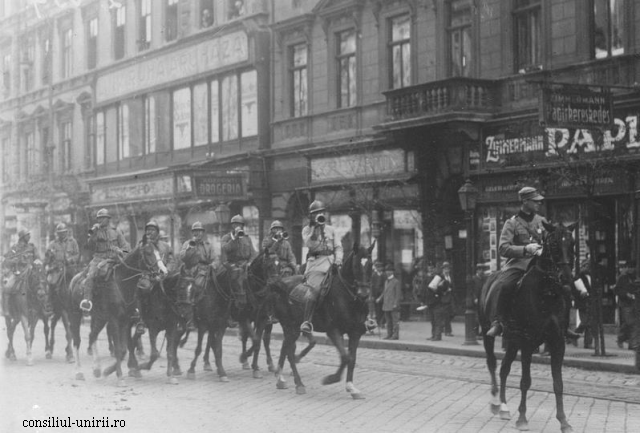
The second stage of the Romanian-Hungarian war ended in August 1919. The Hungarian capital was occupied, and the Soviet republic was dismantled.
“The occupation of Budapest was a problem, because, even though Romania had been attacked, and it was pushing against an enemy that had attacked it twice, it was asked to cease the assault. There was enormous pressure, and it was only by the initiative of Romanian commanders with authority in the field that Budapest, Hungary’s most sensitive political and military point, was occupied and the Soviet republic dissolved. At that time, it could be said that the population of Budapest received the Romanian troops with gratitude. In addition, Romania had additional objectives. On the one side, they had to crush the enemy and make it impossible for them to attack. On the other, it was gaining a better position at the peace conference. The Romanian troops left Hungary only after the Treaty of Trianon of June 1920. Considering the tribulations that the Romanian delegation at the peace conference faced, I believe it was a wise move.
100 years ago, Romania took military action in Central Europe in order to secure its state stability, in line with the will of the people that had voted to unite it. The Romanian military intervention against Bolshevik Hungary ultimately brought along with it much needed peace.