
The Union of Transylvania with Romania
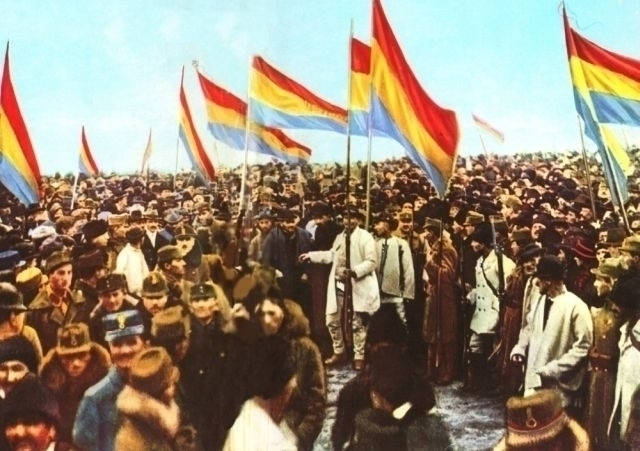
On 1 December 1918 the National Assembly of Romanians in Transylvania gathered in Alba Iulia
Steliu Lambru, 16.12.2019, 14:19
On 1 December 1918 the National Assembly of Romanians in Transylvania gathered in Alba Iulia, a city where the leaders of the great peasant revolt of 1784-85, Horea and Closca, were executed. The Romanian Grand National Council, a representative body with legislative power, called together the 1228 delegates to the symbolic city to write the resolution to unite with the Kingdom of Romania. The council was made up of 8 bishops, among them Greek Catholic Iuliu Hossu and Orthodox Miron Cristea, and 200 members of all social estates. Its mission was to consult Romanians regarding their future by calling a vote. Together with the Romanian National Council, which had an executive function, and was made up of 6 members from the Romanian National Party and 6 members from the Social Democratic Party, the Romanian Grand National Council decided that a new beginning could only be based on universal suffrage, something for which Romanian parties and national organizations in Transylvania had started to militate as early as 1881.
The difficulties in organizing such a vote were daunting. WWI, with its staggering loss of life, had only just ended. Transylvania was a stateless province, the Hungarian crown was falling apart, unable to make any move in the matter. The authority of the Hungarian state, represented by the court system, Parliament, government, magistrates, armed forces and civil servants, everything that had enforced public order and Hungarian authority, had ceased to exist. In Austria-Hungary, the first universal suffrage elections had taken place in 1907, but only on the Austrian side of the empire. A year before, in 1906, during the reign of Franz Joseph, a new electoral law had passed, which gave the right to vote to all men over 24 years of age, irrespective of wealth or social origin. As Transylvania and the Banat were on the Hungarian side, Romanians did not get the benefit of universal suffrage, with the exception of Romanians in the province of Bukovina, which was on the Austrian side. In 1907, five Romanian deputies from Bukovina were going to the parliament in Vienna, with the same number being sent to the legislative body in 1911, right before the Great War.
In the confusing circumstances at the end of 1918, Romanians reacted based on the principles of self-governance. The action was political as well, since the elections were organized by two parties with relatively equal representation in the parliament in Budapest, the Romanian National Party and the Romanian wing of the Social Democratic Party of Hungary. Daniel Barbu is a historian and professor with the Bucharest University School of Political Science. He described what he called the only electoral process of its time which was not organized by a government or public authority, but by civil society:
“The micro-history data that we have on the elections in each locality voting for its delegates shows us that they used a procedure that rather resembled the Roman kind, which was acclamation. Normally, two or three or four notable figures of each village, such as the priest, the major land owner, if he was Romanian, the teacher, or a wealthier peasant, were elected by acclamation, by consent, and endowed with authority to represent the entire locality.”
The vote that sent to Alba Iulia the 1228 delegates to vote for Transylvania uniting with Romania would be a less democratic procedure than contemporary ones. However, these were murky times, WWI had brought to the surface expectations and reactions that had previously been repressed. Daniel Barbu told us that the meeting of democracy and universal suffrage has to be seen through the eyes of the people who had witnessed the Bolshevik revolution and the anarchy that was looming after 4 years of war:
“The question is whether the members of the Assembly in Alba Iulia or the writers of the resolution were democrats. They were obviously Romanian patriots. They were people with long parliamentary experience, they had knowledge and practice of politics. My suspicion is that they were not democrats, which was proven by what transpired afterward. On December 6 the Romanian army occupied Transylvania. This was fundamental for the drawing of the borders, and especially for re-establishing order in the country. We had very clear testimony, Ion Lepadatu writes in his memoirs, quoting his diaries written in those days, that the villages are moving. When we are talking of the Soviet commune, we are thinking only of Budapest and the Hungary beyond the river Tisza. However, all of Europe, including England, was gripped by revolutionary fever. For several months, cities like Turin, Munich, Berlin, were under the red flag of associations of workers and soldiers. Similar things were starting to happen in Transylvania too.”
The vote for Transylvania to unite with Romania was a laborious process, it took over a month, at the end of which the desire for a new beginning had become clear. It was the effort of a large human community to organize without institutions or assistance, based solely on the will to keep the peace and to belong to another state. On December 1, 1918, Alba Iulia was the fulcrum of Romanian identity in Transylvania. That end of year was a glorious one, the end of an era, but mainly the beginning of another one, which gave people a great deal of hope.


























