Centenary of the Treaty of Trianon
On June 4th, 1920, the Grand Trianon Palace of Versailles hosted the signing of the peace treaty between the Entente Powers and Hungary
România Internațional, 24.08.2020, 12:02
On June 4th, 1920, the Grand Trianon Palace of Versailles hosted the signing of the peace treaty between the Entente Powers, winners of World War I, and Hungary. As a result of the treaty, new countries emerged on the map of Europe, such as Yugoslavia, Czechoslovakia and Hungary, alongside countries that had doubled their territory and population, such as Romania. Thus, the new Kingdom of Greater Romania would also comprise the regions of Banat, Bukovina, Crisana, Maramures and Transylvania, all provinces in Austria-Hungary with predominantly Romanian speaking populations.
In March 1918, Bessarabia, a Romanian province in Russia, joined the new pan-Romanian construct based on the principle of national self-determination. The Treaty of Trianon was signed to establish the borders between the new Hungary and its neighbors: Austria, Czechoslovakia, the future Yugoslavia and Romania.
The end of WWI had occurred in the month of November of the year 1918, when Germany had capitulated to the French, English and American forces. However, the Hungarian population and its elite in particular had not peacefully accepted the outcome, and resorted to a method of toppling the existing order after the model of the Bolshevik Revolution of 1917, headed by Lenin in Russia. So, the Hungarian Soviet Republic, set up in 1919, started a war against Czechoslovakia and Romania, in order to get back its territories. The victories of the Romanian and Czechoslovakian armies led to the occupation of Budapest and the dismantling of Soviet Hungary. In early 1920, the long-awaited peace with Hungary was therefore finally signed.
Historian Ioan Scurtu described the atmosphere in the eastern half of the former Austria-Hungary, in the early 1920, before the signing of the peace treaty:
“The Treaty of Trianon was signed after fierce debates with the Hungarian delegation, starting in January 1920, as they tried to maintain the integrity of Hungary by contesting the claims and decisions made by Romanians, Slovaks, Croats and Slovenians, which had created new states. It was a belated signing, also because the Hungarian delegation, headed by Albert Apponyi, realized it had no chance of success at the peace conference, because the decisions made there were based on the principle of national self-determination, that is the will of the people. The chairman of the conference, the French Prime Minister Alexandre Millerand, stated that the peoples had spoken in the autumn of 1918, when they freely decided their fate. Therefore, the arguments presented by the Hungarian delegation, which said the dismantling of millennial Hungary would be a catastrophe, did not stand.”
Romania won at Trianon not only because it was part of the winners group, but also because it had some solid arguments. Ioan Scurtu explains:
“The main argument was the decision of the National Assembly in Alba Iulia, which was a representative gathering. The 1228 delegates from all of Transylvanias districts had imperative mandates to vote for the union of Transylvania with Romania. Secondly, it was the convention of August 1916, on the basis of which Romania had entered the war at the request of the Entente, and there Romanias borders were clearly established, including those with Hungary. The third argument was the contribution of the Romanian Army to the victory of the Entente Powers, because when Romania joined the war in the summer of 1916, the western front in France was relieved, which in turn meant the transfer of Austrian and German troops to the Romanian front. Some big battles where held in Romania, such as those of Marasti, Marasesti and Oituz, in the summer of 1917, where the military forces of the Central Powers suffered significant losses, and that facilitated the victory of the Entente Powers in 1918.”
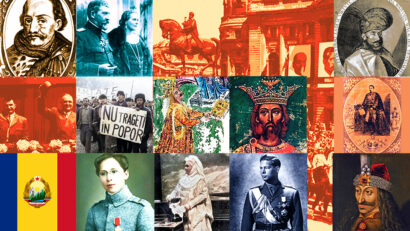
Talking about the Union of 1918, consolidated by the Treaty of Trianon, signed in 1920, the Romanian historian Nicolage Iorga wrote: “our homage must go to all Romanians, from the highest-ranking military to the last peasant dressed in military clothes.” All Romanians had indeed contributed to the triumph, but Romania did have an exceptional generation of exceptional personalities that made the victory possible. The two sovereigns, Ferdinand and Mary, must definitely be top of the list when we speak of the 1918 generation. There follow Ion I.C. Bratianu, Iuliu Maniu, Vasile Goldis, Stefan Cicio-Pop, George Pop de Basesti, Ion Inculet, Pantelimon Halipa, Ion Nistor, military such as sub-lieutenant Ecaterina Teodoroiu, captain Grigore Ignat, generals Constantin Prezan, Alexandru Averescu, Eremia Grigorescu and many more. However, Romania paid dearly for that triumph.
Here is Ioan Scurtu once more:
“Little Romania paid dearly, because it paid in lots of blood. It is estimated that some 800,000 Romanians died in battle because of diseases, famish and other hardships they had to endure in two years of war. The country also lost major material and spiritual assets, as a result of the fact that the German, Austrian-Hungarian, Bulgarian and Turkish occupiers plundered the occupied territories and sent those assets to their territories. Also, we should not forget that the Romanian Government in Iasi sent to Russia Romanias Treasure, part in December 1916 and the rest in July 1917, which has not been returned ever since. The official document signed on the occasion clearly stipulated that the Russian side took responsibility for carrying the treasure and bringing it back to Romania.”
100 years ago, the Treaty of Trianon confirmed peoples will. It was the start of an era that they had dreamed of for a long time. (M.Ignatescu)