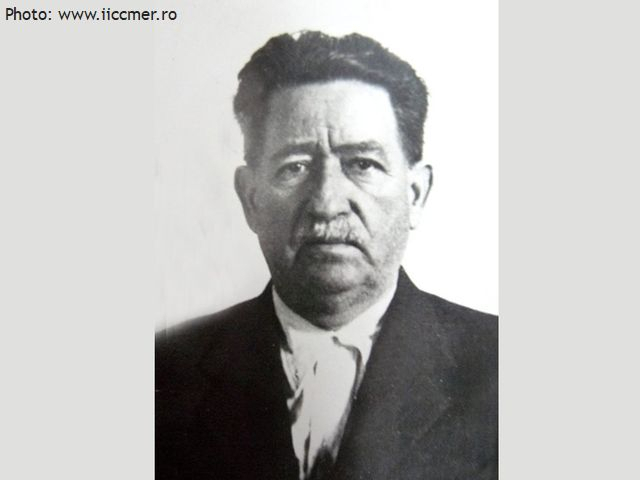
Ion Mihalache
Teacher Ion Mihalache, a major Romanian politician before 1945, represented the peasant middle class. He was a man of integrity, defender of conservative Romanian peasant values, but was also a militant for modernization and prosperity for all, especially the most disadvantaged.
Steliu Lambru, 14.02.2022, 13:12
Teacher Ion Mihalache, a major Romanian politician before 1945, represented the peasant middle class. He was a man of integrity, defender of conservative Romanian peasant values, but was also a militant for modernization and prosperity for all, especially the most disadvantaged.
Ion Mihalache was born on March 3, 1882, in Topoloveni, a village 90 km northwest of Bucharest. He came from a peasant family, and loved education, so he became a teacher at19 years of age, in 1901. When Romania joined the war, in 1916, he volunteered as an officer commanding a company on the front lines. He took part in the military campaigns in 1916-1917, and was decorated with the Michael the Brave order for his abilities as a commander.
In the tumultuous years after the war, he took part in organizing the referendum by which the Romanian population of Bessarabia voted to unite with Romania in 1918. After the war, he went into politics and was a founder of the National Peasant Party, to defend the interests of the peasantry, the largest social class at that time. The emergence of such a party was also justified by the fact that King Ferdinand I had promised an ample agrarian reform in a famous speech from 1917.
In 1919, in the first elections in Greater Romania, the Peasant Party formed a coalition with the the Romanian National Party of Transylvania, and formed a government led by Alexandru Vaida-Voevod. Mihalache was appointed minister of agriculture and land management. In 1920, the so-called Mihalache Law was passed, granting agriculture schools 100 ha of land each, and horticultural schools 25 ha to help with education.
In 1926, these two agrarian parties joined, and the National Peasant Party was born, the most important opposition party facing off against the National Liberal Party. Mihalache became party deputy chairman, and Iuliu Maniu, the head of the former Transylvanian party, became chairman.
The great electoral success of the new party came that same year, when the National Peasant Party won in a landslide, forming the government. They bring with them a policy of encouraging agriculture, in line with Mihalache’s political thinking. He went on to hold the position of agriculture minister until 1930, becoming then minister of the interior, a post he held until 1933.In 1941, when Romania joined WWII, Mihalache, then 59 years of age, was mobilized to the front line. However, he was recalled back home upon order from General Ion Antonescu.
Our guest today is General Constantin Durican, aide de camp for General Ioanitiu, head of the General Staff of the Romanian army. In 1996, in an interview with Radio Romania’s Center for Oral History, he recalled the episode in which Mihalache was supposed to be convinced that it was in Romania’s best interest to fight on Germany’s side:
Constantin Durican: Mihalache had the Michael the Brave order decoration from the war of 1916-1918. And because he was against Marshal Antonescu and on Maniu’s side, Antonescu order he be mobilized. He gave him a car, to show him why Romania was with the Germans, why we were fighting, and what we were getting ourselves into. Of course, the choice in that situation was pretty difficult, it was very hard to judge the leaders irrespective of their choice.
After the war, he started the most difficult period of his life, which sorely tested his character. In the 1946 elections, in a climate of extreme tensions caused by the communists, Mihalache held a memorable election speech. Former political detainee Ioan Georgescu, spoke in 2000about that speech, which he attended:
Ioan Georgescu: I recall there was a joint meeting of the Peasant Party and the Liberals, led by Dinu Bratianu and Ion Mihalache. They came here, to Campulung, and spoke to a large audience. I was present there. I remember a beautiful comparison he made then. He said: ‘So far we have stood on our right leg (he was talking about Antonescu) and now some are coming to tell us to stand on our left leg. And I say, and I think I’m saying it right, we have to stand on both legs.
Another former political detainee, Cicerone Ionitoiu, talked in 2001 about how he visited Mihalache in 1946, detained by the communist government:
Cicerone Ionitoiu: When we went to him, he was being prosecuted under false chargers, to prevent him from running for office in Muscel. We went there, we were about 12 people, from Bucharest, to support him on the day of the trial. He arrived at night, he received us, it was late, about 11 o’clock at night. He said: ‘Hey, boys, you need your sleep’. We told him that we want to talk to him, that he shouldn’t worry about us. Then a teacher arrived, Bratulescu, who took us in. And Mihalache saw us out of Campulung, and told us ‘Well, you visited me, what would it be like if I didn’t honor you by seeing you out of town?’ That’s the kind of man he was.
In 1947, Mihalache, along with the entire leadership of the National Peasant Party, was sentenced to prison. On February 5, 1963, he passed away in the Ramnicu Sarat prison, just one year before the general amnesty of 1964. (C.C.)